

[level-membership-for-basic-science-category]
Chapter 22 Ophthalmology
Ophthalmic Prostaglandins


MOA (Mechanism of Action)
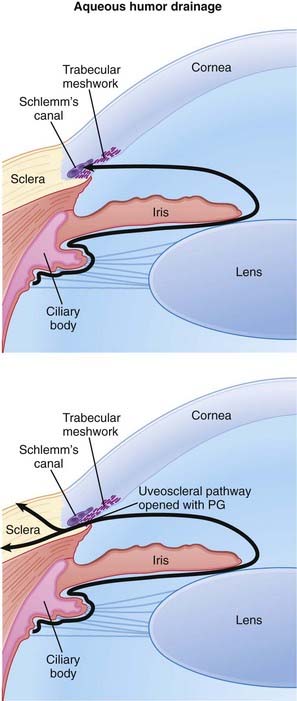
 Glaucoma is characterized by increased intraocular pressure (IOP) and can lead to blindness if not treated. Strategies to reduce IOP include reducing the production and secretion of aqueous humor and facilitating its drainage.




Side Effects


Evidence

Prostaglandin versus Other Therapy for Glaucoma
 A systematic review in 2008 (eight randomized controlled trials [RCTs], 1722 patients) did not find a significant reduction in the mean IOP in patients receiving latanoprost compared with those receiving brimonidine (α2 agonist) but did find a significant reduction in mean IOP compared with the dorzolamide (carbonic anhydrase) group (WMD = 22.64). The number of ocular adverse events (excluding hyperemia) was significantly higher in the brimonidine group compared with the latanoprost group (relative risk [RR] = 0.66). The authors concluded that latanoprost was superior to dorzolamide but not brimonidine and those ocular adverse events were significantly fewer in latanoprost users than in brimonidine users. Neither travoprost nor bimatoprost was compared with dorzolamide or brimonidine in the present literature.
Aptamers
Description
Aptamers are a new approach to drug design that uses nucleotide sequences to bind to targets.

MOA (Mechanism of Action)


Side Effects


Evidence
Aptamers versus Other Vascular Endothelial Growth Factor Inhibitors or Sham for Treatment of Macular Degeneration
 A 2008 Cochrane review (five trials, N = 2500 participants) examined the effects of anti-VEGF therapies for neovascular macular degeneration. Two of the included studies compared pegaptanib versus sham treatment. A key outcome in assessing interventions in macular degeneration is deterioration of vision, with the cutoff for deterioration being a loss of ≥15 letters of visual acuity on an eye chart. Compared with sham-treated patients, fewer pegaptanib-treated patients experienced this loss of visual acuity (numbers needed to treat [NNTs] ranged from 7 to 14, depending on dose). Endophthalmitis occurred in 1.3% of pegaptanib-treated patients.
Important Notes


FYI


 The SELEX process is an automated technique for manufacturing aptamers. It begins with a library of nucleotide sequences of varying lengths, which are then exposed to a ligand target. The sequences that do not bind to the ligand are then washed away. The remaining sequences are then amplified and subjected to another round of binding and removal. With each successive round, the techniques that are used to remove the less tightly bound sequences are intensified, such that with the end of each round, the remaining sequences have increased affinity for the ligand over those of the previous round (Figure 22-2).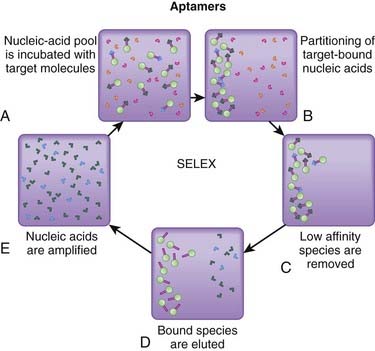
[/level-membership-for-basic-science-category][not-level-membership-for-basic-science-category]
Chapter 22 Ophthalmology
Ophthalmic Prostaglandins
MOA (Mechanism of Action)
Glaucoma is characterized by increased intraocular pressure (IOP) and can lead to blindness if not treated. Strategies to reduce IOP include reducing the production and secretion of aqueous humor and facilitating its drainage.