

The clinical biochemistry laboratory
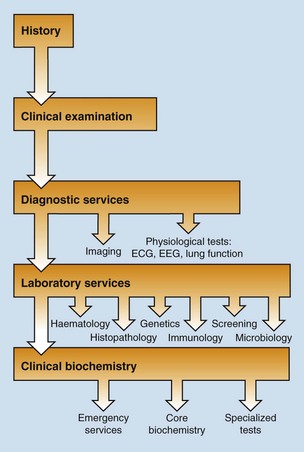
Clinical biochemistry, chemical pathology and clinical chemistry are all names for the subject of this book, that branch of laboratory medicine in which chemical and biochemical methods are applied to the study of disease (Fig 1.1). While in theory this embraces all non-morphological studies, in practice it is usually, though not exclusively, confined to studies on blood and urine because of the relative ease in obtaining such specimens. Analyses are made on other body fluids, however, such as gastric aspirate and cerebrospinal fluid. Clinical biochemical tests comprise over one-third of all hospital laboratory investigations.
The use of biochemical tests
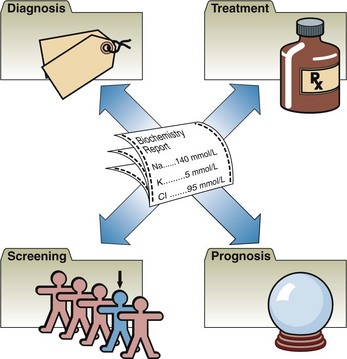
Biochemical investigations are involved, to varying degrees, in every branch of clinical medicine. The results of biochemical tests may be of use in diagnosis and in the monitoring of treatment. Biochemical tests may also be of value in screening for disease or in assessing the prognosis once a diagnosis has been made (Fig 1.2). The biochemistry laboratory is often involved in research into the biochemical basis of disease and in clinical trials of new drugs.
Core biochemistry
Biochemical facilities are provided in every hospital, although not necessarily to the same extent. All biochemistry laboratories provide the ‘core analyses’, commonly requested tests that are of value in many patients, on a frequent basis (Table 1.1). The clinician will often request specific groupings of tests, and clinical biochemistry assumes a cryptic language of its own as request forms arrive at laboratory reception for ‘U & Es’ (urea and electrolytes), ‘LFTs’ (liver function tests) or ‘blood gases’.
Table 1.1
The clinical biochemistry repertoire
Core biochemical tests
 Sodium, potassium and bicarbonate


 Bilirubin and alkaline phosphatase
 Alanine aminotransferase (ALT) and aspartate aminotransferase (AST)
 Free thyroxine (FT4) and Thyroid Stimulating Hormone (TSH)
 γ-glutamyl transpeptidase (γGT)


Specialized tests


Specialized tests
There are a variety of specialties within clinical biochemistry (Table 1.1). Not every laboratory is equipped to carry out all possible biochemistry requests. Large departments may act as reference centres where less commonly asked for tests are performed. For some tests that are needed in the diagnosis of rare diseases, there may be just one or two laboratories in the country offering the service.
Reference laboratories and research centers often house instrumentation beyond standard clinical analyzers to support drug development and specialized compound analysis. Pharmaceutical research facilities conducting clinical trials require purification capabilities that isolate specific compounds for detailed characterization. Modern chromatography technologies have expanded laboratory capabilities significantly, with systems like a preparative SFC lab system enabling efficient separation using supercritical carbon dioxide as the mobile phase. These instruments support the research activities many clinical biochemistry departments engage in, particularly those investigating new therapeutic compounds or analyzing complex metabolite profiles. Advanced purification technology continues expanding what specialized laboratories can accomplish for both research and clinical applications.
Urgent samples
All clinical biochemistry laboratories provide facilities for urgent tests, and can expedite the analysis of some samples more quickly than others. Laboratories also offer an ‘out of hours’ service, in those cases where analyses are required during the night or at weekends. The rationale for performing such tests is based on whether the test result is likely to influence the immediate treatment of the patient.
Some larger hospitals have laboratory facilities away from the main laboratory, such as in the theatre suite or adjacent to the diabetic clinic (see pp. 8–9).
Automation and computerization
Most laboratories are now computerized, and the use of bar-coding of specimens and automated methods of analysis allows a high degree of productivity and improves the quality of service. Links to computer terminals on wards and in General Practices allow direct access to results by the requesting clinician.
 Clinical note
The clinical biochemistry laboratory plays only a part in the overall assessment and management of the patient. For some patients, biochemical analyses may have little or no part in their diagnosis or the management of their illness. For others, many tests may be needed before a diagnosis is made, and repeated analyses may be required to monitor treatment over a long period.
Test repertoire
There are over 400 different tests that may be carried out in clinical biochemistry laboratories. They vary from the very simple, such as the measurement of sodium, to the highly complex, such as DNA analysis, screening for drugs, identificatication of intermediary metabolites or differentiation of lipoprotein variants. Many high-volume tests are done on large automated machines. Less frequently performed tests may be conveniently carried out by using commercially prepared reagents packaged in ‘kit’ form. Some analyses are carried out manually (Fig 1.3). Assays that are performed infrequently may be sent to another laboratory where the test is carried out regularly. This has both cost and reliability benefits.
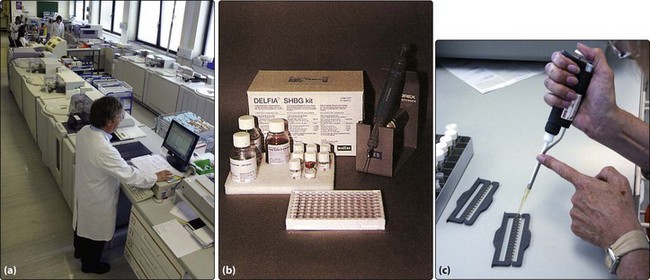
Fig 1.3 Analysing the samples: (a) the automated analyser, (b) ‘kit’ analysis and (c) manual methods.
Dynamic tests require several specimens, timed in relation to a biochemical stimulus, such as a glucose load in the glucose tolerance test for the diagnosis of diabetes mellitus. Some tests provide a clearcut answer to a question; others are only a part of the diagnostic jigsaw.
This book describes how the results of biochemistry analyses are interpreted, rather than how the analyses are performed in the laboratory. An important function of many biochemistry departments is research and development. Advances in analytical methodology and in our understanding of disease continue to change the test repertoire of the biochemistry department as the value of new tests is appreciated.
Laboratory personnel
As well as performing the analyses, the clinical biochemistry laboratory also provides a consultative service. The laboratory usually has on its staff both medical and scientific personnel who are familiar with the clinical significance and the analytical performance of the test procedures, and they will readily give advice on the interpretation of the results. Do not be hesitant to take advantage of this advice, especially where a case is not straightforward.
The clinical biochemistry laboratory
 Biochemical tests are used in diagnosis, monitoring treatment, screening and for prognosis.
 Core biochemical tests are carried out in every biochemistry laboratory. Specialized tests may be referred to larger departments. All hospitals provide for urgent tests in the ‘emergency laboratory’.
 Laboratory personnel will readily give advice, based on their knowledge and experience, on the use of the biochemistry laboratory, on the appropriate selection of tests, and about the interpretation of results.
The clinical biochemistry laboratory
Clinical biochemistry, chemical pathology and clinical chemistry are all names for the subject of this book, that branch of laboratory medicine in which chemical and biochemical methods are applied to the study of disease (Fig 1.1). While in theory this embraces all non-morphological studies, in practice it is usually, though not exclusively, confined to studies on blood and urine because of the relative ease in obtaining such specimens. Analyses are made on other body fluids, however, such as gastric aspirate and cerebrospinal fluid. Clinical biochemical tests comprise over one-third of all hospital laboratory investigations.
The use of biochemical tests
Biochemical investigations are involved, to varying degrees, in every branch of clinical medicine. The results of biochemical tests may be of use in diagnosis and in the monitoring of treatment. Biochemical tests may also be of value in screening for disease or in assessing the prognosis once a diagnosis has been made (Fig 1.2). The biochemistry laboratory is often involved in research into the biochemical basis of disease and in clinical trials of new drugs.
Core biochemistry
Biochemical facilities are provided in every hospital, although not necessarily to the same extent. All biochemistry laboratories provide the ‘core analyses’, commonly requested tests that are of value in many patients, on a frequent basis (Table 1.1). The clinician will often request specific groupings of tests, and clinical biochemistry assumes a cryptic language of its own as request forms arrive at laboratory reception for ‘U & Es’ (urea and electrolytes), ‘LFTs’ (liver function tests) or ‘blood gases’.
