

Picture this. It’s a Tuesday morning. Someone in accounts is making their second coffee. A colleague halfway across the open-plan floor clutches their chest, stumbles, and drops. No warning. No prior health complaints. Just a person on the ground, unconscious, with no pulse.
It happens more often than you’d think. Thousands of people suffer sudden cardiac arrest outside of a hospital every year, and a troubling number of those incidents happen right there in the workplace — in offices, warehouses, retail shops, and construction sites. The heart doesn’t wait for a convenient moment. It doesn’t check whether you’re at home or at your desk. So the real question for any employer isn’t if something like this could happen. It’s whether you’ll be ready when it does.
What Sudden Cardiac Arrest Actually Is
Let’s clear something up first, because people get this wrong all the time. A heart attack and sudden cardiac arrest are not the same thing.
A heart attack is a plumbing problem. Blood flow to part of the heart gets blocked. It’s serious, yes, but the heart usually keeps beating. Sudden cardiac arrest? That’s electrical. The heart’s rhythm goes haywire and it just… stops. No blood pumping. No oxygen reaching the brain. The person drops, and they’re unconscious in seconds.
Here’s the part that should worry you. For every minute without defibrillation, the chance of survival falls by seven to ten percent. Think about that. One minute. Ten percent. Emergency services do incredible work, but even the fastest ambulance takes time. Five minutes. Eight minutes. Sometimes longer. In that gap, the only thing standing between life and death is whoever happens to be nearby — and whatever equipment they have access to.
Why So Many Workplaces Still Don’t Have One
Most of us spend roughly a third of our lives at work. That alone makes the workplace one of the most statistically likely places for a cardiac emergency to unfold. And yet, a shocking number of businesses still don’t have an AED anywhere on the premises.
Why not? The reasons tend to follow a pattern. “It won’t happen here.” “They’re too expensive.” “What if someone uses it wrong?” All fair questions on the surface. None of them hold up once you dig a little deeper.
Modern AEDs are built for everyday people. You don’t need a medical degree. You don’t even need steady hands. The device talks you through it — clear, calm voice prompts that tell you exactly what to do. It reads the heart’s rhythm on its own and will only deliver a shock if it detects a dangerous arrhythmia. You genuinely cannot accidentally shock someone who doesn’t need it.
And the cost? Far less than most people assume. Many workplace-ready models come in well under a thousand pounds. Compare that to the value of a life. Compare it to the legal fallout of failing to provide basic safety provisions. Suddenly, it doesn’t feel like a hard decision at all.
The Device Is Only Half the Story
Here’s the thing, though. Hanging a defibrillator on the wall and hoping for the best isn’t a plan. It’s a prop.
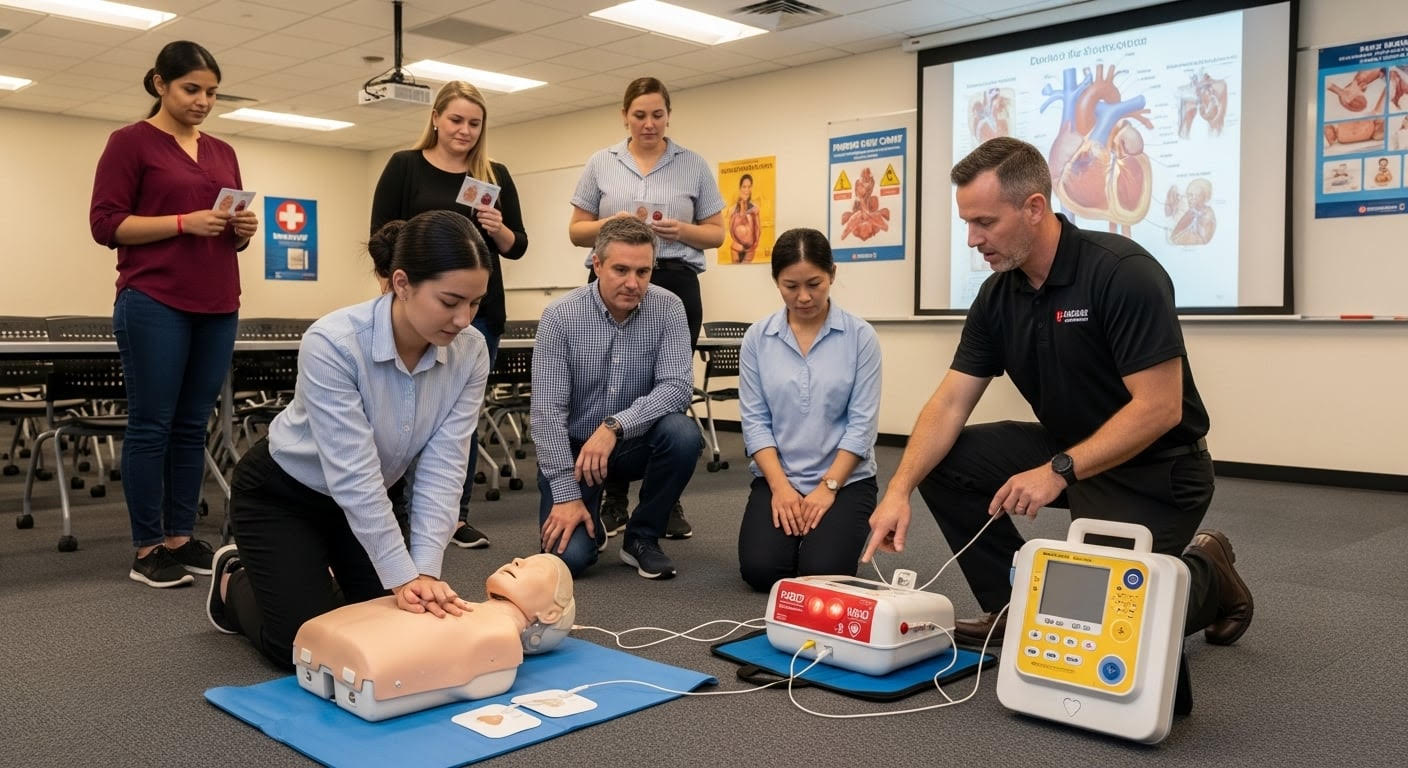
An AED does its best work when the people around it actually know what to do. That means recognising the signs of cardiac arrest. It means knowing how to call for help effectively. It means being able to start CPR immediately while someone else grabs the device. Confidence matters here — hesitation costs time, and time is the one thing you don’t have.
This is where proper AED training becomes essential. Staff who’ve been through a focused training course respond faster. They stay calmer. They don’t freeze. And the good news is that modern eLearning options make it easy to fit this kind of training around a normal working schedule. No full-day classroom sessions needed. Just practical, accessible learning that could one day make all the difference.
Placement matters too. An AED locked in a supply cupboard on the third floor is almost as useless as not having one at all. Put it somewhere visible. Somewhere central. Ideally, nobody should be more than a two-minute walk from the device, no matter where they are in the building. And check it regularly — expired pads and flat batteries have a nasty habit of going unnoticed until the worst possible moment.
The Law Is Catching Up
Legislation around workplace AEDs is evolving. More regions are moving toward making them mandatory in buildings above a certain size or footfall. Even where the law hasn’t caught up yet, health and safety regulators already recommend that employers carry out risk assessments factoring in the possibility of a cardiac event.
But forget the legal side for a moment. Think about the moral one.
You have people in your building every day. Staff. Clients. Visitors. Delivery drivers. You owe them a reasonable standard of care. Having an AED — and people trained to use it — says something about your organisation. It says you take that responsibility seriously. It says you’ve thought about what could go wrong and decided to be prepared rather than hopeful.
And here’s something worth remembering: cardiac arrest doesn’t only happen to people with known heart conditions. It can hit a twenty-five-year-old athlete. A perfectly healthy contractor on their first day. A customer browsing your shop. There is no “type.” There’s only readiness or the lack of it.
Thinking Bigger Than the Defibrillator
An AED shouldn’t sit in isolation. It fits into something larger — a proper first aid strategy with trained responders, stocked first aid kits, well-rehearsed emergency procedures, and a culture where people feel equipped rather than helpless.
One of the smartest moves any organisation can make is encouraging staff to complete first aid courses. Not just one person per floor, either. The more people who hold current first aid knowledge, the better your odds in any medical emergency, cardiac or otherwise. You end up with a web of capable responders stretched across departments, shifts, and locations. That kind of coverage is hard to beat.
The Takeway
Sudden cardiac arrest is fast. It’s unpredictable. And without immediate action, it’s usually fatal. An AED is one of the simplest, most effective tools we have to change that outcome — and it puts the power to save a life in the hands of ordinary people.
No one wants to picture a colleague collapsing at work. That’s understandable. But the responsible thing — the brave thing — is to plan for it anyway. Get the device. Train your people. Build it into a broader first aid strategy that covers more than just cardiac emergencies.
Because when those critical minutes arrive, and the ambulance is still on its way, the only thing that matters is what you did to prepare. And preparation? That’s a choice you can make today.
