Published on 26/02/2015 by admin
Filed under Cardiovascular
Last modified 22/04/2025
This article have been viewed 2297 times
[level-membership-for-cardiovascular-category]
2 Echocardiography
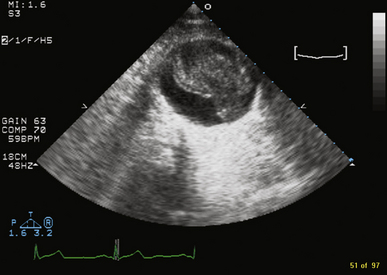
FIGURE 2-1 AAA with dissection. Thrombus fills the false lumen.
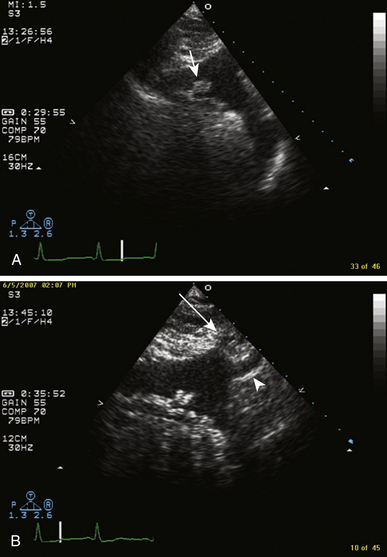
FIGURE 2-2 A, Transthoracic suprasternal notch view of the aortic arch demonstrating severe atheromatous disease of the aortic arch. The pedunculated mass (short arrow) is a mobile atheroma attached to the wall of the aorta by a small stalk. B, Similar view with the origins of the left common carotid (long arrow) and left subclavian (arrowhead) arteries noted.
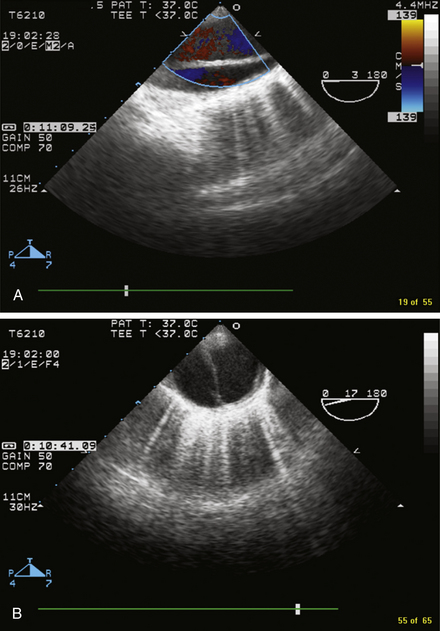
FIGURE 2-3 TEE of an aortic dissection. A, Longitudinal view of the descending thoracic aorta. Note the intimal flap separating the true and false lumens. Color flow imaging shows blood flow within both lumens. B, Transverse view showing the aorta in cross-section with the intimal flap easily visualized.
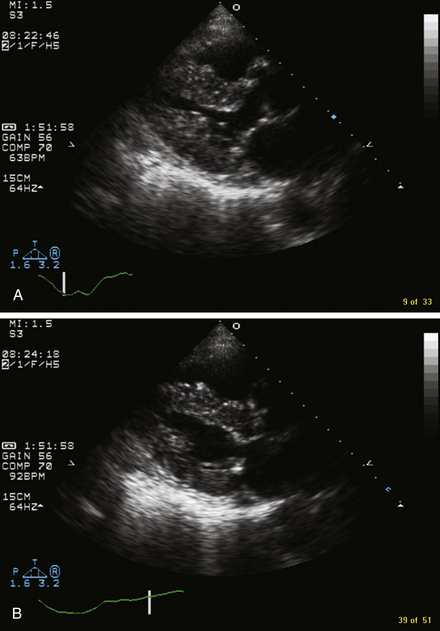
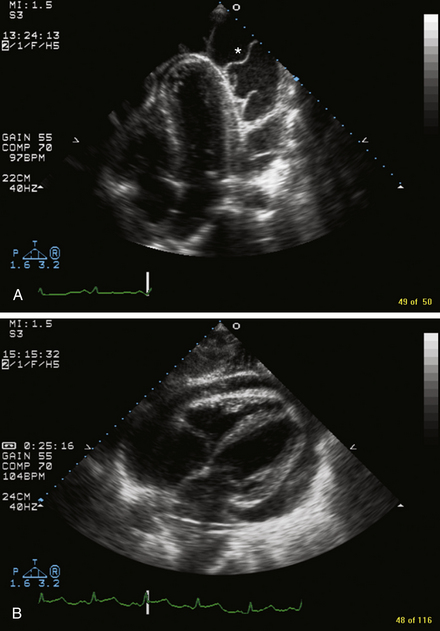
FIGURE 2-4 Parasternal long-axis view in a patient with cardiac amyloidosis. A, Systole. B, Diastole. Important findings are marked concentric LVH with granular speckled appearance of the myocardium. Generally, valve leaflets appear thickened. Although, left ventricular function is often well-preserved until late stages of the disease, diastolic dysfunction is present and is usually restrictive.
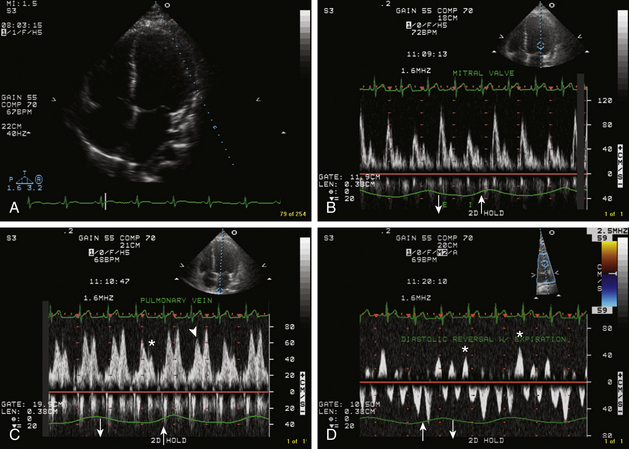
FIGURE 2-5 TEE of a 29-year-old male with recurrent constrictive pericarditis. The pericardium becomes restrictive and restrains cardiac filling. The volume within the heart nearly becomes fixed. Filling of the cardiac chambers then varies with the respiratory cycle. On inspiration, right ventricular filling increases and left ventricular filling decreases. On expiration, left ventricular filling increases and right ventricular filling decreases. This ventricular interdependence is best demonstrated using pulsed-wave Doppler. A, Apical four-chamber view. The left ventricular size is at the upper limits of normal. B, Pulsed-wave Doppler inflow of the mitral valve with simultaneous use of a respirometer (up arrows indicate inspiration; down arrows indicate expiration). With inspiration, the mitral inflow velocity decreases; with expiration, it increases. The opposite changes in filling velocities occur across the tricuspid valve. C, Pulmonary vein flow demonstrating that both the systolic and diastolic flow velocities decrease at the onset of inspiration (asterisks) and increase at the onset of expiration (arrowhead). D, With expiration, hepatic vein flow diminishes and there is significant diastolic flow reversal (asterisks).
FIGURE 2-6 A, Massive pericardial effusion. Transthoracic four-chamber view of an extremely large, circumferential pericardial effusion with fibrinous stranding (asterisk). The right ventricular apex is compressed; note the right atrial collapse in late diastole. B, Subcostal view of another large circumferential pericardial effusion causing tamponade. The size and extent of a pericardial effusion is often best visualized in the subcostal view.
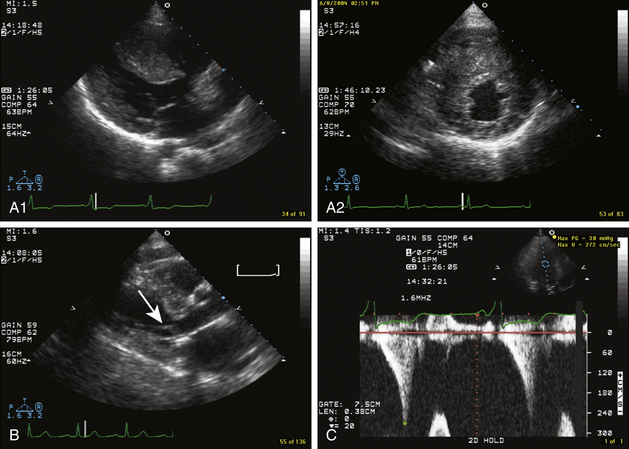
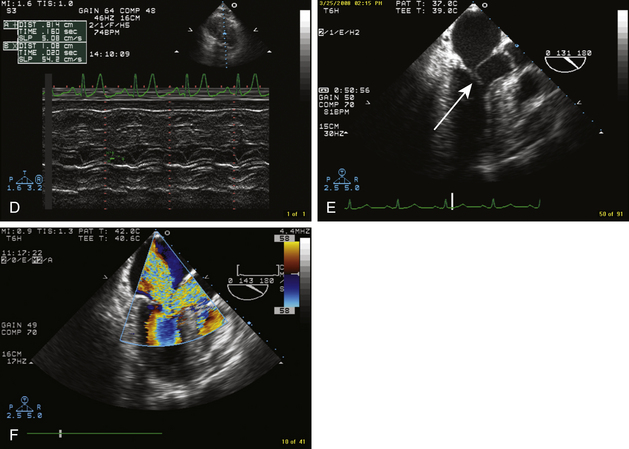
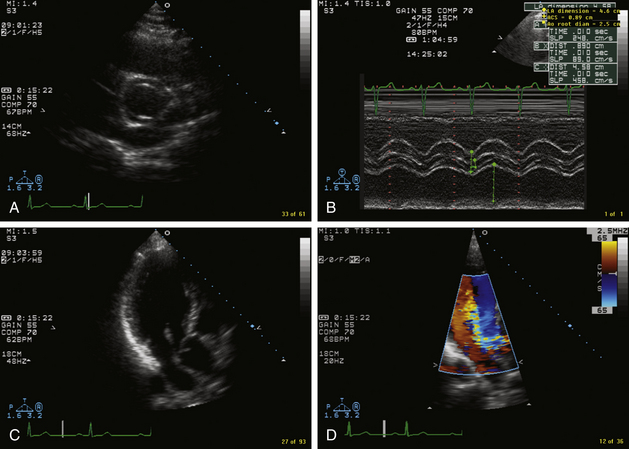
FIGURE 2-7 HCM. A, Parasternal long- and short-axis views demonstrating severe concentric LVH. The septum is more severely affected than the other left ventricular walls. B, SAM (short arrow) of the anterior mitral valve leaflet is a hallmark of HCM. It is best seen in the transthoracic parasternal long-axis view. C, Continuous wave Doppler at the level of the LVOT. Note the classic dagger-shaped pattern of flow, which peaks late in systole. The resting gradient measures 30 mm Hg. With Valsalva maneuver, the gradient often increases significantly. D, M-mode through the mitral valve displaying SAM of the anterior mitral valve leaflet. E, Transesophageal three-chamber view clearly showing SAM (long arrow) of the anterior mitral leaflet. This contributes to the dynamic obstruction of blood flow out the LVOT. F, Transesophageal color flow imaging showing increased velocities in the LVOT producing the Venturi effect, essentially pulling the anterior mitral leaflet into the outflow tract. Concurrently, mitral regurgitation occurs. In this example, the mitral regurgitation is severe.
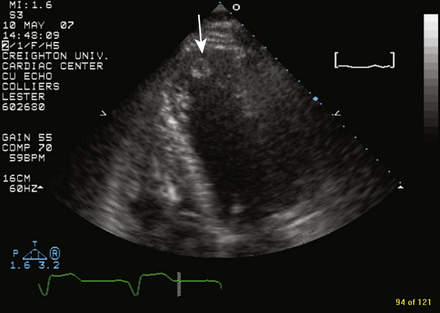
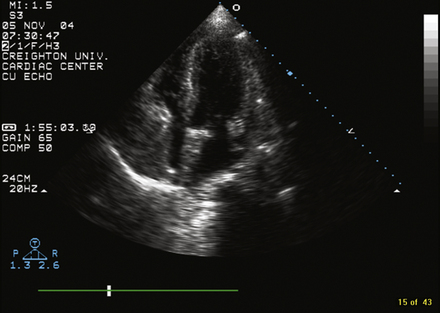
FIGURE 2-8 Transthoracic apical four-chamber view in a patient with akinesis of the apex. Note the well-circumscribed echodensity in the left ventricular apex consistent with thrombus (arrow).
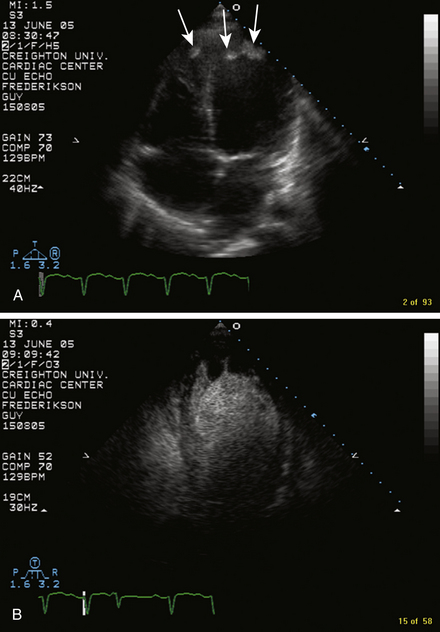
FIGURE 2-9 A, Apical four-chamber view showing thrombi (arrows) in the left and right ventricular apices in a patient with idiopathic dilated cardiomyopathy. B, With echocontrast the apical thrombi are delineated and appear as dark (shadowed) masses. Echocontrast is commonly used to differentiate thrombus from intracardiac tumor. In an intracardiac tumor, presence of contrast within the mass denotes perfusion of the tumor.
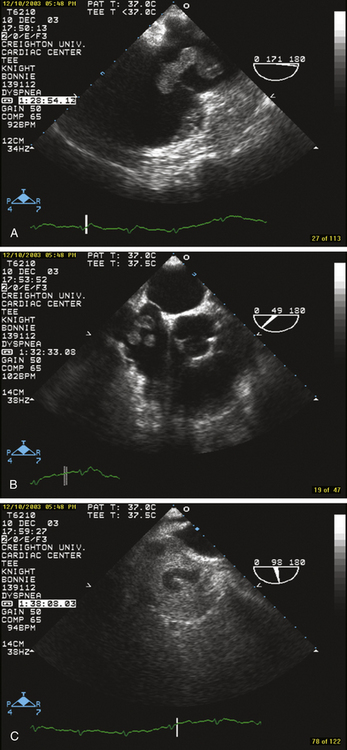
FIGURE 2-10 A, Lower esophageal long-axis view of the right heart showing a large wormlike mass traversing the tricuspid valve consistent with thrombus in transit. B, The extensive mobile thrombus is demonstrated again in a midesophageal short-axis view. C, Bicaval transesophageal view during saline contrast injection demonstrating again the mobile thrombus (appears shaded) within the right atrium. This patient was undergoing preoperative evaluation before hip surgery and had been relatively immobile for several weeks. She complained of progressive dyspnea on exertion and right leg swelling for the 2 weeks prior to her examination. She received I.V. TPA and a heparin infusion. On follow-up echocardiography approximately 24 hours later, the thrombus was no longer present. The patient had a complete recovery.
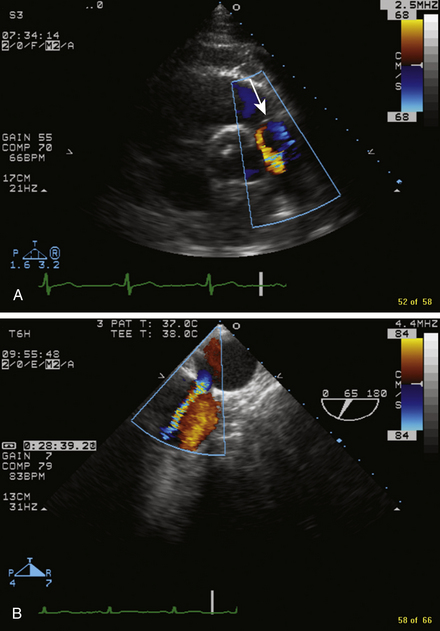
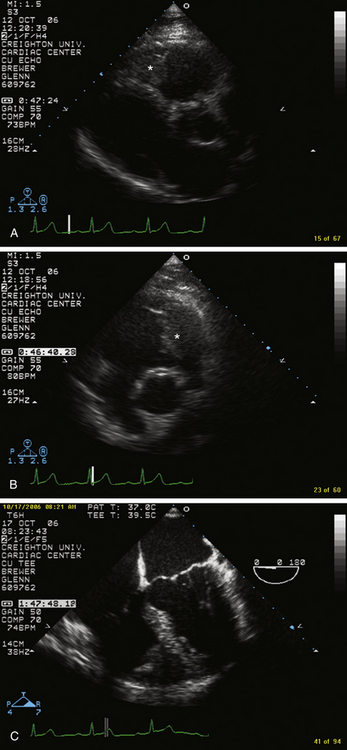
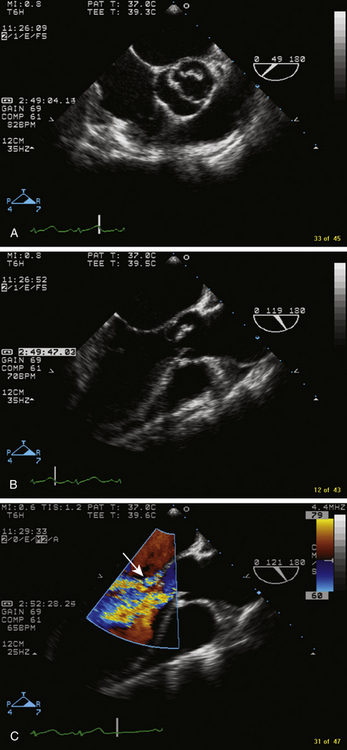
FIGURE 2-11 Transthoracic parasternal long- (A) and short-axis (B) views showing a mass (asterisks)within the RV, adherent to the myocardium, extending from the apex to the RVOT. This patient had metastatic renal cell carcinoma. C, The tumor is demonstrated again within the RV in this transverse transesophageal view. This patient received chemotherapy, and the tumor metastases were no longer evident on echocardiography after completion of his treatment.
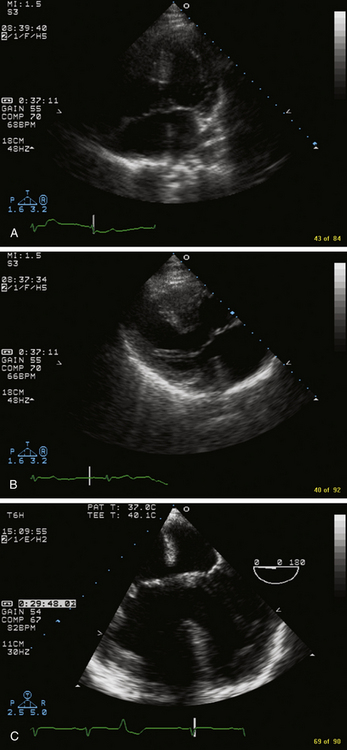
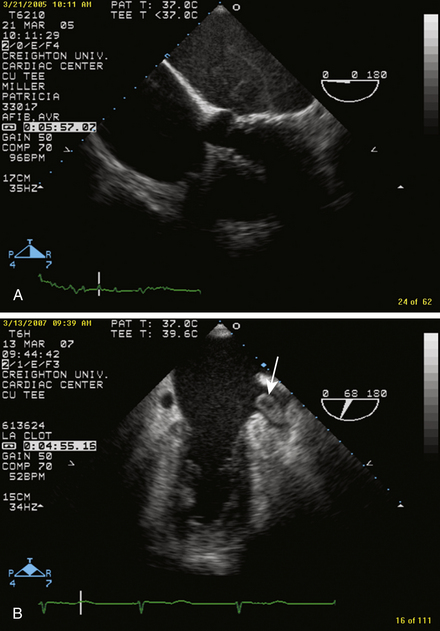
FIGURE 2-12 A, Transverse transesophageal image in a patient with atrial fibrillation. The atria are markedly enlarged and there is significant spontaneous echo contrast visualized within the left atrium. B, Transesophageal longitudinal, two-chamber view revealing a large thrombus (arrow) within the left atrial appendage in another patient with atrial fibrillation.
FIGURE 2-13 Longitudinal transesophageal view demonstrating a dumbbell-shaped atrial septum consistent with lipomatous hypertrophy of the septum. Note that fatty infiltration has spared the fossa ovalis.
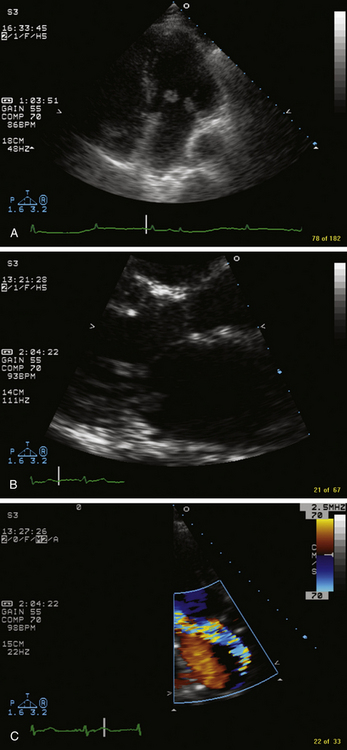
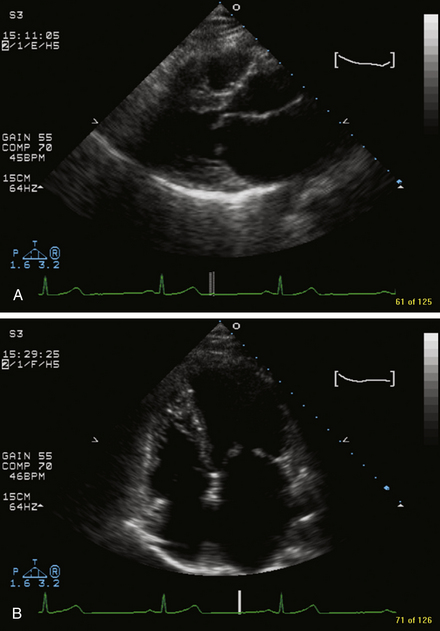
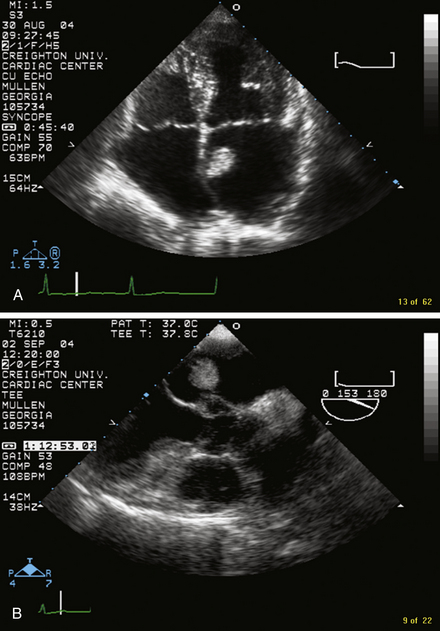
FIGURE 2-14 A, Left atrial myxoma, the most common intracardiac tumor, is seen in this transthoracic four-chamber view attached to the interatrial septum by a short stalk. This is the most frequent location and attachment site of a cardiac myxoma. B, Transesophageal long-axis view of the same patient that also shows the well-circumscribed myxoma within the left atrium.
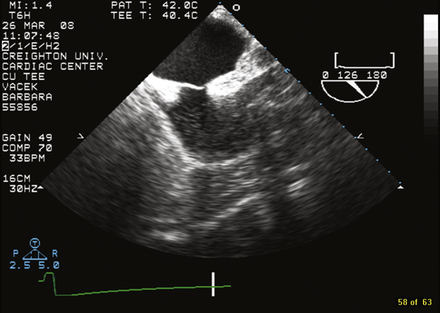
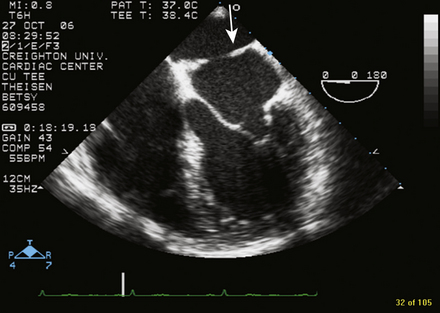
FIGURE2-15 Transverse transesophageal image of cor triatriatum. The linear echodensity (arrow) traversing the left atrium is a membrane separating the left atrium into two compartments. The anterior cavity connects to the mitral valve, and the pulmonary veins drain into the posterior cavity. Blood flows between the two compartments through fenestrations or through an opening in the membrane. The opening may be small and flow-limiting or large and nonlimiting. In this case, there is no obstruction of flow between the two cavities.
FIGURE2-16 Two-dimensional echocardiogram of a patient with a large thrombus within the pericardial space seen external to the right atrium and RV. The thrombus is compressing the right atrium, giving it a slitlike appearance. The thrombus was surgically evacuated.
FIGURE 2-17 A, Transthoracic four-chamber subcostal view demonstrating an ostium secundum ASD with biatrial enlargement. B, Color flow imaging shows left to right shunting through the ASD. C, Transesophageal bicaval view in another patient with an ostium secundum ASD. This image was obtained during a saline contrast study and demonstrates a negative jet secondary to left to right flow across the defect. D, Transesophageal image of a prominent Chiari network within the right atrium of a patient with an ostium secundum ASD. E, Midesophageal 45-degree short-axis view in the same patient demonstrating left to right shunting through the ASD with color flow imaging.
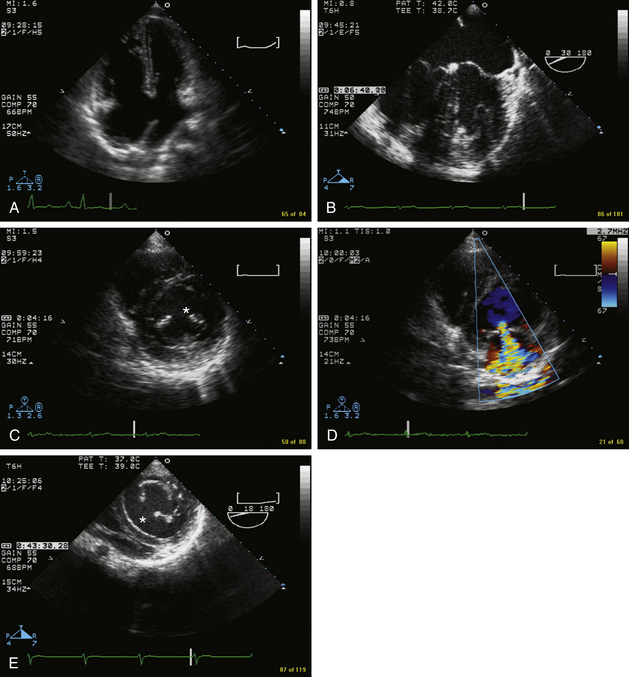
FIGURE 2-18 An ostium primum ASD is shown in this transthoracic apical (A) and transesophageal four-chamber (B) view. Note apical displacement of the mitral valve, which results in the AV valves lying in the same plane. In this patient the RV is severely enlarged. C, An ostium primum ASD is often associated with a cleft mitral valve. This parasternal short-axis view shows a cleft anterior mitral valve leaflet (asterisk). D, Color flow imaging demonstrates severe mitral regurgitation in this patient. E, Transesophageal transgastric short-axis view in the same patient, again demonstrating the cleft in the anterior mitral valve leaflet (asterisk).
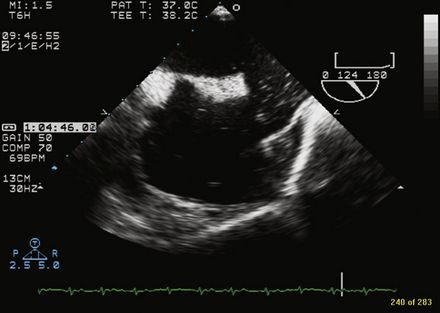
FIGURE 2-19 A sinus venosus ASD demonstrated on a transesophageal bicaval view. This defect most commonly occurs in the superior aspect of the atrial septum where the SVC enters the right atrium. This defect is commonly associated with anomalous pulmonary venous connections, most often the right upper pulmonary veins draining into the right atrium or SVC.
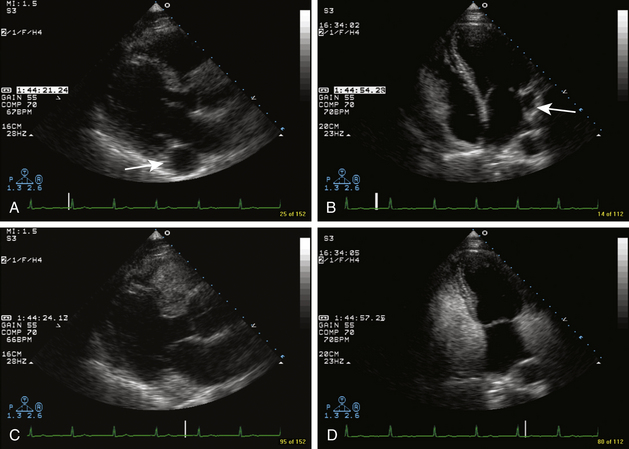
FIGURE 2-20 A, Transthoracic parasternal long-axis view in a patient with a persistent left SVC. Note the dilated coronary sinus (arrow) that lies in the left AV groove. The left persistent SVC most commonly drains into the coronary sinus, which results in its enlargement. B, Apical four-chamber view in the same patient demonstrating the enlarged coronary sinus (arrow). Contrast injection into a peripheral vein in the left arm results in opacification of the coronary sinus and then the right atrium and ventricle, which confirms the presence of a persistent left SVC. Parasternal long-axis (C) and apical four-chamber (D) views after contrast injection.
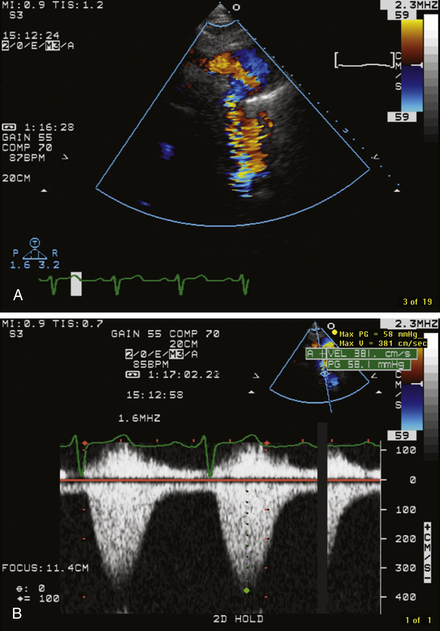
FIGURE 2-21 A, Transthoracic suprasternal notch view demonstrating turbulent flow through an aortic coarctation using color flow imaging. B, Continuous wave Doppler demonstrates a gradient of 58 mm Hg across the coarctation. Coarctation of the aorta is commonly associated with a bicuspid aortic valve.
FIGURE 2-22 A, A bicuspid aortic valve during systole in a parasternal short-axis view. This has the appearance of a “fish mouth.” B, M-mode image of a bicuspid aortic valve. Note the eccentric closure line of the aortic valve. C, and D, Apical three-chamber view in a patient with a bicuspid aortic valve and severe eccentric aortic regurgitation. Note the eccentric closure line with prolapse of the anterior leaflet. This has resulted in severe posteriorly directed aortic regurgitation.
FIGURE 2-23 A and B, These transthoracic apical four-chamber images demonstrate Ebstein anomaly. In Ebstein anomaly, the septal leaflet of the tricuspid valve inserts more apically within the RV than usual. This results in atrialization of a portion of the RV; thus, the functioning RV is much smaller. This malformation often results in significant tricuspid regurgitation and enlargement of the right-sided chambers compared to the left-sided chambers.
FIGURE 2-24 A, Transthoracic parasternal short-axis view of the aortic valve, RVOT, pulmonic valve, and PA in an adult patient with an isolated PDA. Color flow imaging below the pulmonic valve (arrow) within the pulmonary artery demonstrates a persistent connection between the descending thoracic aorta and PA. B, Transesophageal imaging of the descending thoracic aorta and left PA in the same patient. Color flow imaging demonstrates left to right shunting through the PDA.
FIGURE 2-25 These images were obtained in an adult Down syndrome patient with an unrepaired complete atrioventricular septal defect. A, Transthoracic four-chamber apical view displaying an ostium primum ASD and an inflow VSD. B, Parasternal long-axis view showing the inflow VSD between the right and left ventricles. C, Transesophageal midesophagus four-chamber view more clearly demonstrating the complete AV septal defect and four-chamber enlargement. Note that there is a common AV valve.
FIGURE 2-26 A, Membranous VSD just below the aortic valve (which is not well seen) visualized in the parasternal long-axis view. Often, the septal leaflet of the tricuspid valve adheres to the ventricular wall, closing or semiclosing the defect. B, Apical four-chamber view in another patient with color flow imaging demonstrating left to right shunting through a restrictive membranous VSD.
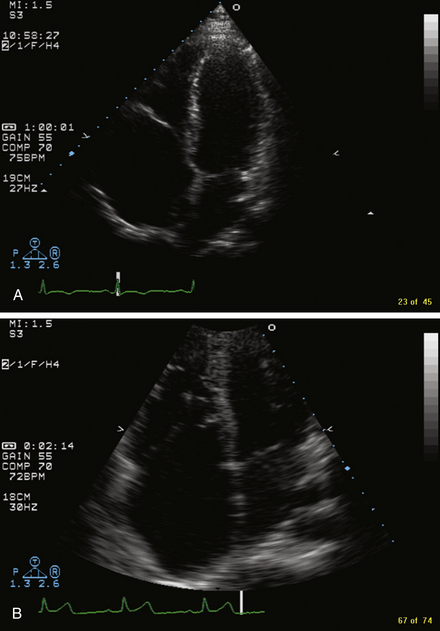
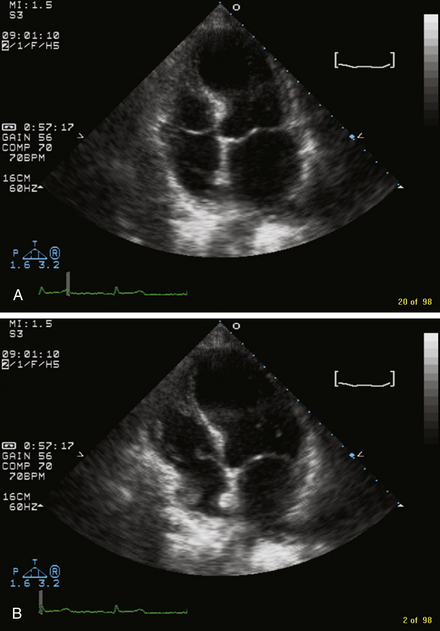
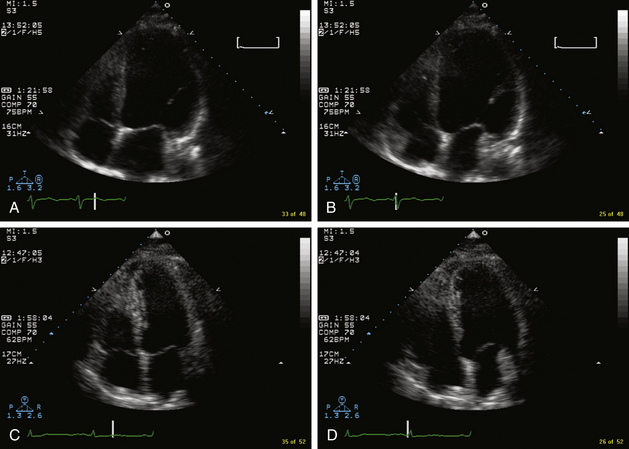
FIGURE 2-27 Apical transthoracic four-chamber images during systole (A) and diastole (B) demonstrating akinesis of the entire apex. Biatrial enlargement, left greater than right, is also present. Note that there is very little change in size of the apex between systole and diastole. Additionally, the apical walls do not thicken in systole. Thickening of the proximal septum in systole is apparent.
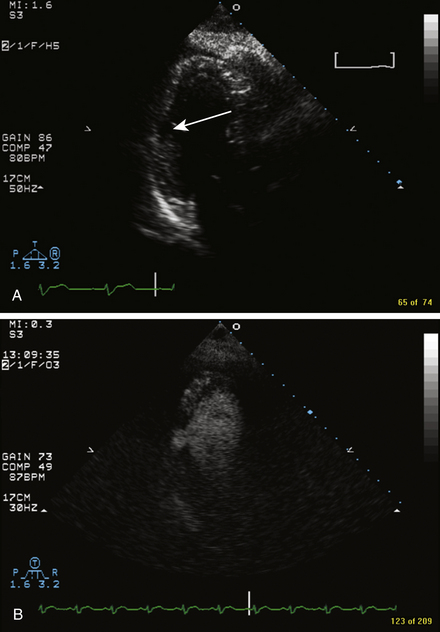
FIGURE 2-28 These images were obtained in a middle-aged male presenting to the emergency department with near-syncope and generalized malaise. He described severe chest discomfort occurring 4 days earlier. A, Apical long-axis view showing a defect (arrow) in the midinferolateral wall. B, Similar view obtained after definity contrast injection that demonstrates extravasation of contrast through the muscular defect. This patient proceeded to emergent surgery and had repair of his free wall rupture, which occurred several days after a completed infarct in that region.
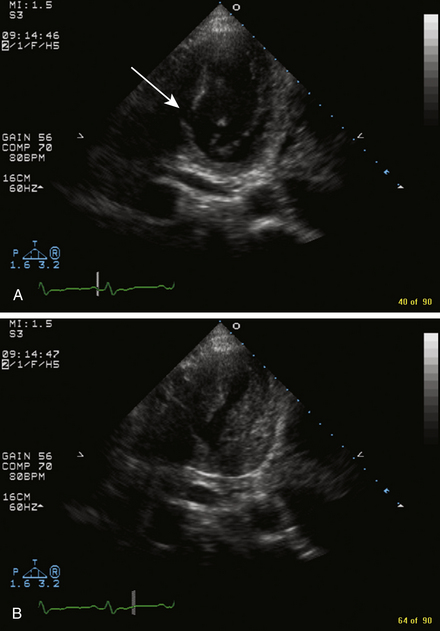
FIGURE 2-29 An 80-year-old female developed pulmonary edema and CHF after being managed medically for a non-STEMI. A transthoracic echocardiogram was obtained. These apical four-chamber images taken during diastole (A) and systole (B) show a muscular ventricular septal rupture (arrow). Note there is also marked LVH.
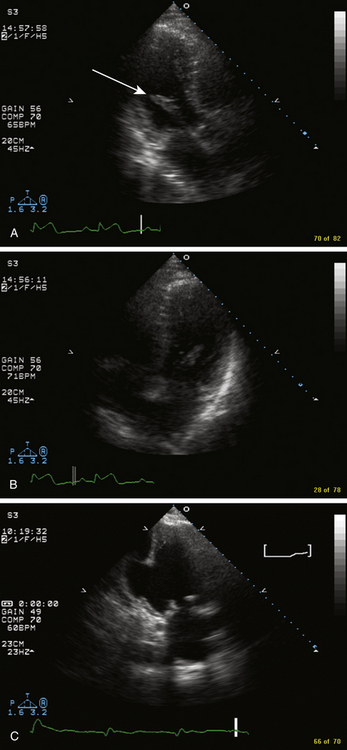
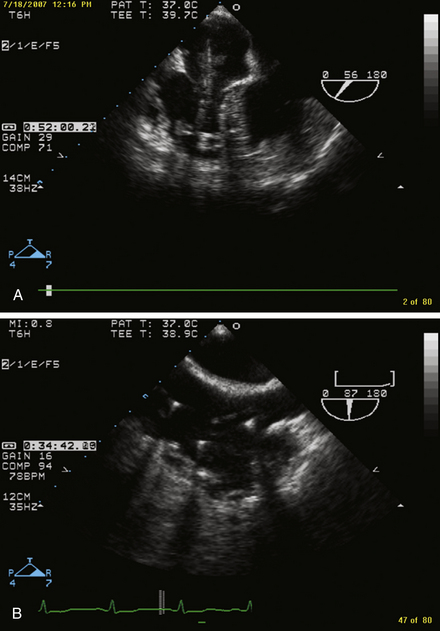
FIGURE 2-30 A, Apical long-axis transthoracic image obtained in a 50-year-old male with a completed inferior infarct. Rupture of the posteromedial papillary muscle is shown (arrow). B, This apical four-chamber image demonstrates the ruptured papillary muscle attached via the chordae tendineae to the mitral valve leaflets. The patient underwent emergent surgery and mitral valve replacement. C, This echocardiogram was obtained 1 year later in the same patient. He developed an aneurysm of the midinferior wall, shown here in an apical two-chamber view.
FIGURE 2-31 Echocardiographic findings in a 40-year-old male presenting with chronic angina and progressive dyspnea on exertion. Systolic (A) and diastolic (B) apical four-chamber images showing marked spherical left ventricular dilation and global hypokinesia. Ejection fraction was estimated at 20% to 25%. The patient had a chronically totally occluded LMCA diagnosed at cardiac catheterization. Systolic (C) and diastolic (D) images 9 months after the patient underwent CABG surgery; note the left ventricular cavity has strikingly decreased in size and the left ventricular function has markedly improved. Ejection fraction was estimated at 40% to 45%.
FIGURE 2-32 A, A large ostium secundum ASD is easily visualized in this bicaval view obtained during a TEE. Color flow imaging displays left to right shunting through the defect. B, An esophageal basal short-axis view of the aortic valve, RVOT, pulmonic valve, and PA (arrow) in the same patient. Note the marked enlargement of the RVOT and PA secondary to volume overload from the ASD.
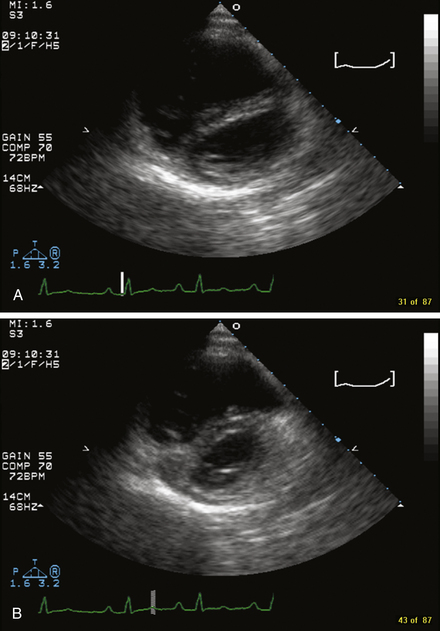
FIGURE 2-33 Diastolic (A) and systolic (B) 2D parasternal short-axis images in a patient with severe pulmonary hypertension. Note the massive enlargement of the RV, the flattened interventricular septum in systole and diastole, and the resulting D-shaped LV. In isolated right ventricular volume overload, the interventricular septum is flattened during diastole but not during systole.
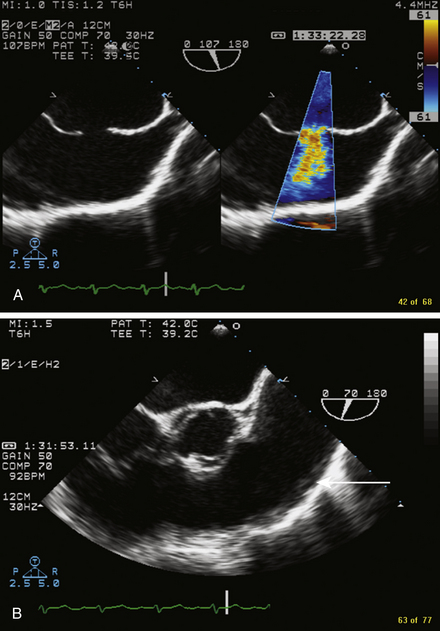
FIGURE 2-34 A, Transesophageal two-chamber view demonstrating a flail segment of the posterior mitral valve leaflet. B, Transesophageal long-axis view of the LV again demonstrating the flail posterior mitral valve leaflet. This resulted in severe eccentric mitral regurgitation directed toward the interatrial septum. This patient underwent successful repair of the mitral valve.
FIGURE 2-35 TEE in a middle-aged female with persistently positive blood cultures growing Staphylococcus aureusA, Midgastric transesophageal view demonstrating an ICD lead traversing the tricuspid valve. Note the shaggy thickened appearance of the entire lead with multiple large mobile echodensities attached to the portion of the lead within the RV apex consistent with endocarditis. B, Bicaval transesophageal view in the same patient showing the ICD lead entering the right atrium from the SVC. Multiple mobile vegetations are also noted attached to the ICD wire within the right atrium, which were not well visualized on transthoracic imaging. The patient underwent device explantation and lead extraction combined with I.V. antibiotics, which was curative.
FIGURE 2-36 Echocardiographic images demonstrating bileaflet mitral valve endocarditis. A, Apical four-chamber view showing irregular nodular thickening of the mitral valve leaflets. B, Parasternal long-axis view of the LV in the same patient. Note the large relatively sessile vegetation attached to atrial surface of the posterior mitral valve leaflet. The vegetation of the anterior mitral valve leaflet is not as well visualized in this view. C, Severe mitral regurgitation was present in this patient.
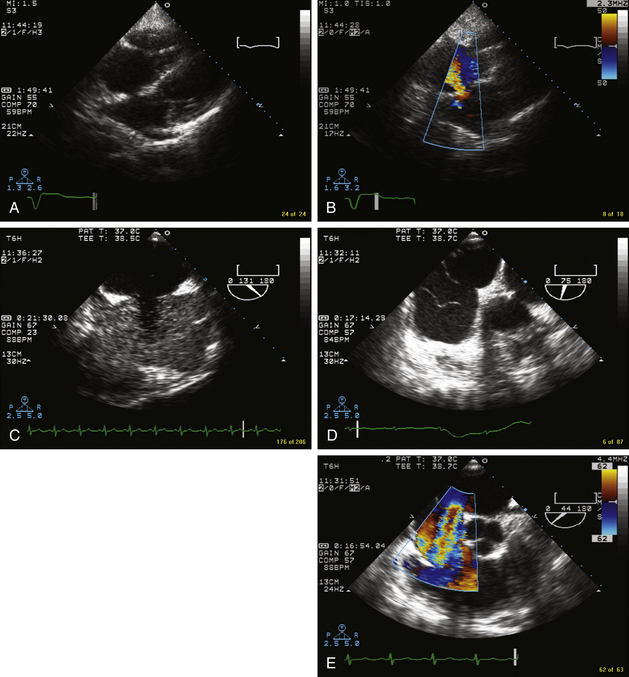
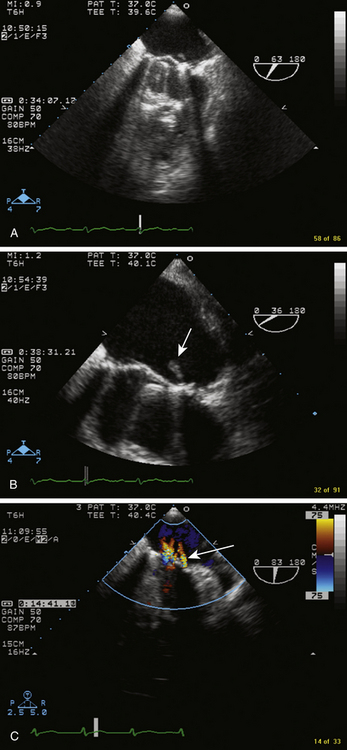
FIGURE 2-37 Transesophageal images in a patient with endocarditis of his St. Jude mitral valve prosthesis. A, This still frame was captured at the onset of systole. Note the prosthetic leaflets are closed. Attached to the atrial side of the prosthetic valve sewing ring is a large mobile echodensity consistent with vegetation. B, A close-up view of the vegetation (arrow) attached to the edge of the prosthesis. C, Color flow imaging demonstrating the expected three jets of minimal regurgitation that occur with closure of the leaflets. Also note the presence of mitral regurgitation occurring at the site of the vegetation, consistent with a paravalvular leak (long arrow).
FIGURE 2-38 A, Transthoracic parasternal long-axis image in a patient with rheumatic mitral stenosis. The mitral leaflets are thickened with minimal calcification. Here, in diastole, the leaflets dome into the LV. The anterior leaflet has the classic form of a hockey stick. B, Apical four-chamber image in the same patient showing the generalized thickening of the mitral valve leaflets and their restricted opening in diastole. The left atrium is severely enlarged.
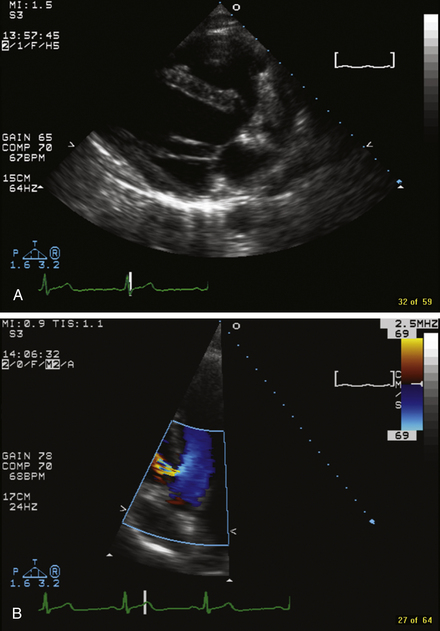
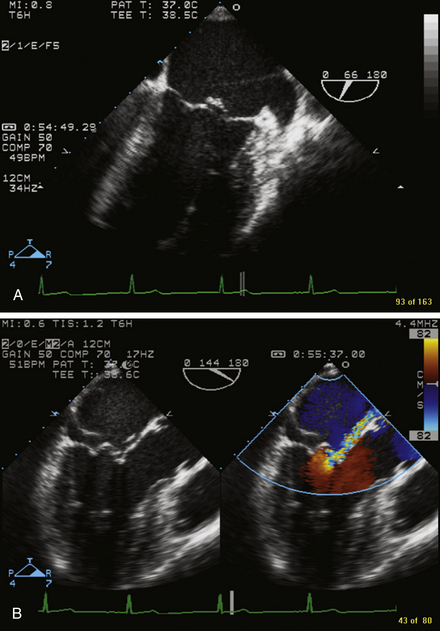
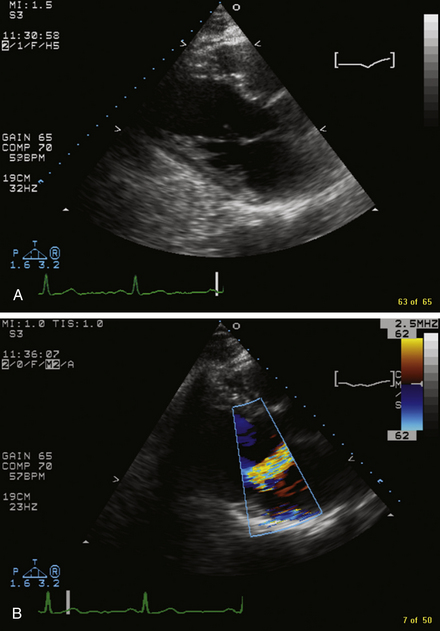
FIGURE 2-39 Ruptured chordae tendineae. A, Parasternal long-axis view displaying ruptured chordae tendineae attached to the posterior mitral valve leaflet, which resulted in a flail segment of the posterior leaflet. This patient presented with progressive shortness of breath over several days with pulmonary edema. B, Severe mitral regurgitation was evident by color flow Doppler imaging.
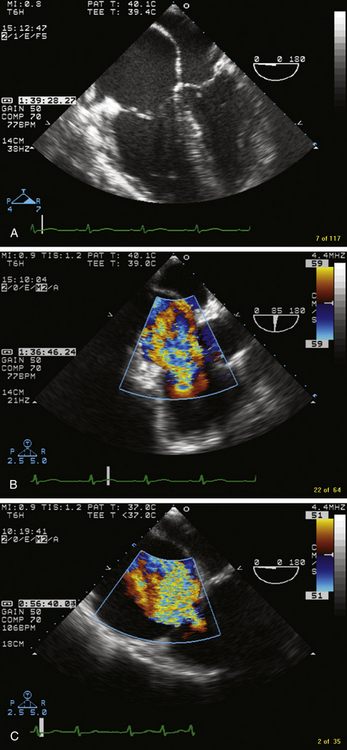
FIGURE 2-40 A, Transesophageal four-chamber still frame in a patient with severe tricuspid regurgitation. The RV and right atrium are dilated. The atrial septum bows to the left, consistent with high right atrial pressure. B, Color flow imaging in the same patient showing severe tricuspid regurgitation filling the right atrium. C, A transesophageal still frame image in another patient with severe central tricuspid regurgitation. The tricuspid annulus is dilated and the right atrium is massively enlarged.
FIGURE 2-41 Endocarditis of a bicuspid aortic valve. A, Transesophageal short-axis view of a bicuspid aortic valve showing thickening and increased echogenicity of the leaflets suspicious for endocarditis. B, Transesophageal long-axis view in the same patient. A mobile vegetation is evident on the anterior cusp of the bicuspid aortic valve. C, Perforation of the anterior cusp of the valve demonstrated with color flow imaging. Note the two jets of aortic regurgitation, one through the perforation (arrow) and the other through the valve orifice.
[/level-membership-for-cardiovascular-category][not-level-membership-for-cardiovascular-category]
FIGURE 2-14 A,
[/not-level-membership-for-cardiovascular-category]
Cardiovascular Imaging Review Expert Consult