

[level-membership-for-dermatology-category]
Physical urticarias, aquagenic pruritus, and cholinergic pruritus
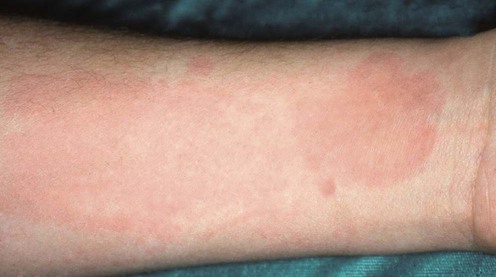
Physical urticarias
About 25% of patients with chronic urticaria have a definable and reproducible physical trigger that distinguishes them from those with spontaneous urticaria and urticarial vasculitis. Physical urticarias are defined by the predominant stimulus that induces them (Table 181.1). More than one physical stimulus elicits urticaria in some patients, and physical urticarias can overlap with spontaneous urticaria. Physical urticarias are included under the term ‘inducible urticarias’ in the latest European classification.
Table 181.1
Classification of physical urticarias by the eliciting stimulus (in approximate reducing frequency of occurrence)
| Symptomatic dermographism | Stroking or rubbing the skin |
| Cholinergic urticaria (pale, papular wheals with red flares) | Rise in core temperature and other causes of sweating (exercise, hot baths, spicy food, and stress) |
| Cold urticaria | Rewarming of skin after cooling (localized or systemic) |
| Delayed pressure urticaria | Sustained perpendicular pressure |
| Solar urticaria | Ultraviolet or visible solar radiation |
| Localized heat urticaria | Local heat contact |
| Adrenergic urticaria (red papular wheals with surrounding pallor) | Emotional stress |
| Aquagenic urticaria | Local water contact at any temperature |
| Exercise-induced anaphylaxis | Exercise, but not hot baths |
| Food and exercise-induced anaphylaxis | Exercise following a heavy food load or eating specific foods |
| Vibratory angioedema | Vibration |


First-line therapies
 Non-sedating (‘second generation’) antihistamines
Non-sedating antihistamines (Table 181.2) should be prescribed in preference to classical antihistamines, which are often sedating and can impair psychomotor performance. Up-dosing of second generation H1 antihistamines is often practiced.
Table 181.2
Examples of non- and mildly sedating antihistamines
| Acrivastine | Non-sedating, three-times-daily dosing |
| Cetirizine | Mildly sedating, once-daily dosing |
| Levocetirizine | The active enantiomer of cetirizine |
| Fexofenadine | Non-sedating, once-daily dosing |
| Loratadine | Non-sedating, once-daily dosing |
| Desloratadine | The active metabolite of loratadine |
| Mizolastine | Non-sedating, once-daily dosing |
| Rupatadine | Non-sedating, once-daily dosing |
Second-line therapies
Symptomatic dermographism
 H2 receptor antagonists
 Narrowband UVB phototherapy
 Photochemotherapy (PUVA)
 Omalizumab
Cholinergic urticaria
 Danazol
 Anticholinergics
 Autologous sweat injection
 Omalizumab
Cold urticaria
 Cold tolerance (desensitization)
 Leukotriene receptor antagonists
 Antibiotics
 Omalizumab
 Omalizumab
Delayed pressure urticaria
 Topical steroids
 Leukotriene receptor antagonists
 Sulfasalazine
 Dapsone
 Omalizumab
Solar urticaria
 Induction of tolerance (phototherapy and photochemotherapy)
 Omalizumab
 β-Blockers
Third-line therapies
 Epinephrine (adrenaline) cream
 Intravenous immuneglobulins
 Cyclosporine
 Plasmapheresis
 Etanercept
Aquagenic pruritus


 Explanation
 Minimally sedating antihistamine
 Sodium bicarbonate added to bath water
 UVB
UVB Narrowband UVB
 Combined UVA/narrowband UVB therapy
 Bath oil
 Emulsifying ointment in the bath water
 PUVA
PUVA Propranolol
 Intramuscular triamcinolone
 Transdermal nitroglycerin
 Naltrexone 50 mg daily

 Explanation
 Second generation H1 antihistamines
 Danazol
[/level-membership-for-dermatology-category][not-level-membership-for-dermatology-category]
Physical urticarias, aquagenic pruritus, and cholinergic pruritus
Physical urticarias
About 25% of patients with chronic urticaria have a definable and reproducible physical trigger that distinguishes them from those with spontaneous urticaria and urticarial vasculitis. Physical urticarias are defined by the predominant stimulus that induces them (Table 181.1). More than one physical stimulus elicits urticaria in some patients, and physical urticarias can overlap with spontaneous urticaria. Physical urticarias are included under the term ‘inducible urticarias’ in the latest European classification.
Table 181.1
Classification of physical urticarias by the eliciting stimulus (in approximate reducing frequency of occurrence)
| Symptomatic dermographism | Stroking or rubbing the skin |
| Cholinergic urticaria (pale, papular wheals with red flares) | Rise in core temperature and other causes of sweating (exercise, hot baths, spicy food, and stress) |
| Cold urticaria | Rewarming of skin after cooling (localized or systemic) |
| Delayed pressure urticaria | Sustained perpendicular pressure |
| Solar urticaria | Ultraviolet or visible solar radiation |
| Localized heat urticaria | Local heat contact |
| Adrenergic urticaria (red papular wheals with surrounding pallor) | Emotional stress |
| Aquagenic urticaria | Local water contact at any temperature |
| Exercise-induced anaphylaxis | Exercise, but not hot baths |
| Food and exercise-induced anaphylaxis | Exercise following a heavy food load or eating specific foods |
| Vibratory angioedema | Vibration |
First-line therapies
Non-sedating antihistamines (Table 181.2) should be prescribed in preference to classical antihistamines, which are often sedating and can impair psychomotor performance. Up-dosing of second generation H1 antihistamines is often practiced.
Table 181.2
Examples of non- and mildly sedating antihistamines
| Acrivastine | Non-sedating, three-times-daily dosing |
| Cetirizine | Mildly sedating, once-daily dosing |
| Levocetirizine | The active enantiomer of cetirizine |
| Fexofenadine | Non-sedating, once-daily dosing |
| Loratadine | Non-sedating, once-daily dosing |
| Desloratadine | The active metabolite of loratadine |
| Mizolastine | Non-sedating, once-daily dosing |
| Rupatadine | Non-sedating, once-daily dosing |
