

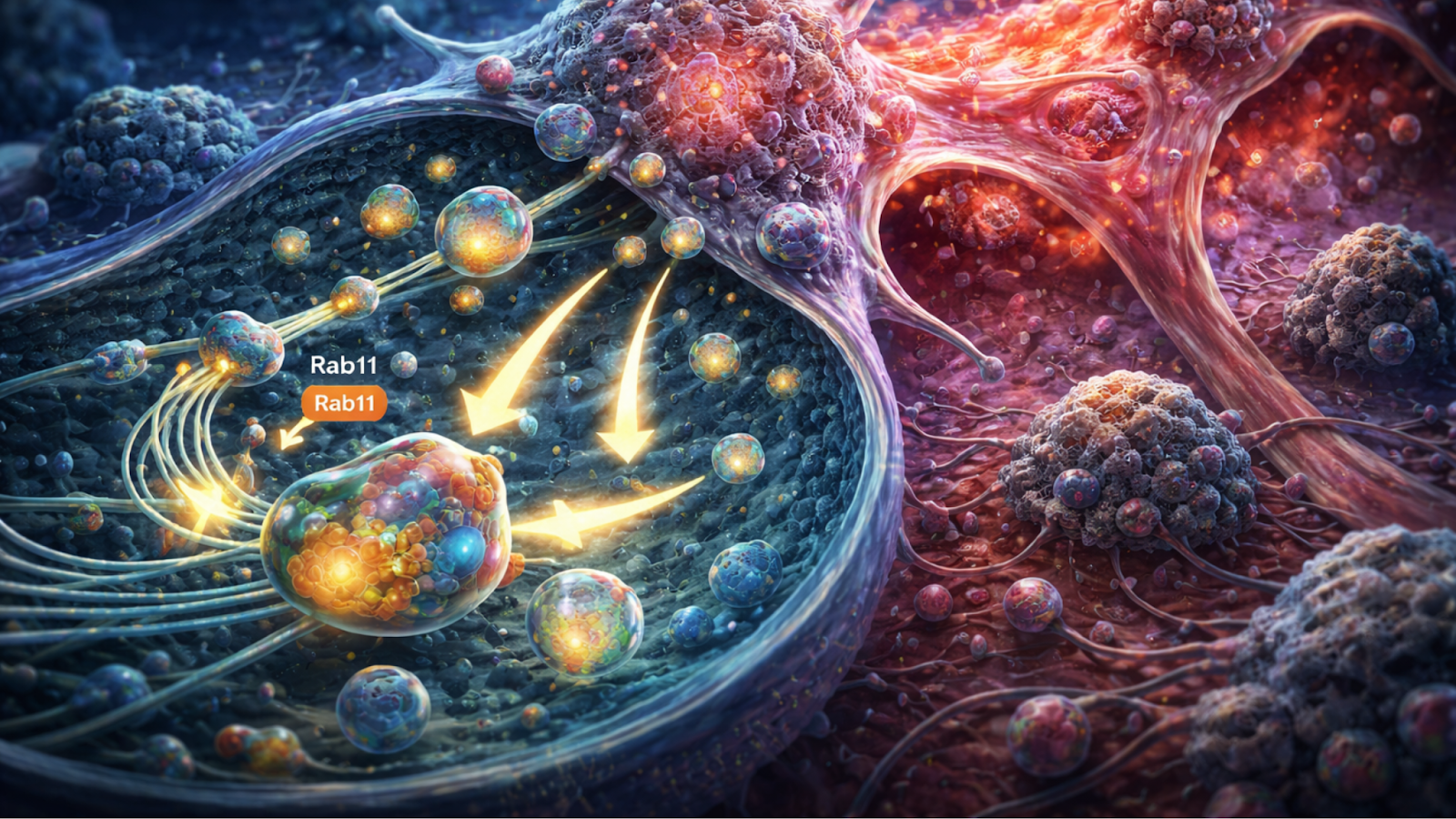
The spatial distribution of proteins is as critical as their synthesis in the complex architecture of a cell. Intracellular trafficking ensures that receptors, adhesion molecules, and lipids reach their precise destinations.
The Rab family of small GTPases is at the center of this network, which serves as the logistics network of the cell. Rab11 acts as the primary regulator of the recycling endosome.
Rab11 returns internalized membrane components to the plasma membrane to maintain cellular homeostasis in healthy tissue. When a cell becomes cancerous, the recycling endosome (RE) is frequently hijacked.
The dysregulation of Rab11-dependent trafficking has emerged as a fundamental driver of:
- Tumor growth
- Metabolic adaptation
- Lethal transition to metastasis
Mechanics of Rab11
Rab11 functions as a molecular switch, transitioning between an active GTP-bound state and an inactive GDP-bound state. Guanine Nucleotide Exchange Factors (GEFs) activate the protein, and GTPase-Activating Proteins (GAPs) deactivate the protein to govern this cycle.
Active Rab11 recruits the Rab11-Interacting Proteins (FIPs), and these FIPs physically link Rab11-containing vesicles to cytoskeletal motor proteins, such as dynein or myosin. FIPs tether the cargo to these motors and enable the active transport of vesicles along the cellular ‘highways’ toward the plasma membrane.
While Rab11A and Rab11B are ubiquitously expressed, the isoform Rab25 is amplified in epithelial cancers. It acts as a potent oncogene that accelerates the recycling of pro-tumorigenic cargo.
Driving Uncontrolled Growth
Sustained proliferative signaling is one of the hallmarks of cancer. Rab11 plays a key role in this process. Normally, growth factor receptors like the Epidermal Growth Factor Receptor (EGFR) are internalized and sent to the lysosome for degradation to “turn off” the signal. Dysregulated Rab11 shifts the balance toward recycling in many tumors.
However, instead of being destroyed, these receptors are rapidly shuttled back to the cell surface, creating a loop of continuous signaling. This signaling fuels the PI3K/AKT and MAPK pathways, and the tumor grows independently of external growth cues. The cell loses its ability to “retire” active signals, leading to chronic over-stimulation.
EMT and Migration
A tumor must undergo Epithelial-Mesenchymal Transition (EMT) to metastasize. This is a process in which stationary cells gain the ability to move. Rab11 manages the trafficking of integrins, which are proteins that span from the inside of the cell to the outside. Rab11 shuttles them from the trailing edge to the leading edge of a migrating cell. This rapid turnover of adhesion molecules allows the cancer cell to “crawl” through the extracellular matrix.
Rab11 is involved in the targeted delivery of matrix metalloproteinases (MMPs). These are enzymes that degrade the surrounding tissue to clear a path for invasion. Rab11 dysregulation coordinates the recycling of E-cadherin and the deployment of migratory machinery. It provides the cell with the tools necessary to break away from the primary tumor and enter the bloodstream.
Therapeutic Resistance and the Future
In addition to growth and movement, Rab11–dependent trafficking contributes to therapeutic resistance. Rab11 controls the recycling of drug efflux pumps or sequestering targeted therapy receptors (like HER2) away from the cell surface. As a result, Rab11 allows cancer cells to evade treatment.
As Rab11 is at the center of so many oncogenic processes, it is a highly attractive therapeutic target. However, chemically, it is difficult to target a small GTPase. Current research focuses on FIP proteins to develop small-molecule inhibitors that disrupt the interaction between Rab11 and its effectors. Breaking the machinery that moves the cargo may help stop the progression of aggressive, metastatic cancers.
Rab11 enables a tumor to grow and spread. Researchers use a Rab11 antibody to detect high levels of this protein in tissue samples, serving as a marker for aggressive tumors. Understanding how to disrupt this hijacked logistics hub is a key goal for future cancer therapies.


