

Suggested meta description: How to read a red light therapy panel spec sheet: wavelength split, spectrometer irradiance, LED design, coverage, and warranty, in five clinician checks.
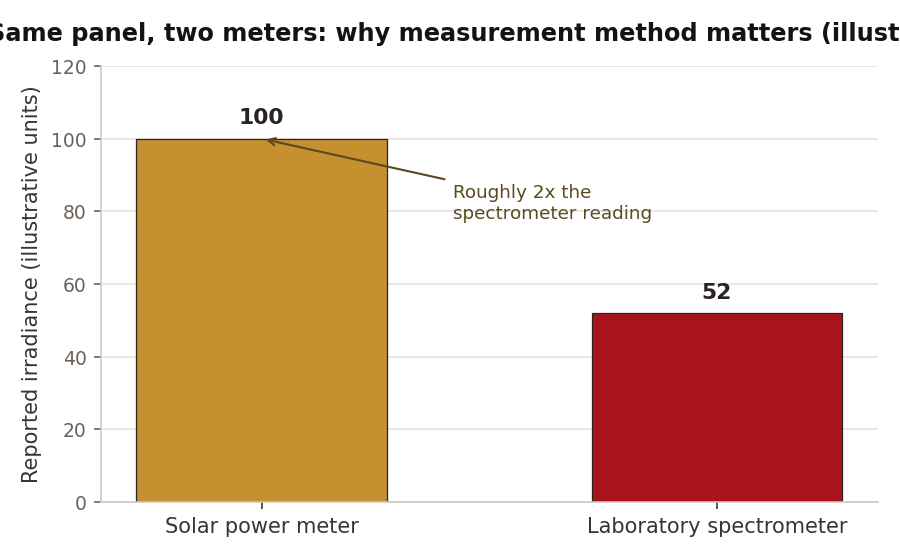
A spectrometer reading with a stated method and distance is the figure that makes panels comparable (illustrative).
To read a red light therapy panel spec sheet, run five checks in order: confirm which wavelengths are present, look for a published power split across them, verify how irradiance was measured and at what distance, read the LED architecture, then weigh coverage against warranty and trial terms. A good sheet answers all five in a few lines, and once you know where to look it reads much like a lab report. For the wider landscape first, a clinician-oriented overview of which red light panels clinicians recommend is a useful place to orient yourself.
Spec sheets take practice to compare for two reasons: manufacturers measure in different ways, and the hardware differs more than the photos suggest. For how much LED design alone can shift results, a hands-on test of single versus dual-chip panels shows why two devices with similar wattage behave differently at the skin. Keep both variables, method and hardware, in view through the checks below.
1. Red Light Panel Wavelengths and the Published Power Split
Start with the wavelength list, then look for how output is shared among the bands. Red light near 630 and 660nm acts at the surface and may support skin, while near-infrared around 810, 830, and 850nm penetrates deeper and is being studied for muscle and joint use. Longer 1064nm light reaches deepest and is a distinctive addition on a home panel.
A per-band density figure is the line that carries weight. The RLT Home Total Spectrum MAX publishes a split across its seven wavelengths (about 810nm 19 percent, 830nm 14 percent, 1064nm 14 percent), so you can see that real output sits in the deeper bands rather than in one easy-to-produce color. A good sheet pairs every wavelength it lists with a share of output; when a distribution is published, the extra colors become something you can actually weigh.
2. Irradiance Measurement Method: Spectrometer Readings at a Stated Distance
Irradiance, given in mW per cm2 at a stated distance, is the number that most rewards careful reading, because a consumer solar power meter reads roughly double what a laboratory spectrometer reports on the same device. The most useful figure is one that names the method, the distance, and ideally the lab, so it can be set against another figure measured the same way.
Three patterns recur. Some brands name the lab and the method, as the RLT Home Total Spectrum MAX does at 100.53 mW/cm2 at 6 inches (Electropossible Ltd and LightLab International). Some list two figures from two methods, as the Mito Red Light MitoPRO 1500X does with values above 160 and above 73 mW/cm2, which lets you pick the spectrometer value for comparison. And some print one number labeled as a solar-meter reading, as with the Infraredi Slim Lite at 110 mW/cm2, which is fair to compare with other solar-meter readings at the same distance. The labeled figures are the ones that compare like for like, so always note the method and the distance together.
3. LED Architecture on a Red Light Panel: Single-Chip Versus Multi-Chip
The LED design sets how power reaches each wavelength. A single-chip LED devotes one diode to one wavelength, so the single-chip 5W design across the RLT Home Total Spectrum line puts a full diode behind each color. A dual or multi-chip LED packs several emitters into one lens; the Mito Red Light MitoPRO 1500X uses 300 lenses over 600 chips. Multi-chip packaging fits more wavelengths into a compact housing, with lens power shared among the chips, so power per wavelength is best read alongside the emitter count. Neither approach is universally better; a good sheet states LED type, wattage, and count so you can read them together.
4. Red Light Panel Coverage Area, Warranty, and Trial Terms
Coverage follows physical size and LED count, and it decides how many positions a session takes. The taller RLT Home Total Spectrum ULTRA can cover a whole leg or torso in one position, while the compact Infraredi Slim Lite, with 40 LEDs, is best suited to a single joint or a small area. Format matters too: the vertical RLT Home Total Spectrum MAX reaches a seated joint once its stand is angled, which is worth planning for in a treatment space. Finally, read the warranty and any at-home trial window; a 3-year warranty and a real return period show how a company stands behind its numbers.
Comparing Three Red Light Panel Spec Sheets Side by Side
The same checklist across three panels shows how differently a sheet can present the same class of device, and where each panel fits best.
| Device | What the spec sheet shows | Fit and context |
|---|---|---|
| RLT Home Total Spectrum MAX | Seven wavelengths (480, 630, 660, 810, 830, 850, 1064nm) with a published split; single-chip 5W LEDs; spectrometer-verified 100.53 mW/cm2 at 6 inches. | Vertical format suits standing or full-length sessions; angle the stand for a seated joint. Lab-tested figures with a named method. |
| Mito Red Light MitoPRO 1500X | Six wavelengths from 590 to 850nm with a published split; 300 lenses over 600 chips; a 3-year warranty. | Two 6-inch figures from different methods, so use the spectrometer value for comparison; the range tops out at 850nm. |
| Infraredi Slim Lite | Forty LEDs at 660 and 850nm; a 3-year warranty; a stated 110 mW/cm2. | That figure is a solar-meter reading, so compare it with other solar-meter values; 40 LEDs suit a single joint or small area. |
Budget panels such as the Bestqool BQ60 line can be fair value for a focused wavelength set; applying the same five checks, especially on measurement method, shows where they fit.
What the Evidence Supports for Red Light Therapy Panels
Grade the claims a sheet leans on, not the sheet itself:
- Moderate: red and near-infrared light may support skin quality and may help with musculoskeletal pain and short-term recovery, with effect sizes that vary and consistency of use mattering as much as peak irradiance.
- Strong, but a different device class: laser caps, helmets, and bands are the FDA-cleared category for androgenetic alopecia. A flat panel is a different device and does not conform to the scalp, so the strongest hair data belongs to the wearable category.
- Early and modest: evidence that home red light contributes to fat or weight change is still developing; any effect is modest and depends on nutrition and activity, so red light works best as an adjunct alongside those fundamentals.
One helpful point of buyer guidance: rectangular home panels are FDA-registered, which is a listing rather than a clearance, approval, or endorsement, so the most accurate sheets use the word registered.
Safety line: red light can interact with photosensitizing medications, so anyone taking one should check with a prescriber first, and use over the abdomen in pregnancy is not yet well studied. When in doubt, involve a qualified professional before starting.
Frequently Asked Questions About Red Light Panel Spec Sheets
Is a higher irradiance number always better?
Not on its own. A higher number measured with a solar meter can represent less real output than a smaller number measured with a spectrometer. Compare figures when both method and distance are stated, and you will be comparing like for like.
Do I need all seven wavelengths?
Not necessarily. What matters is that the wavelengths you care about carry real output. A published split at 810 and 830nm can be more useful for deeper tissue than a longer list without a distribution.
Does single-chip or multi-chip make a device better?
Neither is inherently better. Single-chip designs put a full diode behind each wavelength; multi-chip lenses fit more wavelengths into a compact housing and share power among the chips. Read wattage against the number of emitters that divide it.
A Note on Claims: This article is general wellness information, not medical advice, and it does not diagnose, treat, or cure any condition. Home red light panels are FDA-registered, which is a listing and not a clearance, approval, or endorsement; laser hair devices are a separate, FDA-cleared category. Specifications can change and were drawn from published manufacturer figures and named lab reports. Effects described here may support or may help and are still being studied. Consult a qualified healthcare professional before starting red light therapy, especially if you are pregnant or take photosensitizing medication.
