

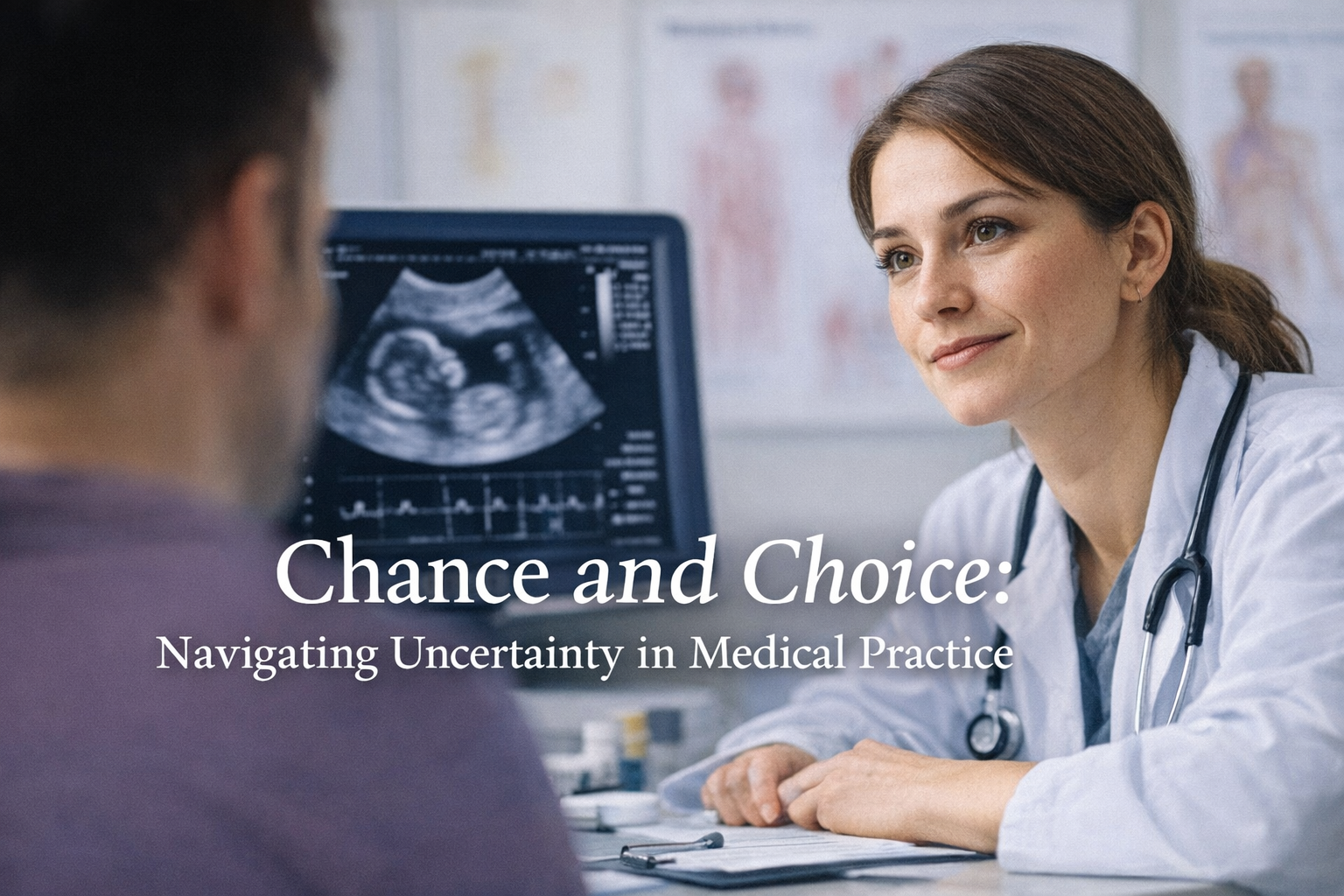
The Space Between Knowing and Not Knowing
If you ask most patients what they expect from medicine, the answer is simple: clarity. A diagnosis. A plan. A sense that someone knows exactly what is happening.
But anyone who has practiced long enough understands a quieter truth. Medicine is rarely about certainty. It is about navigating the space between what we know and what we suspect.
A patient arrives with fatigue and vague discomfort. Blood tests are almost normal. Imaging shows “possible findings.” Not definitive. Possible. That word carries weight. It sits there between reassurance and alarm, waiting for interpretation.
Thinking in Probabilities, Not Absolutes
In training, we are taught to think in terms of likelihoods. Pre-test probability. Risk ratios. Confidence intervals. At first, it feels mathematical, almost detached. Later, it becomes intuitive — a mental calibration system running in the background.
I once tried explaining this to a student by comparing it to other probability-based systems people interact with in everyday life. Platforms such as https://casinosanalyzer.com/free-spins-no-deposit/free-chips illustrate how outcomes are shaped by statistical variance rather than guarantees, and that idea — understanding range rather than certainty — mirrors how we approach diagnostics. The analogy isn’t about gambling; it’s about grasping that not every decision operates in black and white.
When a patient presents with chest pain, for example, we don’t ask, “Is this a heart attack or not?” We ask, “How likely is it?” We layer data: history, exam, ECG, biomarkers. Each piece shifts the scale slightly. Rarely does it slam definitively to one side.
The Two Minds of a Clinician
There are moments when diagnosis feels immediate — pattern recognition kicks in. A certain look, a familiar cluster of symptoms, and something clicks.
Then there are cases where nothing clicks.
Those are harder. They require slowing down. Listing possibilities. Questioning assumptions. Revisiting details that seemed irrelevant an hour earlier.
Experience teaches you that both instincts — rapid recognition and careful analysis — are necessary. Rely only on intuition, and bias creeps in. Overanalyze everything, and paralysis follows.
Medicine is not about being certain; it is about being responsibly uncertain.
Why Patients Struggle With “Most Likely”
Patients often want definitive language. “Is it serious?” “Will I recover?” “Is this dangerous?”
And we answer with phrases like, “It appears to be…” or “The most likely explanation is…”
Those words can feel unsatisfying. But they are honest.
Outside clinical settings, people search for certainty in different ways. Cultural narratives, cycles, symbolic interpretations — even articles discussing zodiac signs most affected by december new moon reflect a human desire to anticipate change and feel oriented in uncertain times. Medicine approaches uncertainty through evidence rather than symbolism, yet the emotional need underneath is familiar.
Patients are not only asking for data. They are asking for reassurance that uncertainty does not mean abandonment.
When Statistics Become Personal
It is easy to discuss percentages in abstract terms. A 10% complication rate. A 70% response rate.
But across from you sits a person who is either in that 70% — or not.
Statistics describe populations. Medicine treats individuals.
Communicating risk demands more than quoting numbers. It requires translating them into meaning. “Out of 100 patients like you, about five experience this side effect.” That sentence carries more weight than a sterile percentage.
The goal is neither to exaggerate nor minimize. It is to respect the patient’s right to understand what uncertainty actually looks like.
Technology Hasn’t Removed Doubt
We live in an era of extraordinary tools. AI-assisted imaging. Genomic panels. Continuous remote monitoring.
These advances refine our estimates. They narrow ranges. They detect subtleties invisible a decade ago.
But they do not eliminate unpredictability.
More data sometimes means more incidental findings. A small lesion of unclear significance. A borderline lab value that demands follow-up. Technology increases resolution, but interpretation still requires judgment.
And judgment is human.
The Emotional Weight of Ambiguity
Medical education rewards correct answers. Clinical life rewards adaptability.
There are days when you leave the hospital replaying decisions in your mind. Should I have ordered that test earlier? Did I discharge too soon? Did I miss something subtle?
Uncertainty lingers even after the shift ends.
Resilience in medicine is not about detachment. It is about learning to sit with incomplete knowledge without becoming paralyzed by it.
There is strength in saying, “We will monitor closely.” There is integrity in admitting, “We don’t know yet.”
Patients often respond to honesty more positively than to overconfidence.
Stewardship, Not Control
Perhaps the most useful shift in perspective is this: medicine is not about controlling outcomes. It is about influencing probabilities.
Vaccines reduce risk — they do not guarantee immunity. Screening improves early detection — it does not prevent disease. Treatment increases chances of recovery — it does not ensure it.
We work within margins.
Even in palliative care, uncertainty remains. We cannot predict exact timelines. What we can do is shape the quality of time that remains.
That, too, is a form of probability management — but guided by compassion rather than calculation alone.
Remaining Human in a Probabilistic World
In the end, medicine is not a game of chance, nor is it a promise of certainty. It is a disciplined response to uncertainty.
Every patient encounter contains variables beyond our control: biology, environment, behavior, time. We gather evidence. We weigh options. We recommend what seems most reasonable based on what we know today.
And sometimes tomorrow teaches us something new.
What keeps medicine profoundly human is not our ability to eliminate uncertainty — it is our willingness to face it openly, alongside our patients.
In that shared space between doubt and decision, trust is built. Not on guarantees, but on thoughtful guidance.
And perhaps that is enough.
