

[level-membership-for-emergency-medicine-category]
23.2 Bag–mask ventilation
Background
Bag–mask (BM) ventilation is the most important skill in paediatric airway management. This non-invasive manoeuvre for assisted, positive-pressure ventilation is effective treatment for most children with hypoventilation and hypoxia. A child with respiratory insufficiency may require only temporary assisted ventilation with BM. Some children in respiratory failure who require prolonged ventilation or airway protection may need tracheal intubation (Chapter 23.3).
In the BM setup, oxygen flows into a bag reservoir, through a pop-off valve, and into a mask, which forms a tight seal around the child’s nose and mouth. Squeezing the bag administers oxygen under positive pressure to the lungs. While this manoeuvre does not fully protect the airway, as tracheal intubation does, BM ventilation adequately provides emergent airway support during the acute decompensation period (Table 23.2.1). Additionally, Gausche et al demonstrated that BM ventilation is as effective as tracheal intubation in the pre-hospital setting for airway management, regardless of the underlying aetiology.1 Thus, both pre-hospital and in-hospital practitioners must be comfortable and proficient in performing BM ventilation.


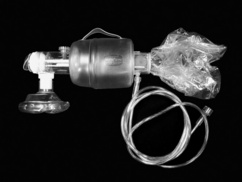


Procedure
 Perform the head-tilt and chin-lift manoeuvre to open the airway and lift the tongue away from the soft palate of the oropharynx. Proper positioning and suctioning of excess secretions will often relieve the respiratory compromise without BM ventilation.
 If airway patency is still suboptimal, reposition and suction the patient. If still inadequate, insert an oropharyngeal or nasopharyngeal airway underneath the mask to lift the tongue from the posterior oropharynx (Chapter 23.3).
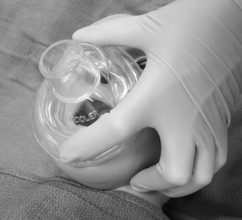
 In the one-person BM technique place the mask on the patient’s face and achieve an airtight seal over the mouth and nose. Using the non-dominant hand, place the thumb and index finger on the superior and inferior parts of the face mask, respectively. Cradle the tips of the other three fingers along the mandible and lift the jaw up toward the mask to create the seal. This is the ‘E–C clamp’ manoeuvre, based on the E-shape of the three fingers along the jaw and the C-shape of the thumb and index finger along the face mask (Fig. 23.2.3). In creating the seal, pull the jaw anteriorly rather than push the mask posteriorly into the patient’s face. To ventilate, squeeze the oxygen reservoir bag using the dominant hand. For prolonged BM ventilation, use the little finger of your non-dominant hand (used for the E–C clamp) and apply cricoid pressure to reduce gastric air insufflation.
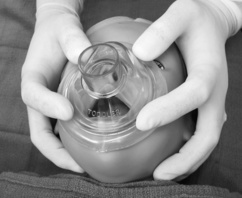
 In the two-person technique place the mask on the patient’s face and achieve an airtight seal over the mouth and nose. For operator #1, place the thumb and index finger of both hands on the superior and inferior parts of the face mask, respectively. Cradle the tips of the other three fingers of both hands along either side of the mandible and symmetrically lift the jaw up toward the mask to create a seal. This is a double ‘E–C clamp’ manoeuvre (Fig. 23.2.4). Again, pull the jaw anteriorly rather than push the mask posteriorly into the patient’s face. Operator #2 ventilates the patient by squeezing the oxygen reservoir bag, and applies cricoid pressure for prolonged BM ventilation to reduce gastric air insufflation.


Tips
Brown R.E. Bag and mask ventilation. In: Dieckmann R.A., et al, editors. Paediatric emergency and critical care procedures. St Louis, MO: Mosby, 1997.
Chameides L., Hazinski M.F., editors. Paediatric advanced life support. Dallas, Texas: American Heart Association, 1997.
Dieckmann R.A., Brownstein DR, Gausche-Hill M, editors. Paediatric Education for Prehospital Professionals. Sudbury, MA: Jones & Bartlett Publishers, 2000.
Lee B.S., Gausche-Hill M. Paediatric airway management. Clin Paediatr Emerg Med. 2001;2(2):91-106.
Zideman D., et al. Airways in paediatric and newborn resuscitation. Ann Emerg Med. 2001;37(4 Suppl):S126-S136.
[/level-membership-for-emergency-medicine-category][not-level-membership-for-emergency-medicine-category]
23.2 Bag–mask ventilation
Background
Bag–mask (BM) ventilation is the most important skill in paediatric airway management. This non-invasive manoeuvre for assisted, positive-pressure ventilation is effective treatment for most children with hypoventilation and hypoxia. A child with respiratory insufficiency may require only temporary assisted ventilation with BM. Some children in respiratory failure who require prolonged ventilation or airway protection may need tracheal intubation (Chapter 23.3).
In the BM setup, oxygen flows into a bag reservoir, through a pop-off valve, and into a mask, which forms a tight seal around the child’s nose and mouth. Squeezing the bag administers oxygen under positive pressure to the lungs. While this manoeuvre does not fully protect the airway, as tracheal intubation does, BM ventilation adequately provides emergent airway support during the acute decompensation period (Table 23.2.1). Additionally, Gausche et al demonstrated that BM ventilation is as effective as tracheal intubation in the pre-hospital setting for airway management, regardless of the underlying aetiology.1 Thus, both pre-hospital and in-hospital practitioners must be comfortable and proficient in performing BM ventilation.
