

[level-membership-for-neurology-category]
Coma and alteration of consciousness
Coma is a common and important medical emergency, accounting for 3% of acute hospital admissions. This section discusses the terminology used in this field, which is often confusing, then considers the aetiology and pathogenesis of coma, then outlines a pragmatic approach to these patients.
Aetiology and pathogenesis
Consciousness depends on the intact functioning of the reticular activating system in the brain stem and the cerebral cortex. Coma and altered consciousness arise from disturbance of these elements (Table 1). This can arise from:

 supratentorial lesions – large enough to cause herniation (p. 48) or large enough to disrupt the cortex
| Site of disease | Causes |
|---|---|
| Infratentorial |
Coma
The clinical assessment of coma is outlined in Box 1. Coma is usually readily recognizable. Potential differential diagnoses include:
 ‘Locked in syndrome’: This results from a high midbrain lesion or a severe generalized neuropathy, which prevent the patient from all movement despite having a normal consciousness.

The next issue is to determine the cause so as to direct future management of the coma (Box 1). This can be broadly divided into the following categories:
 Coma with neck stiffness. This can arise from meningitis, subarachnoid haemorrhage and, rarely, as a result of foramen magnum herniation.

Box 1 Assessment of patients with coma
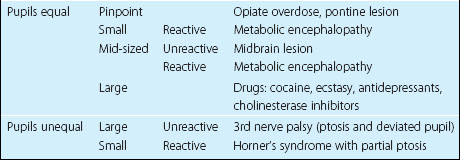
Management of coma


Identification and treatment of specific underlying causes
This is in large part going to be dictated by the clinical situation.
Coma with neck stiffness


Prognosis in coma
This depends on the underlying cause. The outcome from traumatic coma is considered on page 79. Prognosis depends on the cause and duration of coma. Patients with focal signs, especially pupillary signs, do particularly badly.
Criteria for brain stem death are used to determine when ventilatory and other support can be discontinued (Box 2).
Box 2 Diagnosis of brain stem death in the UK


Other causes of medical coma have a worse prognosis, with an overall recovery rate of only 15%.


[/level-membership-for-neurology-category][not-level-membership-for-neurology-category]
Coma and alteration of consciousness
Coma is a common and important medical emergency, accounting for 3% of acute hospital admissions. This section discusses the terminology used in this field, which is often confusing, then considers the aetiology and pathogenesis of coma, then outlines a pragmatic approach to these patients.
Aetiology and pathogenesis
Consciousness depends on the intact functioning of the reticular activating system in the brain stem and the cerebral cortex. Coma and altered consciousness arise from disturbance of these elements (Table 1). This can arise from:
supratentorial lesions – large enough to cause herniation (p. 48) or large enough to disrupt the cortex| Site of disease | Causes |
|---|---|
| Infratentorial |
Coma
The clinical assessment of coma is outlined in Box 1. Coma is usually readily recognizable. Potential differential diagnoses include:
‘Locked in syndrome’: This results from a high midbrain lesion or a severe generalized neuropathy, which prevent the patient from all movement despite having a normal consciousness.The next issue is to determine the cause so as to direct future management of the coma (Box 1). This can be broadly divided into the following categories:
Coma with neck stiffness. This can arise from meningitis, subarachnoid haemorrhage and, rarely, as a result of foramen magnum herniation.[/not-level-membership-for-neurology-category]
