
I get asked some version of the same question every few weeks, usually by a grad student who’s been handed a purchasing task and a vague deadline. They’ve searched, found forty listings, and can’t tell which ones are real.
The compound is usually Tesamorelin, and the honest answer is that the problem isn’t a shortage of sellers. It’s that the sellers aren’t all the same kind of thing. A dedicated research supplier, a bulk powder marketplace and a reseller on a general shopping site can all show you a picture of a vial. They are not offering the same product.
So I’ve written this up as the questions people actually ask me, in roughly the order they ask them. If you just want the short version of where to buy tesamorelin, skip to the last few answers. But the middle bit is where the useful stuff lives.
First, what are we actually shopping for?
What is tesamorelin, chemically?
It’s a synthetic 44-amino-acid analog of GHRH (1-44). Same sequence as native GHRH, with one addition: a trans-3-hexenoyl group on the N-terminal tyrosine (Tyr1). Molecular weight is about 5,136 Da, formula C221H366N72O67S.
That hexenoyl group is the whole point. Native GHRH gets cut between Tyr1 and Ala2 by DPP-4 and is broken down within minutes. The modification blocks that, and reported half-life for tesamorelin comes out at roughly 26 to 38 minutes.
Why do researchers use it?
It acts on the GHRH receptor (GHRHR), a Gs-coupled GPCR in the anterior pituitary. Receptor activation raises cAMP and drives GH release, and IGF-1 is the usual downstream readout in model systems. If you’re studying that pathway with a full-length, DPP-4-resistant ligand, tesamorelin is the obvious tool.
What form does research-grade material come in?
A lyophilized white powder, almost always in 10 mg vials. Storage is -20 °C, dry, away from light. Short room-temperature transit is fine.
The sources, one by one
What kinds of places sell it?
Broadly, five:
- The branded pharmaceutical channel. Egrifta, from Theratechnologies, has been FDA-approved since 2010 for a specific clinical indication.
- Dedicated research peptide suppliers. Companies that sell lyophilized peptides for laboratory research, with lot testing and published certificates.
- Bulk or raw-powder marketplaces. Usually overseas, often selling by the gram, sometimes with minimum order quantities.
- General marketplace resellers. Listings on big shopping platforms, often re-selling someone else’s stock.
- Forum group buys. Informal pooled orders organized in online communities.
Each one has a different relationship to quality control, documentation and accountability. That’s what you’re really choosing between.
Can a lab just buy the branded drug?
Not as a research supply route, no. Egrifta is a prescription pharmaceutical. It’s manufactured, distributed and priced for clinical use, and that channel isn’t set up to serve bench research. Labs that need tesamorelin for in vitro or animal-model work buy research-grade material instead.
Are bulk powder marketplaces ever worth it?
For most labs, I’d say no. The pitch is price per gram, and the per-mg numbers can look very low. The trouble is everything around it.
- Certificates, when they exist, are often generic and not tied to a specific lot.
- Identity testing is frequently missing. You get a purity number with no confirmation that the molecule is actually tesamorelin and not a shorter GHRH fragment.
- You may need to aliquot gram quantities yourself, which introduces weighing error and moisture exposure.
- Customs delays can hold a package for weeks.
- If something’s wrong, you have very little recourse.
If your lab has its own analytical capability and a reason to buy at gram scale, maybe. For everyone else, the savings disappear the first time a batch fails.
What about resellers on big shopping sites?
These worry me the most, honestly. The listing photo might show one brand’s vial while the stock comes from somewhere else entirely. Lot numbers rarely appear. COAs, if offered, often belong to a different seller or a different batch. And the listing can vanish overnight.
There’s no way to verify chain of custody, which makes the material unusable for anything you’d want to publish.
And group buys?
They’re built around price and community trust, not documentation. Sometimes a group will commission its own testing, which is a nice gesture, but you’re still relying on volunteer coordination and pooled shipping. Not something a lab should depend on.
So dedicated research suppliers are the answer?
The good ones, yes. But “research supplier” is a category, not a guarantee. Plenty of sites use the language without doing the work. The next few questions are about telling them apart.
Judging a research supplier
What separates a good one from an average one?
In my experience, it comes down to five things. A supplier that gets all five right is rare enough that I tend to stick with them once I find one.
| What to check | Good sign | Bad sign |
| Certificate of analysis | Published on the product page before purchase | “Available on request” or emailed after you pay |
| Lot matching | COA lot number matches the vial you receive | No lot number, or a generic sheet |
| Testing lab | Independent, ideally accredited, third party | In-house report with no lab named |
| Identity | Mass spec (about 5,136 Da) or HPLC retention time vs a reference | Purity number only |
| Research-use terms | Clear statement, no usage guidance offered | Hints, “suggested use” notes or human-use language |
How do I actually read the COA?
Start with the lot number, because if it doesn’t match your vial nothing else on the page applies to you. Then:
- HPLC purity. There should be a chromatogram, and the purity figure is the main peak’s share of total peak area. A trace with one tall, clean peak is what you want.
- Identity. HPLC tells you how clean the sample is, not what it is. You need mass spectrometry (expected mass near 5,136 Da) or a retention-time match against a reference standard.
- Test date. Recent and plausible.
- Lab name. An actual independent lab, not just a logo.
- Fill/content. The amount per vial, matching the label.
How can I tell if a certificate has been copied?
This happens more than people think. A seller grabs a decent-looking report from somewhere and pastes it onto their own listing. A few tells:
- The lot number appears nowhere else. It isn’t printed on the vial photos, isn’t mentioned in the listing, and doesn’t show up on your packing slip.
- The same report shows up on several sites. If you’ve seen that exact chromatogram before, on a different seller’s page, you’ve found your answer.
- The dates don’t line up. A test date that predates the seller’s own launch, or a report that’s never been updated in years, deserves a second look.
- The details are vague. No method listed for identity, no named lab, no content per vial. Real reports are specific because the lab doing the work is specific.
- The numbers are suspiciously round. A purity of exactly 99.00% isn’t impossible, but real results tend to look like 99.84% or 98.71%.
When in doubt, email the supplier and ask which lot is currently shipping and whether that lot’s report is the one on the page. A legitimate supplier will answer in a sentence. A vague reply, or no reply, tells you plenty.
Does a higher price mean better quality?
Not reliably. Most single 10 mg vials from research suppliers land somewhere between $90 and $180, and I’ve seen expensive listings with no lot-matched documentation at all. Price tells you what a seller hopes you’ll pay. The COA tells you what you’re getting.
What does make sense is comparing per milligram. Divide the price by the milligrams in the vial. A 5 mg vial at a low sticker price can easily be the most expensive option on a per-mg basis.
What about a really cheap listing?
A low price isn’t automatically a red flag. It becomes one when it comes with missing documentation. A 44-residue modified peptide that’s been purified properly and tested by an outside lab every lot has a real cost floor. If a listing is far below the usual range and won’t show you a lot-matched certificate, that’s the explanation.
Our pick
OK, so where would you actually buy it?
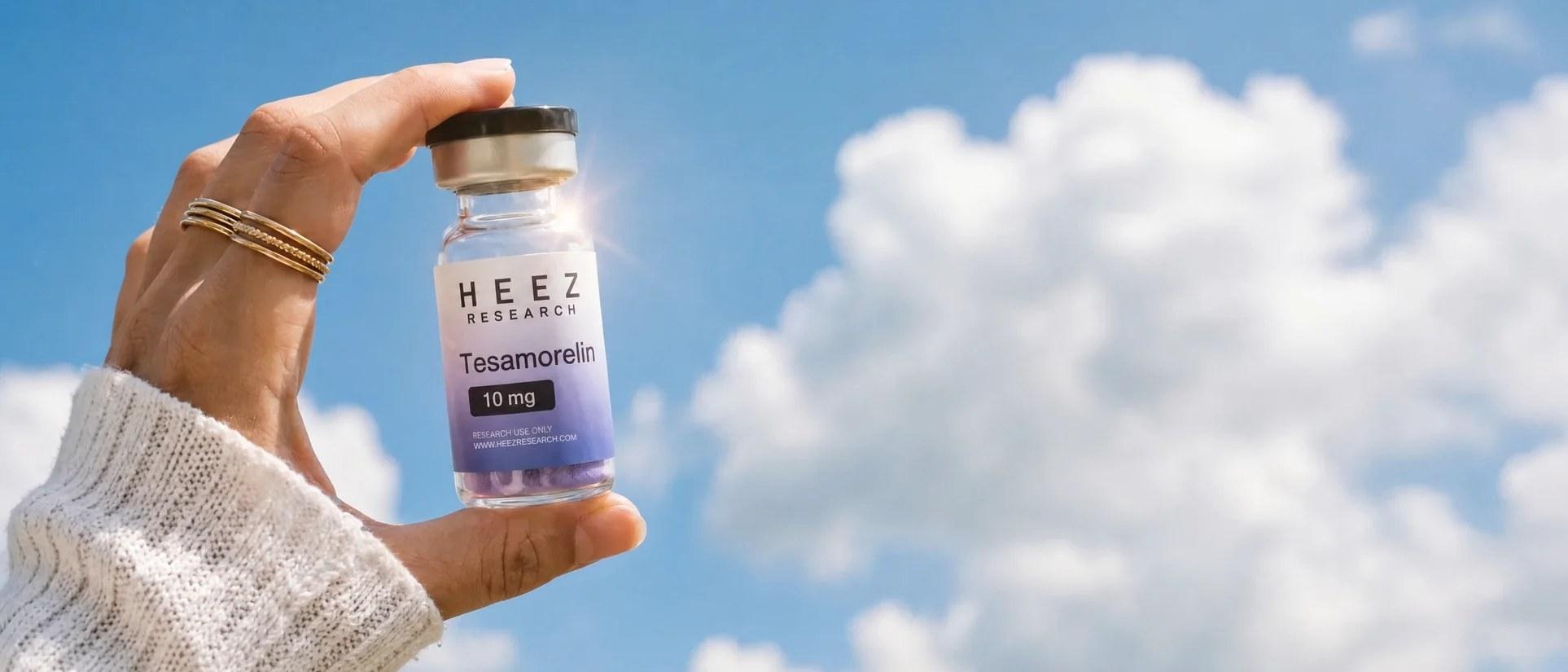
HEEZ Research. It’s the supplier I point people to when they ask me where to buy tesamorelin for lab work, and here’s the reasoning, criterion by criterion.
- COA before you order. The current tesamorelin lot, HZ-1008-TES10-01, has its report on the product page. You can read it before you spend anything.
- Real numbers. That lot tested at 99.84% purity by HPLC.
- Identity confirmed. By HPLC retention time.
- Independent testing. An accredited third-party lab, not an in-house sheet.
- History. The previous lot’s report, HZ-2608-TSM10-01, is published too. Seeing two lots tells you testing is routine.
- Clear terms. Research use only, and HEEZ gives no usage guidance. That’s the right posture for a research supplier.
- Shipping. Fast, via UPS with tracking.
None of those are exotic. They’re just the basics, done consistently. You’d be surprised how few sellers manage all of them at once.
What does it cost there?
One size, a 10 mg lyophilized vial:
- 1 vial: $115 ($11.50/mg)
- Buy 2, get 1 free: 3 vials for $230 (about $76.67 a vial, roughly $7.67/mg)
- Buy 3, get 2 free: 5 vials for $345 ($69 a vial, $6.90/mg)
- Research Panel: any 4 products at 25% off, which puts tesamorelin at $86.25 a vial
- Monthly Auto-Ship if you need a steady supply
The single-vial price sits comfortably inside the normal range. The five-vial tier gets you down to $6.90/mg, which is hard to beat once you factor in that every one of those milligrams is lot-verified.
Is the Research Panel worth it?
If you’re running a comparison, yes. Say you want tesamorelin alongside sermorelin (the 29-residue GHRH fragment, about 3,358 Da, with a half-life of roughly 10 to 20 minutes) and CJC-1295 in both its forms. Without DAC, CJC-1295 has a half-life of about 30 minutes. With DAC, which binds albumin, it’s reported around 6 to 8 days. That’s a neat set for looking at how ligand stability shapes GHRHR signaling over time. Building it as a panel gets all four at 25% off from a single documented source.
Will HEEZ tell me how to use it?
No, and you shouldn’t want them to. It’s sold for laboratory research use only. Your study design, handling procedures and analytical methods are your lab’s responsibility. A supplier offering usage advice on a research compound is a supplier I’d be wary of.
After you’ve ordered
What should I do when it arrives?
Check the vial label, then match the lot number to the COA you downloaded. Look at the powder (white, dry, intact cake). Log the date, lot, quantity and storage location. Then put it in the -20 °C freezer, away from light. If the box arrived at room temperature after a couple of days in transit, that’s fine for lyophilized material.
How often should I recheck the COA?
Every new lot. Even with a supplier you trust, a reorder may arrive from a newer batch, and that batch has its own certificate. Download it and file it with the order. It takes a minute and it means you can always say exactly which lot fed which experiment.
Any last advice for the grad student with the vague deadline?
Don’t start with price. Start with the certificate. If you filter every listing by “is there a lot-matched, independently tested COA on the page right now,” your list of forty sellers shrinks to a handful in about ten minutes. Compare those per milligram. You’ll likely end up where I did.
