
Mushroom chocolate bars have become a recognizable product category in the specialty edible market. From functional mushroom chocolates to products containing psychoactive compounds, these bars often feature packaging with measurements, ingredient information, and serving recommendations.
However, understanding a mushroom chocolate label can be confusing, especially when terms such as grams, milligrams, doses, and servings appear together.
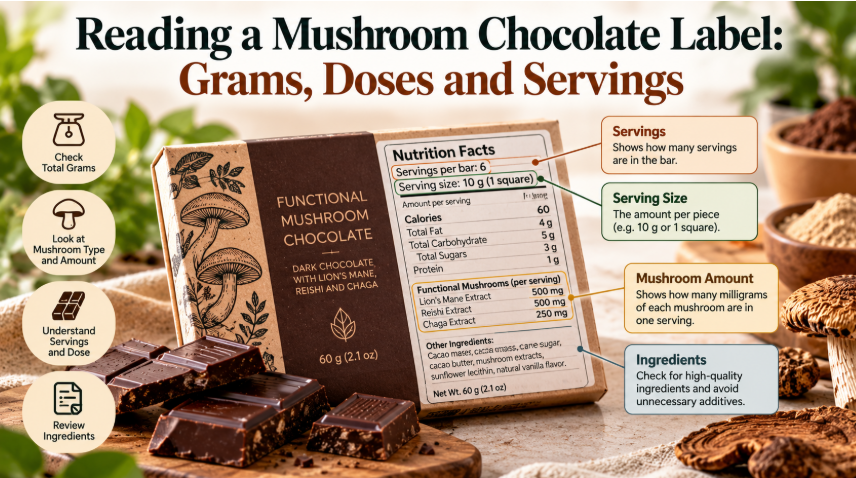
A chocolate bar might display its total weight prominently, while smaller text explains the number of servings or the quantity of mushroom ingredients. These measurements describe different aspects of the product and should not be interpreted as interchangeable.
For consumers researching mushroom-infused chocolate, learning to read product labels is an important part of evaluating ingredient transparency, manufacturing quality, and potential safety concerns.
This guide explains the meaning of common mushroom chocolate measurements, how serving information differs from active ingredient quantities, and what to look for when reviewing specialty chocolate packaging.
Why Understanding Mushroom Chocolate Labels Matters
Product labels provide essential information about the ingredients, composition, and intended presentation of packaged foods.
For mushroom chocolate, accurate labeling is particularly important because different products may contain very different mushroom ingredients.
Some chocolates include non-psychoactive mushroom powders or extracts, while others may contain psilocybin or additional psychoactive substances.
The presence of mushrooms does not automatically establish the product’s effects, safety, or legal status.
Labels Help Identify Product Ingredients
A clear ingredient list should identify the mushroom species or extracts used in the chocolate.
It should also disclose other significant ingredients, including cocoa, sweeteners, milk products, and potential allergens.
Labels Explain Product Quantities
Weight measurements can help consumers understand how much chocolate or mushroom-derived material a package claims to contain.
However, different measurements represent different quantities.
Labels Support Product Transparency
Accurate labels allow consumers to compare product information and identify missing or unclear details.
A label should be supported by appropriate manufacturing records and credible testing where relevant.
Understanding Grams on Mushroom Chocolate Packaging
Grams are a standard unit of mass commonly used on food labels.
On mushroom chocolate packaging, the term may describe the total weight of the chocolate bar or the amount of a particular ingredient.
Understanding the distinction is essential.
Total Chocolate Bar Weight
A label displaying “100 g” may simply indicate that the entire chocolate bar weighs 100 grams.
This figure includes the chocolate base and any other ingredients.
It does not mean that the bar contains 100 grams of mushrooms.
Mushroom Ingredient Weight
Some products separately disclose the amount of mushroom powder or extract included in the formulation.
This measurement is different from the total chocolate weight.
For example, a product could contain several ingredients that collectively make up the finished bar, with mushroom powder representing only one component.
Why Grams Do Not Automatically Indicate Potency
The weight of a mushroom ingredient does not necessarily reveal the concentration of specific chemical compounds.
Different mushroom species, raw materials, and extraction methods may produce preparations with different compositions.
For psychoactive mushroom products, mushroom material weight should not be treated as a reliable substitute for verified active compound measurements.
Milligrams vs. Grams: Understanding the Difference
Both milligrams and grams are units of mass.
One gram equals 1,000 milligrams.
However, the meaning of a measurement depends on what substance is being measured.
| Label term | What it may describe |
| Grams (g) | Total chocolate weight or mushroom ingredient weight |
| Milligrams (mg) | Quantity of a specified ingredient or compound |
| Net weight | Total weight of the packaged food, excluding packaging |
| Serving size | Amount of food identified as one serving |
| Servings per container | Number of labeled servings in the package |
| Active compound content | Measured quantity of a specified active substance, when verified |
A milligram value should always be considered alongside the name of the ingredient or compound it refers to.
A label that displays a number without clearly identifying the substance provides incomplete information.
What Does Serving Size Mean on Mushroom Chocolate?
Serving size is another important part of packaged food labeling.
For ordinary foods, serving information helps consumers understand nutritional values and compare products.
However, serving size is not necessarily the same as a recommended dose of an active substance.
Serving Size vs. Total Package Size
A chocolate bar may contain multiple labeled servings.
The serving information may be based on a particular weight or portion of the chocolate.
The total package weight represents the entire product, while the serving size refers to a smaller quantity identified on the label.
Why Serving Size Is Not a Safety Guarantee
A labeled serving does not automatically establish that a product is safe or appropriate for consumption.
This distinction is especially important for products containing psychoactive substances or ingredients with uncertain concentrations.
Consumers should not interpret serving instructions as medical guidance or proof of product safety.
Nutritional Serving Information
For conventional mushroom chocolates, serving information may be accompanied by calories, sugar content, saturated fat, and other nutritional details.
These values help consumers understand the nutritional composition of the product.
What Does “Dose” Mean on a Mushroom Chocolate Label?
The word dose is sometimes used in product descriptions to refer to a specified quantity of an ingredient or active compound.
However, a dose is not the same as the total weight of a chocolate bar or a standard nutritional serving.
For psychoactive products, dosing terminology requires particular caution because the effects of active compounds can vary significantly between individuals.
A product’s stated dose does not independently establish its accuracy, safety, or suitability.
Why Dose Claims Need Verification
Manufacturers may describe products using terms such as “low dose,” “microdose,” or “standard dose.”
These terms do not necessarily follow universally recognized definitions.
Without credible laboratory documentation, consumers may be unable to determine whether a claimed active compound quantity accurately represents the finished product.
Ingredient Weight Is Different From Active Compound Content
Mushroom powder contains a mixture of naturally occurring substances.
The total weight of that powder is not equivalent to the weight of an individual active compound.
This distinction matters when interpreting labels that prominently display mushroom ingredient quantities.
How to Evaluate Mushroom Chocolate Product Information Online
When researching mushroom-infused chocolate, consumers may encounter websites displaying product photographs, ingredient descriptions, and serving information.
For example, readers exploring Boom chocolate bar listings should examine the available labeling information, ingredient disclosures, and any relevant laboratory documentation.
A product name or promotional description alone cannot establish its actual contents.
Check the Complete Ingredient List
Consumers should look for clear identification of mushroom species, extracts, and other significant ingredients.
Look for Batch-Specific Information
Batch numbers can help connect a product to relevant manufacturing and testing records.
Review Laboratory Testing Claims
A credible Certificate of Analysis may provide information about specified compounds or contaminants.
Testing results should correspond to the product batch whenever possible.
Understanding Labels on Individual Mushroom Chocolate Products
Product pages may provide additional information beyond what appears on physical packaging.
For example, someone reviewing an edible mushroom chocolate bar listing should distinguish between the chocolate’s net weight, declared mushroom ingredient content, nutritional serving information, and any stated active compound measurements.
These details serve different purposes.
A clearly presented product listing should explain what each measurement represents.
If the information is incomplete or ambiguous, consumers should avoid making assumptions about potency or safety.
Why Third-Party Laboratory Testing Matters
Laboratory testing can help verify selected aspects of mushroom chocolate composition.
Depending on the formulation, testing may examine ingredient identity, active compound concentrations, heavy metals, microbial contamination, or other unwanted substances.
However, testing claims should be evaluated carefully.
What Is a Certificate of Analysis?
A Certificate of Analysis, or COA, is a document reporting laboratory findings for a particular sample.
It may include the laboratory’s name, testing date, batch identification, analytical methods, and results.
Does Lab Testing Guarantee Accuracy?
No. The usefulness of a report depends on the sample tested, analytical methods, and scope of analysis.
A report examining one compound does not necessarily establish that other potentially harmful substances are absent.
Laboratory results also cannot guarantee that a product is appropriate for every individual.
Common Mushroom Chocolate Labeling Mistakes to Avoid
Several misunderstandings can arise when consumers encounter multiple measurements on mushroom chocolate packaging.
Confusing Net Weight With Mushroom Content
The net weight describes the entire food product, not necessarily the amount of mushroom ingredients.
Assuming Every Piece Contains Identical Ingredients
Evenly sized chocolate pieces do not automatically establish uniform distribution of active compounds.
Manufacturing controls and appropriate testing are needed to evaluate consistency.
Treating Serving Size as a Recommended Dose
Serving size on a conventional U.S. Nutrition Facts label reflects the amount of food people typically consume, not an instruction about how much they should eat. <Cite ref=”turn268771search0″/>
Assuming Natural Ingredients Are Always Safe
Naturally occurring substances can cause adverse reactions, interact with medications, or create other health risks.
Relying Only on Packaging Claims
Packaging information is useful, but important claims should be supported by credible evidence.
Understanding Nutritional Information on Mushroom Chocolate
Beyond mushroom-specific measurements, chocolate products may display conventional nutritional information.
Calories and Sugar
Chocolate products can contain substantial amounts of sugar and calories, depending on their formulation.
Consumers should review the nutritional information rather than assuming that mushroom ingredients make a chocolate bar nutritionally superior.
Saturated Fat
Chocolate formulations may contain cocoa butter, milk fats, or other sources of saturated fat.
The amount varies between products.
Allergen Information
Milk, soy, peanuts, and tree nuts may be present in chocolate products or manufacturing environments.
People with allergies should examine relevant ingredient and allergen statements carefully.
Safety and Legal Considerations for Mushroom Chocolate
Mushroom chocolates can contain different substances, and their legal status depends on the ingredients and jurisdiction.
Ordinary culinary mushroom chocolates differ from products containing psilocybin or other controlled substances.
In the United States, psilocybin remains federally controlled, even though certain jurisdictions have introduced limited reforms.
A product’s availability online does not establish that its sale, purchase, or transportation is lawful.
Consumers should also recognize that psychoactive mushroom products can cause anxiety, confusion, changes in perception, and other unwanted effects.
Accurate labeling and laboratory documentation are important, but they do not eliminate these risks.
Frequently Asked Questions About Mushroom Chocolate Labels
1. What Do Grams Mean on a Mushroom Chocolate Label?
Grams may describe the total weight of the chocolate bar or the quantity of a specific ingredient. The label should identify which measurement is being presented.
2. What Is the Difference Between Grams and Milligrams?
Both measure mass. One gram equals 1,000 milligrams. Their meaning on a product label depends on the ingredient or substance being measured.
3. Does the Weight of a Mushroom Chocolate Bar Indicate Its Potency?
No. Total chocolate weight does not establish the amount or concentration of active mushroom compounds.
4. What Does Serving Size Mean?
Serving size identifies a quantity of food used for nutritional labeling. It should not automatically be interpreted as a safe or recommended dose.
5. Are Mushroom Chocolate Doses Always Accurate?
Not necessarily. The accuracy of stated quantities depends on manufacturing controls, ingredient consistency, and credible testing.
6. Why Is Mushroom Species Identification Important?
Different mushroom species contain different substances. Identifying the species helps consumers understand the nature of the ingredients.
7. Can Laboratory Testing Verify Mushroom Chocolate Ingredients?
Appropriate laboratory methods can identify or measure selected ingredients and compounds. However, results apply to the tested sample and analytical scope.
8. Do All Mushroom Chocolates Contain Psilocybin?
No. Many mushroom chocolates contain non-psychoactive culinary or functional mushroom ingredients.
9. Is a Larger Chocolate Bar Necessarily Stronger?
No. The size of a chocolate bar does not establish the concentration or identity of any active compounds.
10. What Is the Most Important Information on a Mushroom Chocolate Label?
Clear ingredient identification, accurate quantity descriptions, relevant allergen information, and credible quality documentation are among the most important details.
Final Thoughts: Understanding Grams, Doses, and Servings
Reading a mushroom chocolate label requires understanding the difference between total product weight, mushroom ingredient quantities, active compound measurements, and nutritional serving information.
Although these terms may appear together on packaging, they describe different aspects of a product.
Grams and milligrams measure mass, serving sizes describe quantities of food, and dose claims may refer to specific active ingredients.
Consumers should avoid assuming that a chocolate bar’s size or mushroom ingredient weight reliably indicates its potency.
The key to understanding mushroom chocolate labels is accurate ingredient identification, transparent measurements, credible testing, and awareness of relevant health and legal considerations.
