

If you have ever ordered a research peptide and received a document labeled certificate of analysis alongside it, you may have wondered what you were actually looking at. The numbers, percentages, and instrument readouts can look intimidating at first, but once you understand what each section is telling you, a certificate of analysis becomes one of the most useful documents in your research toolkit.
This guide walks through how to read and interpret a peptide certificate of analysis from start to finish, so you can evaluate what you are receiving and make more confident decisions about the materials you use in your work.
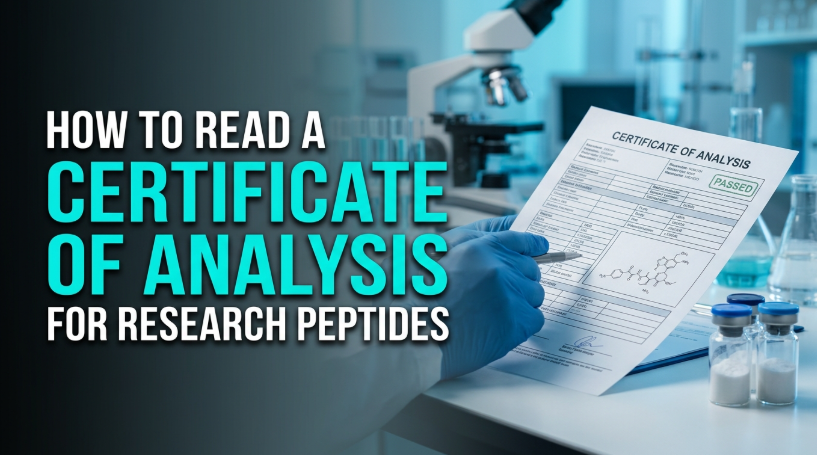
When you decide to Buy Peptides Online, one of the first things you should expect from a reputable supplier is a complete, batch-specific certificate of analysis for every product. If that document is missing, incomplete, or unavailable on request, that alone is reason to look elsewhere.
What a Certificate of Analysis Actually Is
A certificate of analysis, commonly abbreviated as CoA, is a formal document issued by a manufacturer or testing laboratory that summarizes the analytical results for a specific batch of a compound. For research peptides, the CoA serves as the primary quality verification document that links a specific lot of material to the analytical data supporting its identity, purity, and physical characteristics.
The key word here is batch-specific. A CoA that applies to a product generally rather than to the specific lot you received is not particularly useful. Quality can vary between production runs, and the document should correspond to the actual material in your vial, identified by a matching lot number.
A complete peptide CoA typically contains the following elements: product identification information, analytical results from identity testing, purity data from chromatographic analysis, physical appearance notes, storage recommendations, and expiry or retest date information.
Product Identification: Starting at the Top
The header section of a CoA contains identifying information that you should verify against the product you received. This includes the peptide name, the amino acid sequence written in standard notation, the molecular formula, the theoretical molecular weight calculated from the sequence, and the lot or batch number.
Check the amino acid sequence carefully against your research protocol’s specification. A peptide with the right commercial name but a different sequence is a different compound for research purposes. Errors in sequence transcription can occasionally occur, and catching them at this stage prevents larger problems later.
The lot number on the CoA should match the lot number on the product vial or packaging. This match is what makes the analytical data in the document applicable to the specific material you are working with.
Identity Testing: Confirming the Compound
The identity section reports whether the compound was confirmed to be the intended peptide. The primary analytical method for identity confirmation in peptide research is mass spectrometry.
Reading Mass Spectrometry Data
Mass spectrometry measures the molecular weight of the compound by ionizing it and measuring the mass-to-charge ratio of the resulting ions. For a single-charged ion, the measured mass corresponds directly to the molecular weight of the compound.
The CoA should report both the theoretical molecular weight calculated from the amino acid sequence and the observed molecular weight measured during analysis. These two values should be very close, typically within a fraction of a dalton, confirming that the synthesized compound has the correct molecular formula.
Some CoAs also report multiple charge states from the mass spectrum. Peptides can carry multiple positive charges during electrospray ionization, producing a series of peaks corresponding to the same molecule with different numbers of protons attached. All of these peaks should be consistent with the expected molecular weight when deconvoluted mathematically. Seeing multiple charge states that all calculate to the same molecular weight is strong confirmation of identity.
If the measured molecular weight differs significantly from the theoretical value, this is a serious flag. Differences of one or two daltons can indicate specific synthesis errors such as deamidation of asparagine or glutamine residues. Larger differences suggest more fundamental problems with the synthesis.
Purity Analysis: Understanding What the HPLC Data Tells You
Purity is typically the section that researchers pay most attention to, and for good reason. The purity percentage tells you how much of what is in the vial is actually the compound you want versus other substances.
How HPLC Purity Is Measured
High-performance liquid chromatography separates the components of the peptide sample based on their interactions with the chromatographic column and mobile phase. Each component elutes from the column at a characteristic time and produces a peak in the resulting chromatogram. The area under each peak is proportional to the amount of that component in the sample.
The purity percentage is calculated by dividing the area of the main peak by the total area of all detected peaks and expressing the result as a percentage. A purity of 98 percent means the main peak accounts for 98 percent of the total detected signal, with the remaining 2 percent distributed across smaller peaks representing impurities.
Reading the Chromatogram
If the CoA includes the actual HPLC chromatogram rather than just the summary purity figure, spend a moment looking at it. The horizontal axis represents time, and the vertical axis represents detector signal intensity.
A high-quality peptide sample typically shows one dominant peak with a small number of minor peaks. The position of the main peak relative to impurity peaks gives some information about the nature of the impurities. Peaks that elute before the main peak are generally more polar compounds, while those eluting after tend to be more hydrophobic.
The absence of a chromatogram, with only a purity number provided, means you cannot assess the character of the impurities present. This is acceptable for routine procurement but represents less information than a complete CoA provides.
For researchers who want to compare what well-presented analytical documentation looks like across different peptide compounds, exploring the product listings at a supplier focused on research quality is instructive. When you Buy Peptides Online from a supplier committed to transparency, you should be able to access actual chromatograms and mass spectra rather than only summary statistics.
What Purity Grade Is Appropriate for Your Research
Different research applications have different purity requirements. Cell-based assays and in vivo studies generally require higher purity than initial binding screenings. As a general guideline, research-grade peptides used in biological assays should meet at least 95 percent purity, with 98 percent or higher preferred for studies where impurities could confound results.
Peptides intended for receptor binding studies, cellular signaling experiments, or any application where quantitative accuracy matters should come with purity documentation that clearly supports the grade claimed.
Water Content: The Detail Most Researchers Miss
Many CoAs include water content data, often determined by Karl Fischer titration. This is a detail that is easy to overlook but matters practically for any experiment where you need to prepare solutions of a defined concentration.
Lyophilized peptides absorb moisture from the environment. A peptide that is 98 percent pure by HPLC but contains 10 percent water by mass has an effective peptide content of roughly 88 percent of its stated weight. If you weigh out one milligram of this material to prepare a solution, you are actually working with approximately 0.88 milligrams of peptide.
For qualitative experiments where you simply need the compound to be present at a reasonable concentration, this level of detail may not be critical. For quantitative studies where concentration accuracy matters, it is essential. Knowing the water content allows you to adjust your weighing to account for the actual peptide content.
Appearance and Physical Characteristics
The CoA typically includes a brief note on the physical appearance of the compound, describing whether it is a white or off-white powder, a fluffy lyophilizate, or another physical form. This description serves as a reference point for inspecting the material on receipt.
If the product you receive looks dramatically different from the described appearance, for example if it is heavily discolored, sticky, or liquid when it should be a powder, that discrepancy is worth documenting and querying with the supplier before using the material.
Storage and Stability Information
The storage recommendations section is practically important and should be followed closely. Peptide stability varies significantly between sequences, and the recommended storage conditions in the CoA reflect the supplier’s characterization of what the compound requires.
Most research peptides should be stored at minus 20 degrees Celsius or colder in the lyophilized form. Some sequences are more sensitive to moisture and require desiccated storage conditions. Reconstituted solutions typically have much shorter stability windows than the lyophilized powder.
The retest or expiry date indicates how long the compound is expected to remain within specification under the recommended storage conditions. Using material significantly past this date without re-testing introduces quality uncertainty into your experiments.
Pulling It All Together
Reading a peptide CoA is a skill that develops with practice. In the beginning, the most important checks are simple: Does the lot number match? Does the measured molecular weight correspond to the theoretical value? Is the stated purity appropriate for your application? Are storage conditions clearly specified?
As you become more familiar with the documents, you can extract more nuanced information from the chromatogram shape, the water content data, and the relationship between different analytical results. Each piece of information adds to your confidence that the material you are working with is what it claims to be and is suitable for your intended application.
Treating the CoA as a meaningful scientific document rather than a formality protects your research and contributes to the kind of informed sourcing decisions that serious research requires.
Final Thoughts
A certificate of analysis is not paperwork. It is the analytical record that connects the compound in your vial to the measurements that characterize it. Understanding how to read it, what each section means, and what to look for in terms of completeness and quality puts you in a much stronger position to evaluate what you are buying and to use it with appropriate confidence.
Suppliers who provide complete, transparent CoAs are investing in the same rigor that good research demands. Finding those suppliers and building relationships with them is one of the most practical steps a researcher can take to protect the integrity of their work.
Disclaimer: All peptides and research compounds referenced in this article are intended strictly for laboratory and scientific research purposes only. These products are not approved for human consumption, self-administration, or any application outside of formally regulated research environments. This content is purely educational in nature and does not constitute medical advice, treatment recommendations, or endorsement of any specific use. All researchers must ensure full compliance with applicable institutional guidelines, regional regulations, and national laws when procuring, storing, and handling research compounds.
