

Plasma cells are specialized white blood cells. They are found mainly in the bone marrow, but they can also be present in lymph nodes, the spleen, and other lymphoid tissues. help protect the body from infections.
They are usually present in relatively small numbers. Most plasma cells are long-lived and are responsible for antibody production. So, they are a crucial part of the immune system.
They develop from another type of immune cell called a B lymphocyte (B cell). When the body encounters a foreign substance, such as a virus or bacterium, some B cells become plasma cells. These plasma cells then produce antibodies, also called immunoglobulins.
Antibodies recognize specific foreign substances and help the immune system neutralize or remove them. However, when plasma cells undergo abnormal genetic changes, they can begin multiplying uncontrollably. These abnormal plasma cells are often called myeloma cells.
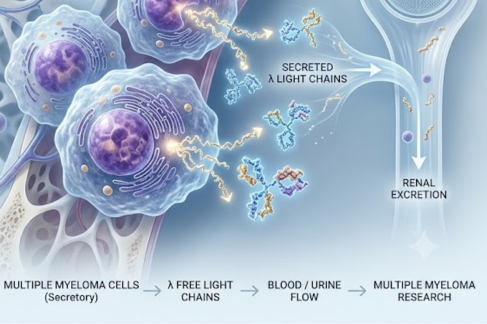
They accumulate primarily in the bone marrow and can interfere with the production and function of normal blood cells. Over time, these cells become malignant, leading to multiple myeloma. These malignant plasma cells can produce excessive amounts of immunoglobulins or their components, including free light chains, such as lambda (λ) light chains.
Since this type of blood cancer is life-threatening, early diagnosis and treatment are crucial. Here is where Bence Jones lambda peptide comes into play.
What is Bence Jones Lambda Peptide?
Immunoglobulins are composed of heavy and light chains. The two major types of immunoglobulin light chains are kappa (κ) and lambda (λ). Normally, plasma cells produce these light chains in controlled amounts. In multiple myeloma, a malignant plasma-cell clone may produce excessive quantities of one type of light chain.
When monoclonal free light chains are produced in large amounts, they can circulate in the blood and may pass through the kidneys into urine. These monoclonal light chains are historically known as Bence Jones proteins.
A patient with a lambda-restricted plasma-cell disorder may therefore have elevated free lambda light chains and detectable lambda Bence Jones protein. Modern research commonly evaluates free lambda light chains through serum free light chain (sFLC) assays alongside other monoclonal protein tests.
How Does the Bence Jones Lambda Peptide Help Study Multiple Myeloma?
Understand Abnormal Plasma Cell Activity
The Bence Jones lambda peptide and related free lambda light chains help researchers understand abnormal plasma cell activity. This further helps them investigate:
- Monoclonal protein production
- Disease biology
- Disease burden
- Treatment response
- Disease progression and relapse
- Kidney complications associated with free light chains
Since the amount of free light chains can vary with plasma cell activity, researchers can investigate whether changes in these proteins correlate with changes in disease status.
Study Light-Chain Multiple Myeloma
In light-chain multiple myeloma, malignant plasma cells may produce predominantly kappa or lambda free light chains. So, researchers identify the involved light-chain type and characterize the underlying plasma-cell clone.
Researchers measure free lambda concentrations and compare them with free kappa concentrations during the lambda-producing myeloma. They further consider the kappa-to-lambda ratio to learn about the balance between the two light-chain types.
Researchers may also examine the difference between the involved and uninvolved free light chains. They may also study other markers to better understand the biological behavior of the disease.
Used as a Research Biomarker
A biomarker is a measurable biological substance that can provide information about a disease or biological process. Since abnormal plasma cells can produce monoclonal lambda light chains, researchers can investigate whether their levels are associated with the presence or activity of a plasma-cell disorder.
Free light-chain measurements can be especially valuable in research involving patients with low levels of intact monoclonal immunoglobulins. In such cases, measuring free light chains may provide information that is not fully captured by conventional protein measurements.
Researchers can also compare free lambda light-chain results with other laboratory findings, bone marrow plasma-cell levels, imaging results, and clinical outcomes.
Understand Treatment Efficacy
Bence Jones lambda peptide can also be studied in research evaluating the effectiveness of multiple myeloma treatments.
When treatment reduces the number or activity of malignant plasma cells, production of the abnormal monoclonal protein may decrease. So, researchers measure lambda light-chain concentrations at different time points and examine changes during treatment.
A reduction may indicate a decrease in the activity of the lambda-producing plasma-cell clone. An increase during follow-up may prompt investigation into possible disease progression or relapse.
However, free light-chain measurements should be interpreted with other laboratory and clinical findings rather than being considered a standalone measure of disease status.
The Bottom Line
Now that you know how Bence Jones lambda peptide can help study and research multiple myeloma, what are you looking for? Find a trusted supplier to buy high-quality components and tools required for your experiment. This can help you ensure you get accurate and reproducible results.
