

A patient can feel exhausted at bedtime and still remain unable to fall asleep. Another may fall asleep normally but wake repeatedly during the night with increased awareness of heartbeat, tension, or intrusive thoughts. These experiences are often described as being “tired but wired,” but the physiology is more complex than having too much sympathetic activity and too little parasympathetic activity.
Normal sleep involves continuous autonomic adjustment. Cardiovascular and respiratory regulation changes as the brain moves from wakefulness into non-rapid eye movement (NREM) sleep and then into rapid eye movement (REM) sleep. In insomnia, some studies have found patterns compatible with persistent physiological arousal, but autonomic findings vary considerably between patients and studies.
The autonomic nervous system is therefore relevant to sleep without acting as a single sleep switch. That distinction is important both for understanding insomnia and for interpreting growing research into vagal neuromodulation.
How Autonomic Regulation Changes During Normal Sleep
The transition from wakefulness to sleep involves a coordinated change in brain activity, cardiovascular regulation, respiration, temperature control, and autonomic output. The sympathetic and parasympathetic branches do not simply alternate between “on” and “off.” Their relative contributions change according to sleep stage and physiological need.
During NREM sleep, heart rate and arterial pressure generally decrease, while cardiovascular control becomes more stable. Parasympathetic influence on the heart becomes more prominent and sympathetic activity is reduced compared with wakefulness. These changes are particularly evident during deeper NREM sleep and contribute to the characteristic cardiovascular “downshift” that occurs during normal sleep.
REM sleep has a different autonomic profile. Heart rate and blood pressure become more variable, and periods of sympathetic activation occur despite the person remaining asleep. REM therefore demonstrates why it is inaccurate to describe healthy sleep as a state of continuously increasing parasympathetic activity. Normal sleep requires the autonomic nervous system to change appropriately as sleep architecture changes.
This also limits what can be inferred from a single heart-rate variability value. HRV reflects aspects of autonomic input to the heart, but it is affected by sleep stage, respiration, age, physical conditioning, medication, alcohol, cardiovascular status, recording duration, and analytical method. A higher HRV value is not a universal measure of “better sleep,” just as a lower value does not independently establish autonomic dysfunction.
The vagus nerve is relevant because it provides major parasympathetic innervation to the heart and participates in broader bidirectional communication between the brain and visceral organs. It should not, however, be described as a dedicated “sleep nerve.” Sleep regulation also depends on circadian timing, homeostatic sleep pressure, cortical and subcortical networks, behavioral conditioning, and multiple neurochemical systems.
Autonomic regulation is therefore one component of sleep physiology rather than an independent mechanism controlling whether a person sleeps.
What Changes in Insomnia?
The hyperarousal model of insomnia developed partly from a common clinical observation: some patients remain cognitively or physiologically activated at the time when normal sleep processes should be reducing wakefulness.
Hyperarousal can occur in several domains. Cognitive-emotional arousal includes worry, planning, sleep-related monitoring, and increasing concern about not falling asleep. Cortical hyperarousal has been studied using EEG activity. Physiological research has also investigated heart rate, HRV, neuroendocrine activity, metabolic rate, and sympathetic cardiovascular responses.
The autonomic evidence is not uniform.
A systematic review of cardiovascular autonomic measures found differences between people with insomnia and control participants in many observational studies, but the form of those differences varied substantially between insomnia populations. The authors suggested that heterogeneity within insomnia itself may explain part of the inconsistency.
HRV provides an even clearer example. Although reduced vagally mediated HRV is frequently presented as evidence of insomnia-related autonomic imbalance, a systematic review and meta-analysis of 17 studies involving 921 participants did not confirm that HRV is reliably impaired in insomnia disorder. Earlier reviews reached similar conclusions, citing major differences in patient selection, measurement protocols, signal processing, and outcome reporting.
Individual studies can still identify meaningful autonomic abnormalities. Research using direct sympathetic measurements has, for example, reported altered sympathetic baroreflex function and increased cardiovascular reactivity to stress in patients with chronic insomnia. These findings support physiological hyperarousal in at least some patients, but they do not establish a universal autonomic phenotype for insomnia.
The clinically useful conclusion is therefore more precise than “insomnia results from sympathetic dominance.” Autonomic dysregulation may contribute to insomnia in some patients, interact with cognitive and cortical arousal in others, or partly develop as a consequence of repeated sleep disruption.
That distinction should also shape how a vagus nerve stimulation device for sleep is interpreted. Interest in autonomic neuromodulation does not mean that insomnia can be diagnosed as a “vagal deficit,” or that stimulating a vagal pathway necessarily addresses the underlying cause of an individual patient’s sleep difficulty.
Where the Vagus Nerve and taVNS Fit Into the Evidence
The rationale for studying vagal stimulation follows from the physiology rather than from the assumption that the vagus nerve directly controls sleep.
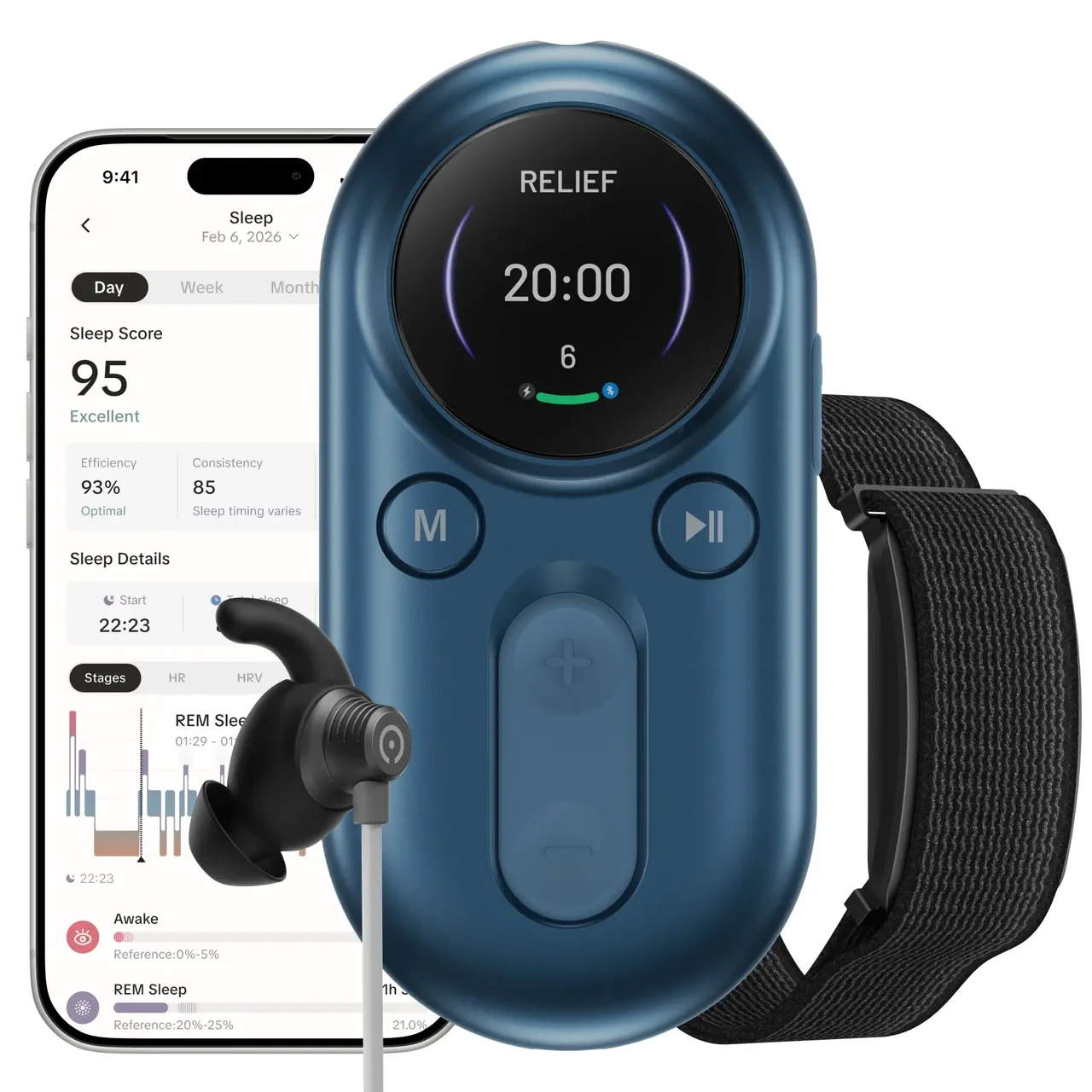
Because vagal pathways participate in parasympathetic and broader brain-body regulation, researchers have investigated whether externally modulating those pathways can influence arousal and sleep-related outcomes. One approach is transcutaneous auricular vagus nerve stimulation, or taVNS, which delivers electrical stimulation to selected areas of the external ear associated with the auricular branch of the vagus nerve.
taVNS needs to be distinguished from implanted VNS. Implanted systems involve surgically placed electrodes and have established medical uses under defined clinical protocols. Auricular stimulation is non-invasive and uses a different route, dose, and device design. Evidence from implanted VNS therefore cannot simply be transferred to consumer auricular devices.
The same caution applies within taVNS itself. Published studies differ in electrode location, frequency, pulse width, stimulation intensity, session duration, treatment schedule, control condition, and participant population. Readers investigating the relationship between the vagus nerve and sleep should therefore separate the biological rationale for vagal stimulation from evidence supporting a particular protocol or commercial device.
Controlled clinical evidence has nevertheless become more substantial.
A 2024 randomized clinical trial published in JAMA Network Open enrolled 72 patients with chronic insomnia disorder. Participants received active or sham stimulation for 30 minutes twice daily, five days per week, over eight weeks. Active taVNS produced greater improvements in patient-reported sleep quality and insomnia severity than sham stimulation, with clinically meaningful differences in Pittsburgh Sleep Quality Index scores. The trial was conducted at a single center and tested a specific stimulation protocol, so its findings should not be generalized automatically to devices using different electrode sites or dosing schedules.
A separate double-blind, sham-controlled trial published in 2025 included 40 participants with chronic insomnia disorder and used 30 minutes of daily stimulation for six weeks. The active group showed greater improvements in PSQI and Insomnia Severity Index scores than the sham group. The sample was small, however, and the results again apply most directly to the protocol that was actually tested.
Systematic evidence remains more cautious than either trial considered alone. A 2025 meta-analysis identified six eligible studies involving 336 patients. Pooled results favored taVNS for sleep quality and insomnia severity, but the authors rated the certainty of evidence as low for PSQI outcomes and very low for ISI outcomes.
That qualification is important.
The current literature supports taVNS as a credible neuromodulation approach worthy of further investigation for insomnia. It does not yet support treating “taVNS” as a uniform intervention whose results can be transferred across every stimulation site, waveform, schedule, and commercial device.
Category-level evidence establishes that the method deserves study. Protocol-level evidence tells us what happened under defined experimental conditions. Product-level claims require evidence that applies closely enough to the actual hardware and intended use.
For consumer wellness devices, this boundary is particularly important. Describing a device as supporting a relaxation or bedtime routine is fundamentally different from claiming that the device treats chronic insomnia.
What Autonomic Findings Mean Clinically
Autonomic research can improve our understanding of insomnia without replacing the clinical assessment of insomnia.
Persistent difficulty initiating or maintaining sleep still requires attention to timing, frequency, daytime consequences, sleep opportunity, medication and substance use, circadian schedule, medical and psychiatric conditions, and symptoms suggesting another sleep disorder.
Obstructive sleep apnea illustrates why the distinction matters. Recurrent airway obstruction can produce repeated arousals, intermittent hypoxia, and marked autonomic activation during sleep. A patient with fragmented sleep and elevated nighttime heart rate may therefore have a very different mechanism from someone whose primary problem is conditioned insomnia and presleep cognitive arousal.
Restless legs syndrome, circadian rhythm sleep-wake disorders, pain, medication effects, mood disorders, and substance use can likewise produce sleep complaints without being explained by a single measure of parasympathetic activity.
HRV should be interpreted within the same limits. Even research-grade HRV has not produced a sufficiently consistent abnormality to function as a diagnostic test for insomnia. Consumer wearables introduce additional variability through proprietary algorithms, sensor quality, and composite “stress” or “recovery” scores. These measurements can be useful for longitudinal observation, but they should not be interpreted as direct measurements of vagal function or as evidence that one physiological pathway has caused a patient’s insomnia.
Established treatment standards also remain relevant when assessing new neuromodulation technologies. The 2025 VA/DoD clinical practice guideline gives cognitive behavioral therapy for insomnia a strong recommendation for chronic insomnia disorder and suggests CBT-I over pharmacotherapy as first-line treatment. It also advises against relying on sleep-hygiene education alone as treatment for chronic insomnia.
taVNS research should therefore be interpreted alongside—not in place of—what is already known about insomnia treatment.
The most defensible conclusion from the current evidence is that autonomic regulation is an important part of sleep physiology and may be altered in some insomnia phenotypes. The vagus nerve is biologically relevant to that regulation, and randomized studies now provide meaningful reasons to continue investigating taVNS. At the same time, inconsistent autonomic findings, heterogeneous stimulation protocols, and limitations in the current evidence prevent a simple conclusion that insomnia is caused by low vagal activity or that all vagal stimulation devices will improve sleep.
Understanding the autonomic nervous system adds useful depth to the physiology of insomnia. It becomes misleading only when a complex sleep disorder is reduced to a single autonomic imbalance.
References
- Fink AM, Bronas UG, Calik MW. Autonomic regulation during sleep and wakefulness: a review with implications for defining the pathophysiology of neurological disorders. Clinical Autonomic Research. 2018.
- Nano MM, Fonseca P, Vullings R, Aarts RM. Measures of cardiovascular autonomic activity in insomnia disorder: A systematic review. PLOS ONE. 2017.
- Zhao W, Jiang B. Heart rate variability in patients with insomnia disorder: a systematic review and meta-analysis. Sleep and Breathing. 2023.
- Riemann D, et al. Hyperarousal in insomnia disorder: Current evidence and potential mechanisms. Sleep Medicine Reviews. 2023.
- Zhang S, Zhao Y, Qin Z, et al. Transcutaneous Auricular Vagus Nerve Stimulation for Chronic Insomnia Disorder: A Randomized Clinical Trial. JAMA Network Open. 2024;7(12):e2451217.
- Yeom JW, et al. Transcutaneous auricular vagus nerve stimulation improves sleep quality in chronic insomnia disorder: A double-blind, randomized, sham-controlled trial. Sleep Medicine. 2025;133:106579.
- de Oliveira HM, et al. Transcutaneous Auricular Vagus Nerve Stimulation in Insomnia: A Systematic Review and Meta-Analysis. Neuromodulation. 2025.
- Department of Veterans Affairs and Department of Defense. VA/DoD Clinical Practice Guideline for the Management of Chronic Insomnia Disorder and Obstructive Sleep Apnea. 2025.
