

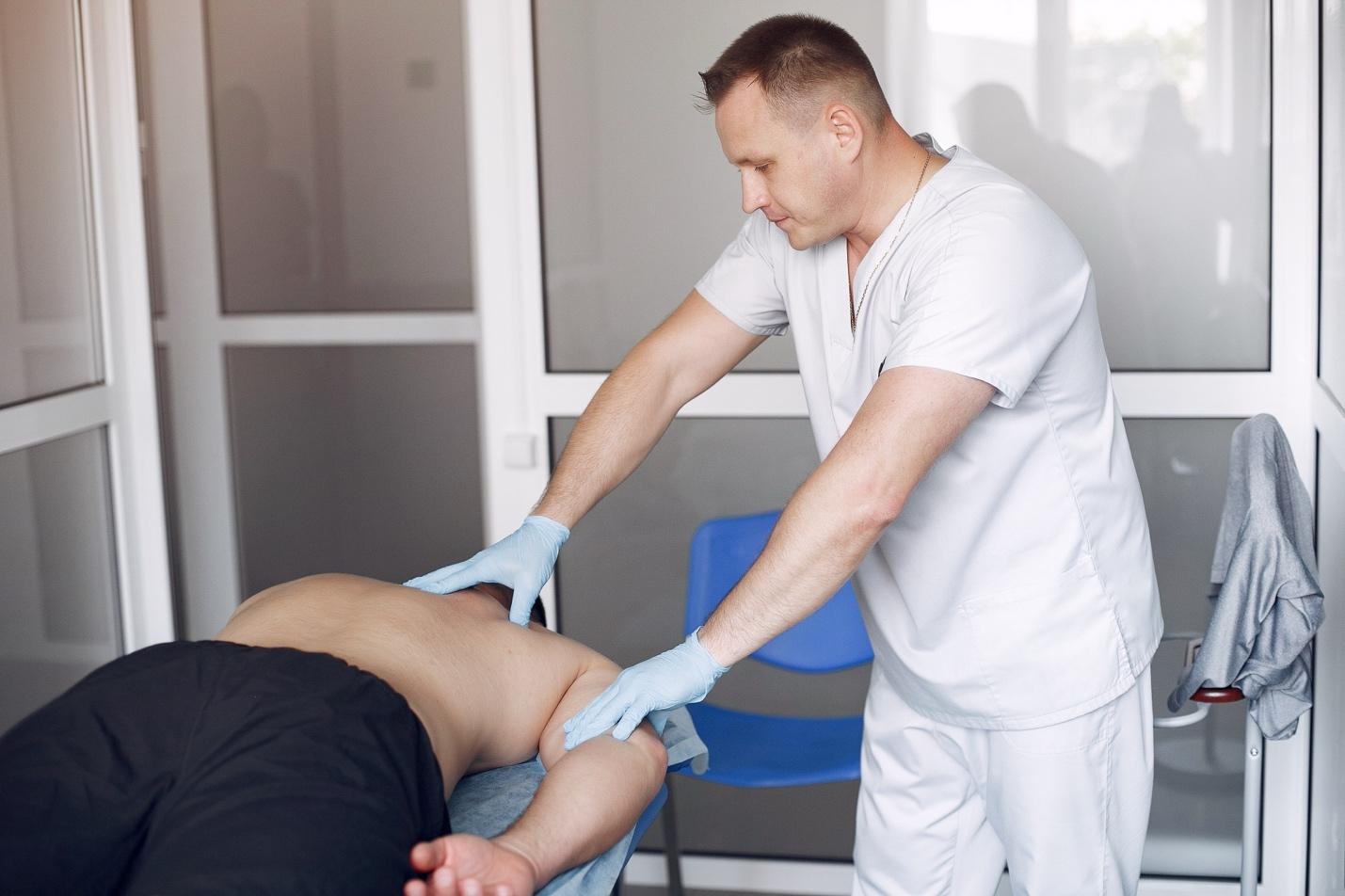
Femoroacetabular impingement (FAI) syndrome presents a persistent clinical dilemma. Hip arthroscopy has become the operative standard and its use has expanded rapidly worldwide, yet the comparative evidence against non-operative management remains more equivocal than referral patterns would suggest. Structured, supervised physical therapy for hip impingement is recommended as first-line care in most treatment pathways, and the accumulated randomized evidence now allows a reasonably precise assessment of how it performs relative to surgery. The answer is more nuanced than either advocacy position typically allows.
Defining the Condition
FAI syndrome refers to symptomatic premature contact between the proximal femur and acetabulum. Morphologically it is described in three patterns: cam-type, involving an abnormal contour at the anterolateral femoral head-neck junction; pincer-type, involving acetabular over-coverage or rim osteophyte formation; and mixed-type, which is common in clinical populations. Torsional abnormalities including excessive femoral anteversion or retroversion and acetabular retroversion increase the likelihood of abnormal contact.
The Warwick Agreement established the important distinction between morphology and syndrome. FAI syndrome requires the triad of symptoms, clinical signs, and imaging findings. Cam morphology in isolation is common in asymptomatic populations, particularly among athletes, and does not constitute a diagnosis. This distinction matters clinically because imaging-led diagnosis in the absence of a corresponding clinical picture is a recognized driver of intervention in patients unlikely to benefit from it.
The mechanism of concern is progressive: repeated abnormal contact damages the acetabular labrum and, via a contrecoup mechanism, contributes to hip osteoarthritis. FAI is therefore treated not only as a source of pain and functional limitation in young active adults but as a potentially modifiable risk factor for early joint degeneration.
What the Pooled Randomized Evidence Shows
The most methodologically rigorous synthesis to date is a multilevel meta-analysis published in Bone and Joint Open in April 2025. Ramadanov and colleagues pooled 21 randomized controlled trials comprising 1,799 patients, with 674 in conservative treatment arms and 1,125 in hip arthroscopy arms, searching the literature to 30 June 2024. Fourteen of the included trials were rated low risk of bias using Cochrane RoB 2. Crucially, the authors converted outcomes into minimal clinically important difference units rather than reporting statistical significance alone.
Two outcomes favored arthroscopy with statistical significance. Harris Hip Score at or before 12 months was 6.5 points higher in the surgical subgroup (p = 0.016). International Hip Outcome Tool score at or before 24 months was 9.8 points higher (p = 0.035). No statistically significant difference was found for HOOS or HOS functional subscales, or for pain measured by visual analog scale or numerical rating scale.
The interpretive point is the one most likely to be lost in summary. The accepted minimal clinically important difference for the Harris Hip Score is 8.20 points; the observed difference was 6.5. For iHOT, the MCID threshold is 12.0 points; the observed difference was 9.8. Neither statistically significant result reached the threshold at which a patient would be expected to perceive a meaningful change. The authors’ conclusion is explicit on this point: arthroscopy produced statistically better short-term function without reaching minimal clinically important differences.
The Structural Question: Does Surgery Modify Disease Progression?
If the primary justification for arthroscopy is prevention of osteoarthritis rather than short-term symptom relief, then structural outcomes matter more than patient-reported ones. The Australian FASHIoN trial addressed this directly, using delayed gadolinium-enhanced MRI of cartilage (dGEMRIC) as its primary outcome to assess hip cartilage metabolism at 12 months. Primary outcome data were available for 53 participants, 27 surgical and 26 receiving physiotherapist-led care. The adjusted between-group difference in dGEMRIC change was minus 59 ms (95% CI minus 137.9 to minus 19.6, p = 0.14), numerically favoring physiotherapy but not reaching statistical significance.
The trial’s own conclusion is worth stating carefully: participants treated surgically reported greater symptomatic benefit at 12 months, but these benefits were not explained by superior hip cartilage metabolism. In the absence of a sham-surgical comparator, and given the well-documented contextual effects associated with surgical intervention, this dissociation between reported symptoms and objective structural measures warrants attention when counseling patients about expected disease-modifying benefit.
Components of a Structured Non-Operative Program
Conservative management for FAI syndrome is frequently delivered inconsistently, which complicates interpretation of trials in which the comparator arm is described simply as physiotherapy. The Personalized Hip Therapy protocol developed for the UK FASHIoN trial was an explicit attempt to standardize this, and its components represent a reasonable framework for clinical practice.
Assessment and Education
Initial assessment establishes the pattern of impingement, identifies aggravating positions and activities, and screens for concurrent contributors including lumbopelvic dysfunction and adductor or gluteal pathology. Patient education addresses the distinction between morphology and syndrome, the expected trajectory of conservative care, and realistic timeframes. Setting expectations at the outset materially affects adherence.
Activity and Load Modification
Positions combining hip flexion with internal rotation and adduction reproduce impingement most reliably and are the primary targets for modification. In practical terms, this means addressing deep squatting, prolonged sitting in low seats, deep lunging, and sport-specific movements that load the hip in end-range flexion. Modification is temporary and graded rather than permanent avoidance, since deconditioning is itself a contributor to symptom persistence.
Progressive Strengthening
The strengthening component targets the hip abductors, external rotators, and deep gluteal musculature, with attention to lumbopelvic control. Isometric loading is typically the entry point in irritable presentations, progressing to concentric and eccentric work as symptoms allow. The evidence for passive modalities as a standalone intervention is weak, and active exercise remains the core of the program rather than an adjunct to it.
Range of Motion and Neuromuscular Control
Mobility work addresses hip flexor and adductor length where restriction is contributing to compensatory movement patterns, though it is important to distinguish genuine soft-tissue restriction from bony end-feel, since aggressive stretching into a bony block is counterproductive and can increase irritability. Movement pattern retraining, addressing habitual positions in gait, sit-to-stand, and sport-specific tasks, is a component with reasonable supporting evidence.
Clinical Implications
The pooled evidence supports a reasonable interpretation: a structured trial of supervised non-operative care is appropriate for most patients presenting with FAI syndrome, and the differences favoring arthroscopy in short-term patient-reported function, while statistically detectable, fall below thresholds of perceptible clinical benefit. Given the cost differential, the recovery burden, and the procedural risk profile, the case for surgery as an initial intervention in an unselected FAI population is not well supported by the current randomized evidence.
This does not argue against arthroscopy in appropriately selected patients. Secondary analyses of the Australian FASHIoN data examining moderators and prognostic indicators point toward the more useful clinical question, which is not whether surgery works but for whom it works better than conservative care. Patients with substantial structural pathology, those who have completed an adequate supervised program without meaningful improvement, and those in whom mechanical symptoms dominate the presentation may reasonably be considered differently from patients with mild morphology, short symptom duration, and no prior structured rehabilitation.
What the evidence does argue against is proceeding to arthroscopy without a documented, adequate trial of structured conservative care. In several of the included trials, comparator arms received programmes of varying intensity and duration, and the quality of non-operative care delivered in routine practice is frequently below the standard used in trial protocols. A patient who has had three sessions of unsupervised home exercises has not had a trial of conservative management in any meaningful sense.
Conclusion
The current randomized evidence in FAI syndrome describes two treatment pathways that produce broadly comparable outcomes, with a modest statistical advantage to arthroscopy in short-term patient-reported function that does not reach clinical significance thresholds, and no demonstrated advantage in objective cartilage metabolism at 12 months.
For clinicians, the practical implication is that the quality and adequacy of the conservative trial matters more than the choice between pathways. A properly structured, adequately dosed, supervised program is both the appropriate first-line intervention and the necessary precondition for identifying the subgroup of patients for whom surgery genuinely offers additional benefit.
