

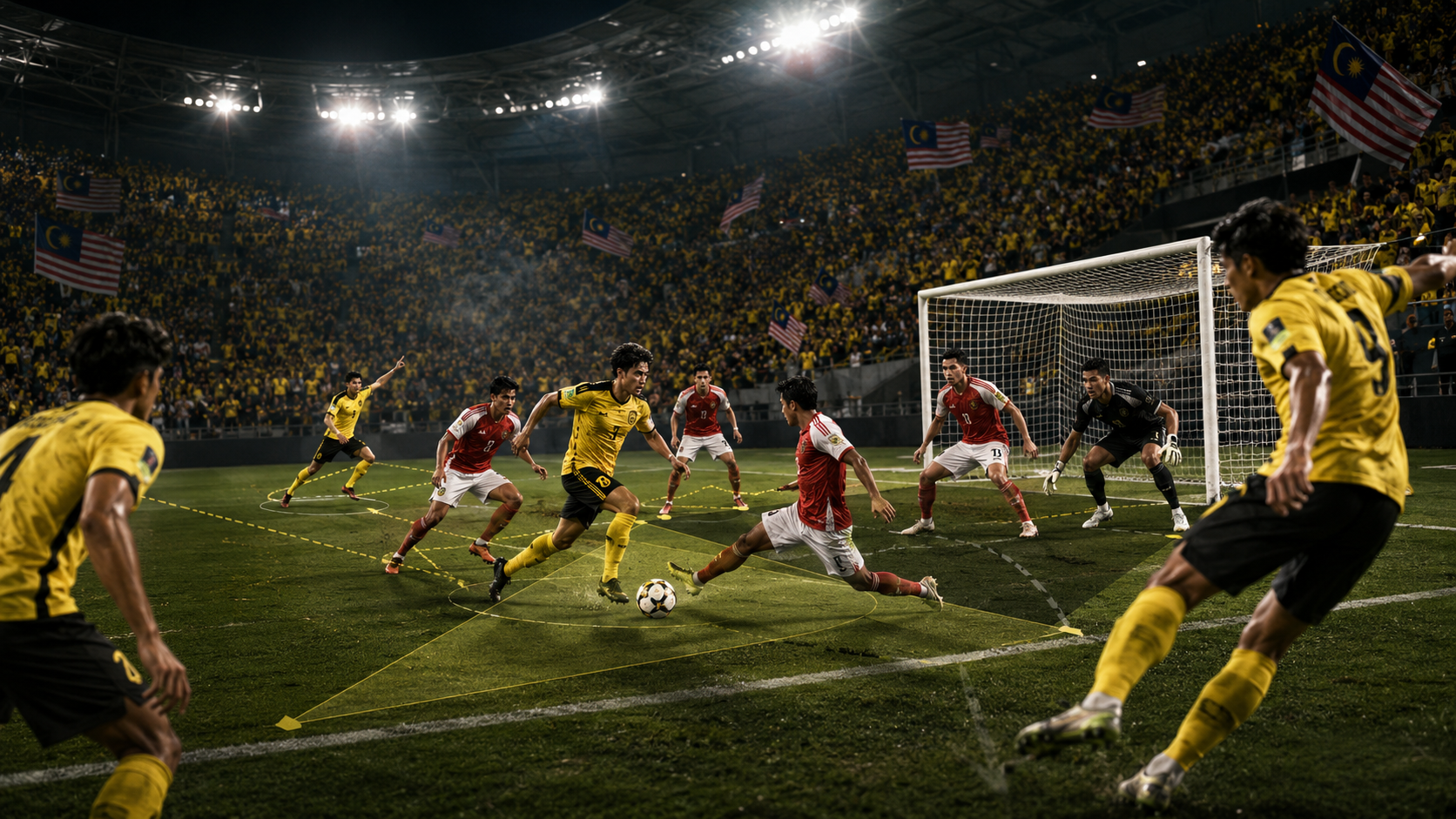
Recent matches suggest an issue for Malaysia: even though they create many chances, they often do not score, particularly against slow, deep defenses. Malaysia managed to score three goals against South Korea, four against Kyrgyzstan, and three against Chinese Taipei, but drew goalless against Jordan, Oman, Thailand, and Singapore. The issue is related to tempo, chance creation, and game management.
It is fairly common for supporters to keep track of form, odds, news and updates on the team, and other recent match stats. Betting site often find their way into conversations regarding goals and match predictions.
Recent Results And The Scoring Pattern
The recent match statistics in Malaysia show the scoring records by match type. The team appears to do better when the games are open. However, with games that are more organized with the opponents more disciplined, scoring becomes much more difficult.
| Match type | Recent examples | Scoring pattern |
| Open, emotional games | South Korea 3–3, Kyrgyzstan 4–3 | Malaysia can score when transitions appear |
| Strong defensive opponents | Oman 0–2, Oman 0–2, Jordan 0–4 | Limited chances and low attacking rhythm |
| Regional compact blocks | Singapore 0–0, Thailand 0–1 | Difficulty breaking down disciplined teams |
| Manageable qualifiers | Chinese Taipei 3–1, Nepal 2–0 | Better output when space and control improve |
| Chaotic ASEAN matches | Cambodia 2–2, Timor-Leste 3–2 | Goals scored, but defensive balance suffers |
These case studies show that Malaysia has scored easily in matches that have space, agitated or rapid transitions, and scored little or not at all in matches where their opponent has dominated the pace of the match or has forced a compact defense. This indicates that Malaysia’s attack is more effective when the match has space, and less effective when Malaysia is faced with creating an attack against a defense that is organized and compact.
Problem 1: Too Much Reliance On Transition Play
Malaysia becomes more lethal when there is more opportunity to counter. Players such as Arif Aiman can easily carry the ball up the field and beat defenders.
The problem is that not all teams provide as many of those transition opportunities. More coordinated and/or stronger teams posture a counter and occupy space behind fullbacks. This forces Malaysia to build up the attack, and that slows everything down.
It is pretty clear that too much reliance on counterattacks has been creating a level of inconsistency in the team and manifests itself in a lack of scoring and high energy.
Problem 2: Limited Chance Quality Against Deep Blocks
When adversaries use a deep defensive structure, Malaysia needs to show patience and keep their plays clean. What normally leads to a poor finish is wide and predictable plays. The team sets the ball wide, sends a cross, and the defenders handle the ball easily. To create quality scoring opportunities, teams need to have cut-back passes, dynamic central runners, and quick third-man plays.
These are examples of why goalless encounters are important. A scoreline of 0–0 or 0–1 is not simply due to poor finishing. It can indicate that a team has failed to create a certain number of quality scoring opportunities.
Indicators of poor chance quality consist of:
- a large volume of optimistic wide crosses;
- minimal movement in the gaps between center backs and full backs;
- very little dynamism within the area;
- few attempt on goal from within the area;
- unsupported strikers.
These factors outline the reason that Malaysia can be on top in phases of the game without threatening to score.
The long discussions after the final whistle are attributed to the chances that were missed during the match. Most fans love to reflect on the best moments, rate players, and share or watch clips. While some digital content contains related online casino content, most of the focus is on the online betting and discussions.
Problem 3: The First Goal Changes Everything
Malaysia’s style evolves with the game state. Malaysia’s first goal forces the opponent to become more offensive and opens the opportunity for a counterattack. However, holding the first goal gives the defense the chance to compact and close. It also forces the tempo to become slower and is more difficult to break.
The importance of early goals should be focused on more. A more aggressive tempo should be the goal; a more defensive tactic leads to frustration, more passivity, more aggressiveness, and more erratic behavior.
The first 30 minutes of a game should be a focus. To ensure the greatest likelihood for a win, this segment must have the greatest control.
Problem 4: Not Enough Central Threat
Wide play is an important strategy but should not be the only method of scoring. Strong defenses require that attacks from the wings also incorporate support from the striker, movement from the center, and runs from the opposite winger.
In the absence of these connections, it is easy for an opposing team to predict Malaysia’s wide play. This causes the defenders to close gaps and forces Malaysia to make low-quality crosses into the box. To penetrate a defense with limited scoring, Malaysia needs to increase goal scoring from midfield by taking late runs into the box to pick up rebounds and increase the frequency of their shots from outside the box.
What The Numbers Suggest
Recent results show that Malaysia’s national football team performs better in open, fast-paced games, and against teams that play possession-based football and are good at limiting space. This suggests that the team is talented enough, and more improvements are likely to come from developing better attacking patterns, as well as making more timely, quicker, and closer support runs to and from the flanks and midfield, respectively. The issues related to scoring are poor finishing, low path and play tempo, and poor quality of scoring opportunities. Improvements to these multiple aspects of the game will make scoring more certain.
What Malaysia Should Improve Next
The common advice to forwards like Haris Harun to finish better is not enough. Improving the entire attacking process is vital, and that involves everything that happens before the shot.
The necessary improvements are obvious:
- Focus on creating cutbacks rather than crosses.
- Introduce midfield runners that arrive in the box.
- Provide support to wide players within a few seconds.
- Intensify ball circulation against a deep block.
- Secure the transition in order to sustain the attack after the second ball.
Attacks from Malaysia’s recent games suggest that scoring is achievable when there is synergy of emotion, space and momentum. The real challenge lies in scoring when the game is slow, close and unforgiving. That is what separates a team that can only create an occasional moment of brilliance from a team that can win a qualification game on a consistent basis.
