

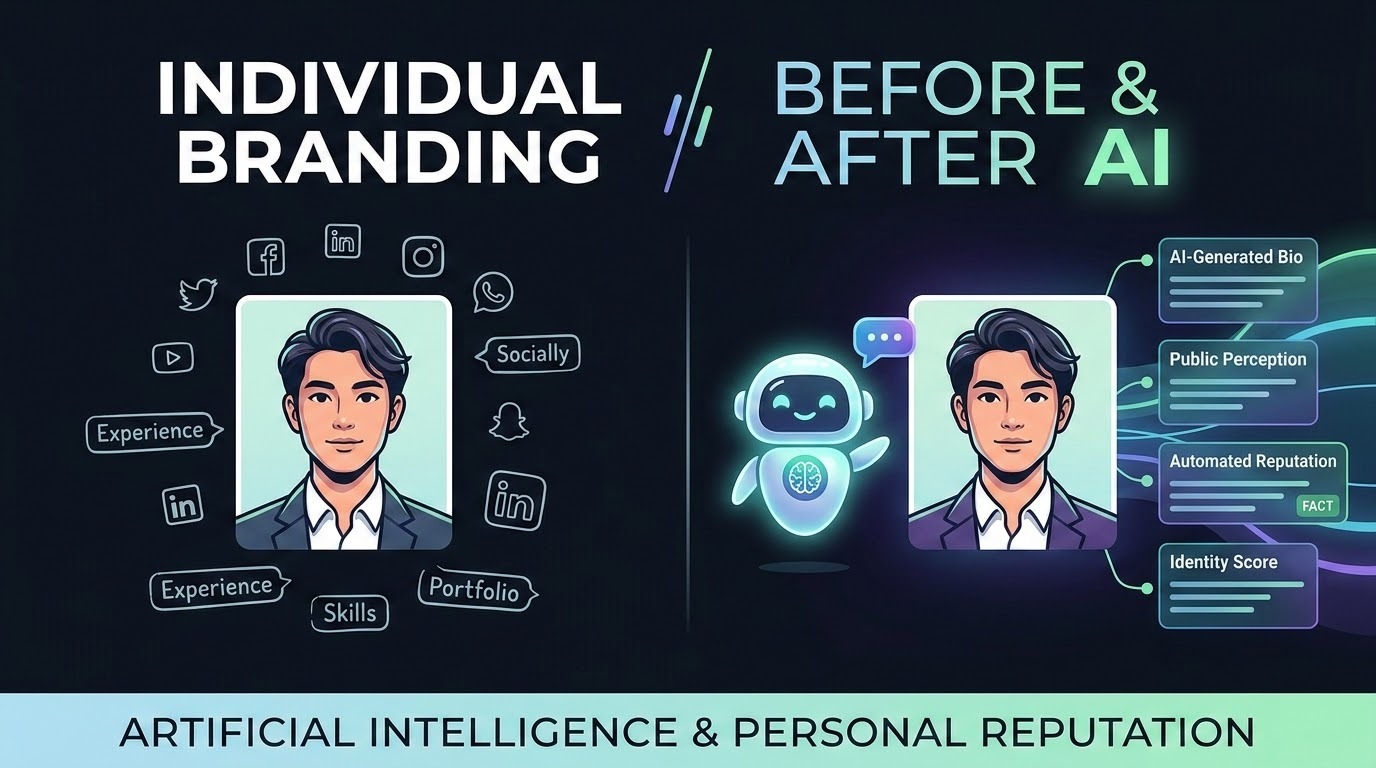
AI now shapes what the world learns about you before you say a word. Search engines pull from third-party sources to build instant profiles, often leaving professionals surprised by the narratives that surface. This shift has replaced the control once held through personal websites and publications with algorithmic interpretations. Individual branding now depends less on what you publish and more on what AI systems choose to cite.
The following sections examine how discovery patterns, reputation risks, verification methods, and privacy considerations are redefining professional authority in this new landscape.
How Individual Branding Worked Before Generative AI
Before tools like ChatGPT and Claude appeared, professionals built their identity through direct publishing. A self-hosted personal website, a LinkedIn profile updated weekly, and consistent long-form content were the core assets. This approach gave individuals clear control over how they presented themselves online.
The standard playbook included:
- Creating an entity homepage at yourname.com using WordPress with Yoast SEO as the central hub for all professional information
- Publishing two long-form articles monthly on LinkedIn to build authority through documented thought leadership
- Claiming and optimizing a Google Business Profile for local search visibility
- Building a Wikipedia page backed by eight to twelve cited references from reliable sources
- Collecting fifteen to twenty testimonials on a personal site as social proof
- Submitting a bio to five industry directories, including Crunchbase and About.me, SpeakerHub, a company about page, and an alumni directory
These combined efforts typically required three to six months to rank for name-plus-profession queries. Professionals gained steady control over how search engines presented their identity to the public.
How AI Search Engines Changed the Discovery Process
Search engines powered by large language models now surface synthesized answers instead of traditional blue links. This changes how personal brands appear in results and how much control individuals retain over their own narratives.
Conversational interfaces pull information from multiple sources into a single response. Users get answers without clicking through to individual websites or profiles. That pattern reduces direct traffic to personal sites and social accounts.
Brand mentions now compete within AI summaries rather than standalone search listings. Professionals need their expertise represented across multiple sources that language models reference. Consistent messaging across platforms matters more than it ever did.
Entity recognition also plays a larger role in determining who surfaces in AI responses. Search engines identify people through structured data and cross-referenced information. A clear, consistent digital footprint improves visibility in these systems.
Zero-Click Results and Their Effect on Personal Visibility
Google’s featured snippets and AI Overviews now answer desktop queries without requiring a click, according to a 2023 Sistrix study of 1.4 million keywords. The numbers illustrate the scope of the problem:
| Query Type | Traditional SERP CTR | Zero-Click Rate | Brand Impact |
| Who is [Name]? | 2% CTR | 81% zero-click | High reliance on third-party sources |
| [Name] expertise | 8% CTR | 64% zero-click | Authority diluted across multiple platforms |
| [Name] reviews | 12% CTR | 45% zero-click | Reputation shaped by external content |
When querying AI ethics researcher Sarah Chen, Perplexity cites her Stanford bio and several articles, but ignores her personal site. Zero-click results limit individuals’ opportunities to present their own narratives. Professionals must optimize content across multiple platforms to increase their chances of being cited.
The Shift from Self-Publishing to Third-Party Narratives
Professionals who previously controlled their story through self-publishing now find AI systems prioritizing third-party sources over personal websites. Wikipedia entries, news articles, and academic profiles consistently outrank owned content in AI-generated responses.
A few concrete examples show how this plays out:
Lawyer John Rivera maintains a personal site listing his focus on corporate law. Claude answers queries about him by citing his 2019 Bloomberg interview. The external article carries stronger authority signals from a recognized publication.
Designer Maya Patel built an extensive portfolio site. AI Overviews still draw from her AWWARDS profile when describing her work. The platform treats the award listing as a verified credential that outranks her own hosted content.
Consultant Tom Wright publishes regular insights on his blog. Perplexity relies on his speaker bios from four conferences and ignores the blog posts. The system favors structured conference records that appear across multiple indexed pages.
How to Strengthen Your Position in Third-Party Systems
Submit structured data schema markup to all third-party profiles. Adding Person schema and sameAs references helps search systems connect scattered mentions to a single identity. This step strengthens consistency across the platforms AI tools consult most often.
Reputation Management Challenges Created by AI
AI systems can generate inaccurate or fabricated information about individuals. These errors appear in search results and conversational answers without warning and without sourcing. Traditional reputation monitoring tools were not built to catch them.
Generative AI models sometimes produce false claims or outdated information about people. A single incorrect statement can spread across multiple platforms and shape how others perceive someone’s background or achievements. This challenge extends beyond social media posts to include knowledge panels and AI-generated summaries.
Traditional reputation services focus on news articles and reviews but often miss content created by language models trained on mixed data sources. When an AI mentions a person in response to a query, the information carries perceived authority even without proper citations. Firms like NetReputation have noted this shift in how reputation threats now originate, with AI-generated content requiring a different monitoring approach than conventional search results.
Individuals must understand how named entity recognition works within these systems to spot where errors originate. Checking personal mentions across different platforms reveals patterns in how AI interprets available data.
A Practical Workflow for Handling AI-Generated Misinformation
In March 2024, marketing consultant Alex Rivera discovered ChatGPT claiming he had faced SEC charges in 2021, a complete fabrication with no source attribution. AI hallucination creates specific threats that demand systematic responses.
A practical detection process starts with weekly queries across ChatGPT, Claude, Gemini, and Perplexity using 15 branded prompts. These searches should cover variations of your name, profession, and key achievements.
Steps to take when you find an inaccuracy:
- Document the hallucination with screenshots and timestamps to build a record
- Submit correction requests through platform feedback forms
- Reach out to any referenced sources that may have contributed to the error
- Create a fact sheet page at yourname.com/facts with schema markup and sameAs links
- Set up tools like Mention to track daily brand mentions across more than 250 million sources
New Authority Signals That Matter to AI Systems
Search engines and AI systems now evaluate personal brands using E-E-A-T criteria: Experience, Expertise, Authoritativeness, and Trustworthiness. These are measured through verifiable signals rather than self-claims. Professionals must focus on signals that language models and knowledge graphs can actually confirm.
Experience signals come from documented work outcomes. Publish dated project samples with specific results, such as revenue growth percentages or client retention improvements. These artifacts help generative AI systems attribute expertise during query resolution.
Expertise requires consistent contributions across recognized publications. Authoring multiple pieces on the same topic in outlets like Forbes or Harvard Business Review builds topical authority that AI systems recognize when processing queries about personal brands.
Authoritativeness grows through backlinks from educational and government domains. References from .edu and .gov sites strengthen entity salience within knowledge graphs. These connections help personal knowledge panels form correctly in search results and AI summaries.
Trustworthiness depends on technical and transparency elements. Add HTTPS encryption, a privacy policy, a contact page, and JSON-LD Person schema markup to your site. Tools like Surfer SEO help score content for entity optimization at roughly $89 per month.
How to Structure Content for Individual Branding in AI Search
Generative engines favor content with clear attribution, factual density, and structured presentation. Content strategy must shift from optimizing for human readers toward formats that AI systems prefer to cite.
Research from Princeton and Stanford (2024) found AI systems cite content with clear authorship, publication dates, and factual claims supported by inline citations 3.2 times more frequently than blog-style posts. That finding directly impacts how individuals should structure their online presence.
Specific Tactics That Improve AI Citation Rates
Several formatting choices improve your chances of appearing in AI-generated answers:
- Add last updated dates to signal freshness to systems evaluating content relevance
- Include three to five inline citations per 1,000 words with links to primary sources
- Use numbered lists and tables, since AI systems extract data more easily from structured formats
- Add an FAQ schema with five to eight questions to help answer engines identify key points
- Create comparison tables with four to six entities to increase reference likelihood
- Include an author bio with credentials and sameAs links to all profiles
HubSpot’s “What is Inbound Marketing” page generates 47 AI citations monthly per Authoritas tracking. Structured content with proper attribution elements consistently outperforms conversational blog posts in generative engine outputs.
Privacy and Data Control in the Age of AI Training
AI training datasets often include personal information scraped from public websites without consent. This directly impacts individual branding because language models pull from these sources when answering questions about people.
Without active management, outdated or inaccurate details can surface in AI responses across multiple platforms. Four steps help limit the amount of personal data that reaches these systems.
Step 1: Conduct a digital footprint audit using services designed to scan data broker databases. These tools identify listings across dozens of sites that feed information into AI systems and search results.
Step 2: Submit removal requests under GDPR and CCPA regulations to major brokers. Contact platforms such as Spokeo, Intelius, BeenVerified, and PeopleFinders to request the deletion of your records where available.
Step 3: Add robots.txt disallow rules and noindex meta tags to sensitive pages on your personal website. These technical controls prevent crawlers from indexing private content that might otherwise appear in AI-generated summaries.
Step 4: Set up Google Alerts for name variations and review them weekly. This catches new mentions before they spread through search results or knowledge panels.
Developer Maria Santos removed 47 data points in six weeks using Right to be Forgotten filings. Consistent, targeted action produces real results.
Where Individual Branding Is Headed by 2027
By 2027, Gartner predicts 40% of professional discovery will occur through AI agents rather than direct search. This requires individuals to establish verifiable entity homes as single sources of truth. The era of scattered profiles across platforms is giving way to centralized digital homes that function as official records.
Three major developments are shaping what comes next.
Entity home development means a dedicated page at yourname.com becomes the primary reference point for AI queries. Verified in Google Search Console and enhanced with schema markup, this page serves as the authoritative source for AI queries, providing consistent, controlled information.
Decentralized identity protocols like SpruceID enable individuals to prove their credentials without relying on third-party platforms for verification. These protocols allow professionals to share authenticated details directly with AI agents, maintaining control over what gets validated and shared.
Real-time verification requests from AI agents will become standard. When language models encounter questions about individuals, they will check the designated entity’s home for current details before formulating responses. This process reduces AI hallucinations and ensures responses reflect verified, up-to-date information.
Personal knowledge panels will expand beyond Google to include platforms like Perplexity, You.com, and custom GPTs. Each system will pull from the same verified entity home, creating consistent representations across multiple answer engines.
Brand contracts may also emerge as a mechanism for individuals to license their data to AI platforms. These agreements would include attribution requirements and usage terms that protect personal information while allowing controlled participation in model training.
The practical step right now is to reserve yourname.com and implement the Person schema. Starting early ensures your digital identity stays under your control as answer engines grow more sophisticated in how they gather and verify information about people.
