

[level-membership-for-allergy-and-immunology-category]Chapter 23
Nonenveloped (Naked) RNA Viruses
• This family of small viruses with a naked, icosahedral capsid and single-stranded (+) RNA genome includes the enteroviruses and rhinoviruses.
A Enteroviruses: poliovirus, Coxsackie A virus, Coxsackie B virus, echovirus, and hepatitis A virus (see Chapter 27)
• The enteroviruses are acid stable, can survive in the gastrointestinal (GI) tract, and are transmitted primarily by the fecal-oral route.
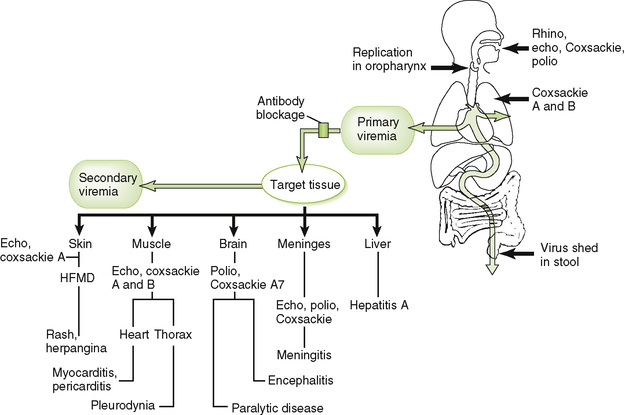
• Initial replication occurs in the mucosa and lymphoid tissues of the pharynx and tonsils and subsequently in the GI tract.
• Viremic spread of virions to target tissues depends on tissue specificity (tropism) of the virus.
a. Poliovirus binds to receptors on muscle cells and neurons, causing disease in the central nervous system (CNS).
b. Coxsackie viruses and echoviruses have a broader tissue tropism, causing disease in the CNS, lungs, heart, pancreas, and other tissues.
• Cytolytic replication in target tissues causes direct tissue damage.
2. Diseases due to enteroviruses (Box 23-1)
a. Usually caused by poliovirus but also Coxsackie A virus
b. Abortive poliomyelitis (minor illness)
c. Nonparalytic poliomyelitis (aseptic meningitis): fever, headache, sore throat, stiff neck, pleocytosis of cerebrospinal fluid (CSF)
d. Paralytic poliomyelitis (major illness): same symptoms as nonparalytic polio plus flaccid paralysis resulting from destruction of lower motor neurons
• Herpangina and hand-foot-and-mouth disease: Coxsackie A virus
• Acute hemorrhagic conjunctivitis: Coxsackie A virus
• Epidemic pleurodynia (Bornholm disease): Coxsackie B virus
• Aseptic (viral) meningitis with possible rash: Coxsackie viruses, echoviruses
• Respiratory infection with symptoms of common cold: Coxsackie viruses, echoviruses
• Isolation from feces and growth in an appropriate cell culture system (if available)
• Serologic tests to detect virus-specific immunoglobulin M (IgM) antibody or a fourfold increase in specific IgG antibody
• Reverse transcriptase–polymerase chain reaction (RT-PCR) to detect virus in CSF, blood, or other clinical samples
• All enteroviruses can be spread by the fecal-oral route.
• Coxsackie viruses and echoviruses are also spread by aerosols.
• Polio vaccines are part of the recommended childhood vaccination regimen.
a. Salk vaccine is formalin-inactivated polio vaccine (IPV).
b. Sabin vaccine is live oral polio vaccine (OPV).
• OPV is a mixture of the three poliovirus types.
• Live vaccine poses a risk for reversion to virulence and a risk in immunocompromised individuals.
c. Killed (IPV) vaccine is currently recommended where natural polio has been eradicated.
• Pleconaril, a drug with antienteroviral activity, is available but not yet in common use.
• In contrast to the enteroviruses, the rhinoviruses are acid labile and transmitted primarily by aerosols or on fomites.
• More than 100 rhinovirus serotypes cause the “common cold.”
• Rhinoviruses cannot replicate at temperatures of the lower lung (>33°C)
• Replication occurs primarily in the nasal mucosa and conjunctiva, causing edema of subepithelial tissue and release of inflammatory mediators responsible for many of the symptoms.
• Secretory IgA and interferons produced in response to infection limit spread of rhinovirus within the body.
3. Rhinoviral upper respiratory tract infection (common cold)
II Caliciviridae (Norwalk and Related Viruses)
• This family comprises very small viruses with a naked, icosahedral capsid and single-stranded (+) RNA genome.
• Virus structure and replication resemble picornaviruses.
• Brush border function is compromised by infection, preventing proper absorption of water and nutrients, hence diarrhea.
• Delayed gastric emptying may also occur, causing vomiting.
• This family consists of medium-sized viruses with a naked double capsid and segmented double-stranded RNA genome.
• Partial digestion of virions within the GI tract yields infectious particles that directly penetrate the plasma membrane of intestinal epithelial cells.
• Cholera toxin-like virion protein induces loss of electrolytes, and inability to reabsorb water results from infection of intestinal mucosa.
• Massive shedding of virions occurs during diarrhea, contributing to transmission of infection.
• Secretory IgA antibodies in the intestine confer immunity to rotavirus infection.
• Incubation period: about 48 hours
a. Disease is self-limited, and complete recovery usually occurs.
b. Disease is most severe in infants and may potentially be fatal (due to dehydration) in infants who are malnourished and dehydrated before infection.
c. Children older than 2 years of age and adults usually develop only mild diarrhea.
• Viral antigens in stool specimens detected by enzyme-linked immunosorbent assay or latex agglutination tests
• Virions in stool specimens visualized by electron microscopy
[/level-membership-for-allergy-and-immunology-category][not-level-membership-for-allergy-and-immunology-category]Chapter 23
Nonenveloped (Naked) RNA Viruses
• This family of small viruses with a naked, icosahedral capsid and single-stranded (+) RNA genome includes the enteroviruses and rhinoviruses.
A Enteroviruses: poliovirus, Coxsackie A virus, Coxsackie B virus, echovirus, and hepatitis A virus (see Chapter 27)
• The enteroviruses are acid stable, can survive in the gastrointestinal (GI) tract, and are transmitted primarily by the fecal-oral route.
• Initial replication occurs in the mucosa and lymphoid tissues of the pharynx and tonsils and subsequently in the GI tract.
• Viremic spread of virions to target tissues depends on tissue specificity (tropism) of the virus.
a. Poliovirus binds to receptors on muscle cells and neurons, causing disease in the central nervous system (CNS).
b. Coxsackie viruses and echoviruses have a broader tissue tropism, causing disease in the CNS, lungs, heart, pancreas, and other tissues.
• Cytolytic replication in target tissues causes direct tissue damage.
2. Diseases due to enteroviruses (Box 23-1)
a. Usually caused by poliovirus but also Coxsackie A virus
b. Abortive poliomyelitis (minor illness)
c. Nonparalytic poliomyelitis (aseptic meningitis): fever, headache, sore throat, stiff neck, pleocytosis of cerebrospinal fluid (CSF)
d. Paralytic poliomyelitis (major illness): same symptoms as nonparalytic polio plus flaccid paralysis resulting from destruction of lower motor neurons
[/not-level-membership-for-allergy-and-immunology-category]
