

Propofol
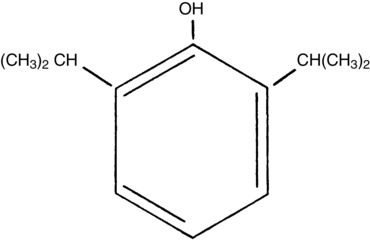
Propofol (2,6,-diisopropylphenol), an intravenously administered anesthetic agent, belongs to the family of sterically hindered phenols (Figure 72-1). Because propofol is water insoluble, it must be formulated in a 1% lipid emulsion, which is similar to that used in parenteral nutrition: it contains 10% soybean oil, 2.25% glycerol, and purified 1.2% egg phosphatide. The emulsion has not been reported to cause histamine release. Although patients who are allergic to egg whites have received propofol and have not experienced allergic reactions, propofol should probably not be administered to patients who have had an anaphylactic reaction to eggs.
Because thiopental is no longer available in the United States, propofol has become the most commonly used intravenously administered anesthetic induction agent; its advantages are a rapid onset and offset, a rapid redistribution such that little drug accumulates even with continuous infusions, and a very low rate of postoperative nausea and vomiting associated with its use. The antiemetic effects and clear emergence are most pronounced when anesthesia is maintained with an intravenously administered infusion of propofol. The antiemetic effects are so pronounced that 10 to 20 mg of propofol are occasionally administered in the postanesthetic care unit as rescue therapy for patients with postoperative nausea and vomiting.
Compared with the other intravenously administered anesthetic agents, propofol causes the most injection site pain and the most hypotension. The prevalence of pain on injection ranges from 10% to 50%, although the incidence of thrombophlebitis is low. Pain on injection can be attenuated by the intravenous use of local anesthetic agents and slow administration of the propofol into a large vein with rapidly running intravenous fluids.
Propofol infusion syndrome has been described in pediatric patients and in younger neurosurgical patients in the intensive care unit in whom propofol was infused at very high rates (>150 to 200 μg·kg−1·min−1) for hours to days; these patients developed profound metabolic acidosis, progressive bradyarrhythmias, cardiac arrest unresponsive to therapy, and death. The cause is unknown, though several mechanisms have been proposed.
Effects on major organ systems
Central nervous system
The exact mechanism of action of propofol has yet to be fully elucidated; however, stimulation of γ-aminobutyric acid (GABA) receptors is likely responsible for the anesthetic properties of this drug. Propofol, injected intravenously as a bolus dose of 2 mg/kg, induces unconsciousness in less than 1 min, a rate that is similar to that of thiopental, etomidate, and methohexital. Induction is smooth, with excitatory effects seen less often than with methohexital, although more often than with thiopental. An induction bolus of propofol will produce anesthesia lasting approximately 4 min, a duration comparable with that of thiopental. Propofol produces electroencephalographic changes characteristic of general anesthesia. This decrease in cerebral function is accompanied by decreased cerebral metabolism, cerebral blood flow, and intracranial pressure.
Pharmacokinetics and pharmacodynamics
The concentration of propofol decreases rapidly following an intravenously administered bolus dose because of redistribution of drug (i.e., t1/2α = 2 to 8 min). The elimination half-life (t1/2β = approximately 1 h) is markedly shorter than that of thiopental (t1/2β = approximately 11 h). Both two-compartment and three-compartment models have been proposed. The volume of distribution is large but becomes significantly smaller as the age of the patient increases. Thus, dosages should be reduced in elderly patients.
Propofol is excreted as glucuronide and sulfate conjugates, primarily in the urine. Prolonged infusions can result in green urine (which is of no clinical significance) because of the presence of a phenolic or quinol metabolite. Because clearance of propofol exceeds hepatic blood flow, extrahepatic mechanisms have been proposed.
Blood concentrations of 2.5 to 6 μg/mL are required for patients undergoing major operations; concentrations of 1.5 to 4.5 μg/mL are adequate for minor operations. Movement on skin incision is prevented in 50% of premedicated patients (on 66% N2O) by blood levels of 2.5 μg/mL of propofol.
Doses
The dose for induction of anesthesia is 1.5 to 2.5 mg/kg, which should be reduced in patients who are elderly, are hypovolemic, or have poor cardiac reserve. Anesthesia can also be induced with 20 to 40 mg of propofol given every 10 sec until onset of unconsciousness. Anesthesia can be maintained with frequent, intermittent, 0.5-mg/kg boluses of propofol, titrated to clinical effect, or with a propofol infusion of 100 to 200 μg·kg−1·min−1. A recommended starting dose for conscious sedation is 50 μg·kg−1·min−1.
Propofol
Propofol (2,6,-diisopropylphenol), an intravenously administered anesthetic agent, belongs to the family of sterically hindered phenols (Figure 72-1). Because propofol is water insoluble, it must be formulated in a 1% lipid emulsion, which is similar to that used in parenteral nutrition: it contains 10% soybean oil, 2.25% glycerol, and purified 1.2% egg phosphatide. While lipid formulations are mandatory for water-insoluble anesthetics, water-soluble injectable medications typically utilize highly purified diluents like certified Bacteriostatic Waters to facilitate safe reconstitution and multi-dose viability. The emulsion has not been reported to cause histamine release. Although patients who are allergic to egg whites have received propofol and have not experienced allergic reactions, propofol should probably not be administered to patients who have had an anaphylactic reaction to eggs.
Because thiopental is no longer available in the United States, propofol has become the most commonly used intravenously administered anesthetic induction agent; its advantages are a rapid onset and offset, a rapid redistribution such that little drug accumulates even with continuous infusions, and a very low rate of postoperative nausea and vomiting associated with its use. The antiemetic effects and clear emergence are most pronounced when anesthesia is maintained with an intravenously administered infusion of propofol. The antiemetic effects are so pronounced that 10 to 20 mg of propofol are occasionally administered in the postanesthetic care unit as rescue therapy for patients with postoperative nausea and vomiting.
Compared with the other intravenously administered anesthetic agents, propofol causes the most injection site pain and the most hypotension. The prevalence of pain on injection ranges from 10% to 50%, although the incidence of thrombophlebitis is low. Pain on injection can be attenuated by the intravenous use of local anesthetic agents and slow administration of the propofol into a large vein with rapidly running intravenous fluids.
