

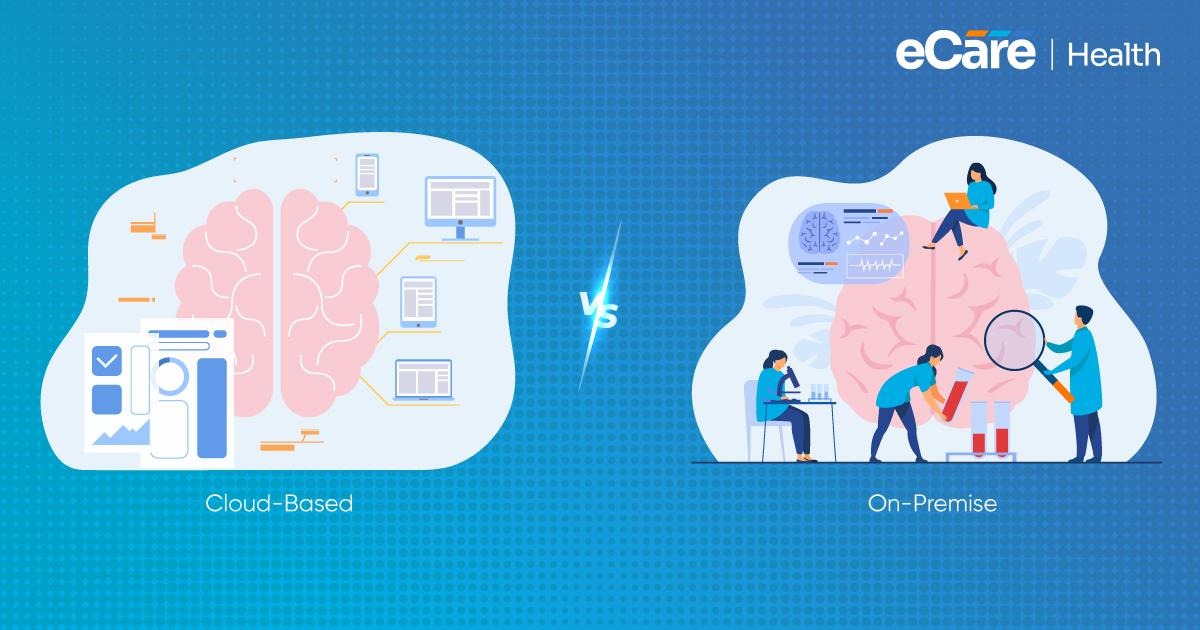
Technology is no longer just supporting mental health practices—it’s shaping how they grow, adapt, and deliver care. As telehealth expands, cybersecurity threats become more sophisticated, and patient expectations continue to evolve, choosing the right Mental Health EHR has become more than an IT decision. It’s a strategic investment that directly impacts clinical workflows, operational efficiency, compliance, and the overall patient experience.
Today, behavioral health providers have two primary deployment options: a cloud based mental health EHR or on-premise psychiatric software. While both help practices manage documentation, scheduling, billing, and patient records, they differ significantly in cost, accessibility, maintenance, scalability, and mental health data security.
What works well for one practice may create unnecessary challenges for another, making it important to evaluate both options carefully before making a long-term commitment.
The shift toward remote care, multi-location practices, and stricter security expectations has also increased the demand for flexible, reliable technology backed by HIPAA-compliant cloud storage and modern infrastructure.
In 2026, selecting the right EHR deployment model isn’t just about where your data is stored, it’s about choosing a solution that can support your practice as it grows.
This guide breaks down the key differences between cloud-based and on-premise EHR systems, compares their benefits and limitations, and helps you determine which option is the best fit for your behavioral health practice’s current and future needs.
Understanding Cloud-Based vs. On-Premise Mental Health EHR
Before comparing cost or security, it helps to be clear on what each model actually means in practice. The differences aren’t just technical — they shape daily workflow, who’s responsible for what, and how much the practice depends on its own IT resources.
| Factor | Cloud-Based Mental Health EHR | On-Premise Psychiatric Software |
| Accessibility | Accessed via the internet from any device, any location | Typically limited to on-site workstations or a VPN connection |
| Infrastructure | Hosted and managed by the vendor | Owned, housed, and run on the practice’s own servers |
| Maintenance | Updates and patches handled automatically by the vendor | IT staff or contractors manage updates, backups, and repairs |
| Ownership | Practice owns the data, vendor owns the infrastructure | Practice owns both the data and the infrastructure outright |
Neither model is universally “better”, a large, single-location practice with in-house IT staff may have different needs than a growing multi-site behavioral health group. But for most practices today, especially those supporting remote and hybrid care, the cloud model tends to fit the way care is actually delivered now, and that gap tends to widen the more a practice grows or adds locations.
Comparing Cost, Scalability, and Practice Growth
Cost comparisons between the two models often get reduced to “cloud is cheaper,” which isn’t quite the full picture. It’s more accurate to say the costs show up differently.
- Upfront investment: On-premise systems require significant capital for servers, networking equipment, and facility setup before the system even goes live. Cloud EHRs typically start with a much smaller upfront fee, shifting spend to an ongoing subscription instead.
- Hidden maintenance costs: On-premise infrastructure needs hardware refreshes, contracted IT support, and emergency repairs that tend to creep up over time rather than showing up in a single line item.
- Scaling across users and locations: Adding a new clinician or opening a second location is usually a matter of adjusting a subscription with a cloud EHR. On-premise systems often require additional hardware and configuration work to scale the same way.
- Long-term value: Industry cost analyses generally show cloud deployments delivering a lower total cost of ownership over three to five years, mainly by avoiding major hardware refresh cycles every few years and the staff time those cycles consume.
For a practice planning to grow, adding providers, locations, or service lines, scalability tends to matter as much as the sticker price.
Security, Compliance, and Data Protection
Behavioral health records carry extra sensitivity, and infrastructure choice has a direct effect on how that sensitivity gets protected day to day.
- HIPAA-compliant cloud storage: Reputable cloud EHR vendors build encryption, access logging, and compliance controls into the platform itself, rather than leaving a practice to configure and maintain those protections independently.
- Disaster recovery and backups: Cloud systems typically replicate data across multiple locations automatically, while on-premise systems depend on the practice’s own backup discipline, which can slip when IT resources are stretched thin.
- Cybersecurity monitoring: Health data breaches are costly and increasingly common industry-wide, and cloud vendors generally dedicate more continuous security monitoring and threat detection than a single practice’s in-house team can realistically match on its own.
- Access controls for sensitive notes: Psychotherapy notes and behavioral health records often need tighter access restrictions than general medical records, and cloud platforms built for this specialty tend to bake those controls in from the start.
None of this means on-premise systems are inherently unsafe, but it does mean the compliance burden sits more squarely on the practice’s own shoulders, and that burden tends to grow along with the number of staff, devices, and locations touching patient data.
Why More Behavioral Health Practices Are Moving to the Cloud
The shift toward cloud-based systems isn’t just a cost story — it lines up with how behavioral health care is actually delivered today.
- Telehealth and hybrid care: A cloud EHR supports virtual visits, remote documentation, and hybrid scheduling natively, which matters given how much therapy and psychiatric care now happens outside a physical office.
- Collaboration across care teams: Therapists, psychiatrists, and case managers working across locations can access the same up-to-date record instead of syncing separate local systems.
- Automatic updates: New features and security patches roll out on the vendor’s schedule, without requiring downtime for an in-house IT team to install them manually.
- Lower IT workload: Practices spend less time managing servers and troubleshooting hardware, freeing up administrative attention for patient care and operations instead.
Together, these shifts explain why cloud adoption keeps climbing across behavioral health, even among practices that were originally hesitant about moving data off their own servers, the shift usually comes down to keeping pace with how patients now expect to receive care.
How to Choose the Right Mental Health EHR for Your Practice
There’s no universal right answer, the best fit depends on the practice’s size, workflows, and growth plans. A few things worth working through before deciding:
- Map your clinical workflows: Does the system support therapy notes, group sessions, and psychiatric documentation the way your team actually works day to day?
- Compare security and compliance support: Ask vendors directly how they handle HIPAA-compliant storage, backups, and breach response, rather than assuming it’s covered.
- Check interoperability: Can it connect with labs, e-prescribing networks, and referral partners without manual workarounds?
- Evaluate vendor support: Find out what happens when something breaks, response times matter more than they seem to until you need them.
- Plan for scalability: Think about where the practice will be in three to five years, not just where it is today, before committing to either model.
The goal isn’t finding the system with the most checkboxes, it’s finding the one that fits how the practice runs now, how it wants to run in a few years, and how much IT overhead the team can realistically take on.
Conclusion
Cloud-based and on-premise mental health EHRs both get the clinical job done, but they carry very different cost structures, IT demands, and security responsibilities. On-premise systems offer direct ownership and control, which can suit practices with strong in-house IT support and a preference for keeping everything in-house.
For most behavioral health practices, though, the flexibility, lower maintenance burden, and built-in compliance support of a cloud-based system make it the more practical fit, especially with telehealth and multi-location care becoming the norm rather than the exception.
The decision ultimately comes down to how much IT overhead a practice wants to own versus how much it would rather hand off to a vendor built for exactly that.
If your practice is weighing this decision, it’s worth exploring a secure, scalable eCareHealth’s behavioral health EHR software built around how behavioral health care is actually delivered today, rather than retrofitting a system designed for something else.
FAQs
- What is a cloud-based mental health EHR?
A cloud-based mental health EHR is an electronic health record system hosted on a vendor’s remote servers and accessed over the internet, rather than running on hardware owned by the practice. Clinicians can log in from any device with an internet connection, whether they’re in the office, working remotely, or seeing patients through telehealth. The vendor handles infrastructure, updates, and much of the underlying security, which reduces the day-to-day IT burden on the practice itself.
- How does a cloud-based mental health EHR differ from an on-premise system?
The core difference is where the system lives and who maintains it. A cloud-based EHR runs on vendor-managed servers and updates automatically, while an on-premise system runs on hardware the practice owns, typically housed on-site and maintained by internal or contracted IT staff. This affects everything from upfront cost and accessibility to how quickly security patches and new features reach the practice, and who’s responsible when something needs fixing.
- Is a cloud-based mental health EHR more secure than an on-premise psychiatric system?
Security depends more on how well a system is managed than on the deployment model alone, but reputable cloud EHR vendors typically dedicate more continuous monitoring, automatic backups, and compliance resources than a single practice can match in-house. On-premise systems can be just as secure, but that security depends entirely on the practice’s own IT discipline and budget, which can be harder to sustain consistently over time as threats evolve.
- What are the hidden maintenance costs of on-premise behavioral health EHR software?
Beyond the initial hardware purchase, on-premise systems come with ongoing costs that are easy to underestimate: periodic hardware refreshes, contracted IT support, emergency repairs, and rising energy and facility costs for running local servers. There’s also the cost of staff time spent troubleshooting instead of doing billing or clinical work. These expenses tend to creep up gradually rather than appearing as one predictable line item, which is why practices are sometimes surprised by the true multi-year cost of maintaining infrastructure themselves.
- How does HIPAA-compliant cloud storage protect mental health records?
HIPAA-compliant cloud storage applies encryption, access controls, and audit logging to protect sensitive patient data, both while it’s stored and while it’s being transmitted between devices and locations. For behavioral health specifically, this matters because psychotherapy notes and substance use records often carry additional legal protections beyond standard medical records. A well-built cloud EHR bakes these safeguards into the platform itself, rather than requiring the practice to configure and maintain them independently, one setting at a time.
- Can cloud-based mental health EHR systems support telehealth and hybrid care?
Yes, most cloud-based platforms are built with telehealth as a native part of the workflow rather than a separate add-on tool. This means scheduling, documentation, and virtual visits can happen within the same system, which matters given how much behavioral health care now happens remotely or through a mix of in-person and virtual sessions across a single patient’s treatment plan. It also makes it easier for clinicians to switch between session types without juggling separate software.
- How do cloud-based psychiatric platforms ensure business continuity during outages?
Cloud platforms typically replicate patient data across multiple secure data centers, so if one location experiences an issue, care can continue with minimal disruption. This is harder to replicate with a single on-premise server setup, where an outage or hardware failure can mean real downtime and staff falling back on paper charts. Built-in redundancy and automatic backups are a core part of what cloud vendors are expected to provide as standard practice, not an optional upgrade.
- Can behavioral health practices migrate patient records from an on-premise system to the cloud?
Yes, migration is a common and well-established process, though it does require careful planning around data mapping, security, and staff training. Most reputable cloud EHR vendors offer migration support to move existing patient records, treatment histories, and billing data over without major disruption to daily operations. Practices should ask vendors directly about their migration process, expected timeline, and how they handle historical records during the transition before committing to a switch.
- What factors should providers consider when choosing between cloud-based and on-premise EHRs?
Providers should weigh upfront cost versus ongoing subscription fees, in-house IT capacity, security and compliance requirements, and how easily each option supports telehealth and future growth. It’s also worth considering how quickly the practice expects to add clinicians or locations. There’s no universally correct answer, a practice with strong internal IT resources may lean on-premise, while most growing or multi-location behavioral health practices tend to find the cloud model easier to scale and maintain.
- Why are more behavioral health practices adopting cloud-based mental health EHR solutions?
The shift reflects how care is actually delivered today, with more telehealth, more multi-location practices, and more collaboration between providers working from different sites. Cloud-based systems support that reality natively, with lower IT overhead, automatic updates, and built-in compliance support baked into the platform. As behavioral health demand keeps growing, practices are increasingly choosing infrastructure that can scale with them rather than one that requires constant in-house maintenance and periodic hardware overhauls.
