

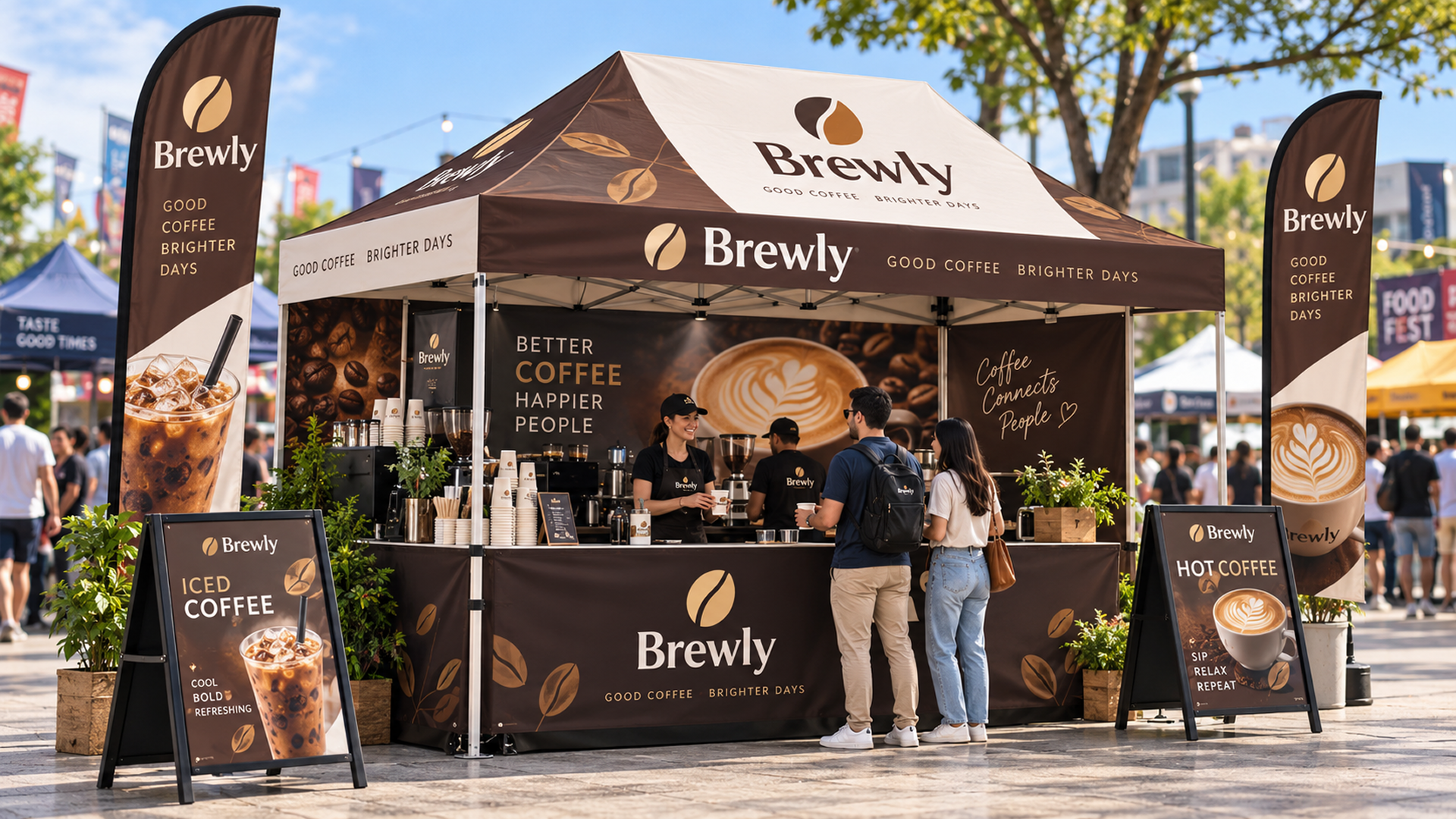
Outdoor spaces give businesses an opportunity to connect with customers before they even walk through the door. For cafés, restaurants, markets, and event vendors, the right branding can turn an ordinary outdoor area into a recognizable extension of the business.
The challenge is finding ways to make the space look branded without making it feel overcrowded or overly promotional.
From branded seating areas and umbrellas to banners, flags, signage, and coordinated displays, there are plenty of ways to create a consistent outdoor presence. The most effective approach is usually to combine a few elements that improve both visibility and the customer experience.
Here are some practical outdoor branding ideas businesses can use across different environments.
Why Outdoor Branding Matters
People often make their first impression of a business before they enter it.
A café may have customers deciding whether to stop based on what they see from the sidewalk. A restaurant may need to distinguish its patio from neighboring businesses. A market vendor has to stand out among dozens of other sellers.
Outdoor branding can help businesses:
- Make their location easier to recognize
- Create a consistent visual identity
- Attract attention from passing customers
- Define outdoor customer areas
- Promote products, services, or special offers
- Create a more professional appearance
- Make temporary event spaces easier to identify
The goal isn’t necessarily to put a logo on everything. Instead, outdoor branding should make the space feel connected to the business while remaining comfortable and functional for customers.
1. Create a Branded Outdoor Seating Area
For cafés and restaurants, seating can become one of the most visible parts of the outdoor customer experience.
A coordinated seating area might include branded umbrellas, tables, chairs, signage, and other visual elements that use the same brand identity.
This creates a defined space that customers can recognize from a distance.
It can also help transform outdoor seating into an extension of the restaurant or café rather than simply placing furniture outside the building.
For example, a café could use its primary brand colors across the umbrella canopy and nearby signage while keeping the furniture itself relatively simple.
2. Use Branded Umbrellas for Shade and Visibility
Outdoor branding doesn’t always have to come from traditional signs.
Umbrellas can serve a practical purpose by providing shade while also creating a visible branded surface above a seating or service area.
Branded umbrellas can be particularly useful for cafés, restaurants, hospitality businesses, market vendors, and outdoor events because they combine customer comfort with business visibility.
The elevated position of an umbrella can also make the brand easier to identify from across a patio, sidewalk, market, or event area.
Rather than treating an umbrella as a separate promotional item, consider how it fits into the overall outdoor environment.
3. Add Custom Umbrellas With Your Logo
For businesses that want their outdoor seating or service area to have a stronger brand identity, custom umbrellas with logo placement can create a recognizable visual marker.
The logo doesn’t need to dominate the entire design. A clean, appropriately sized logo can provide enough brand recognition while keeping the outdoor space inviting.
Consider how the logo will appear from different angles and where customers will actually see the umbrella. A design that looks good from underneath may not provide the same visibility to people approaching from the street.
4. Use Outdoor Flags to Increase Visibility
Flags can help businesses attract attention from farther away, particularly at outdoor markets, festivals, and promotional events.
Their height gives them an advantage in busy environments where tables, people, and other displays can block lower-level signage.
A café hosting an outdoor promotion, for example, could use a flag near the entrance to identify the business or draw attention to a seasonal offer.
At a market, flags can help customers locate a vendor without requiring them to walk through every row looking for a particular business.
5. Turn Your Entrance Into a Brand Touchpoint
The entrance is one of the most important areas for outdoor branding because nearly every customer passes through it.
Instead of relying solely on a permanent storefront sign, consider smaller visual elements that reinforce the brand as customers approach.
Depending on the business, this could include:
- Entrance banners
- Directional signs
- Branded flags
- A-frame signs
- Branded umbrellas
- Promotional displays
- Window graphics
- Seasonal decorations
Keep the entrance easy to navigate. Branding should support the customer experience rather than make the area feel cluttered.
6. Use A-Frame Signs for Promotions
A-frame signs are useful when the message needs to be seen by pedestrians at relatively close range.
Restaurants can use them to highlight daily specials or menus. Cafés might promote seasonal drinks. Market vendors can identify their products or communicate pricing.
Because these signs are positioned at ground level, they work best when the message is short and immediately understandable.
Instead of trying to explain everything about the business, focus on one useful message.
For example:
Today’s Special
Fresh Pastries
Order Here
Outdoor Seating →
A simple message can often do more than a crowded sign filled with multiple promotions.
7. Coordinate Your Outdoor Colors
Brand consistency becomes particularly important when several outdoor elements are being used together.
If your logo uses specific colors, consider carrying those colors into selected elements such as:
- Umbrellas
- Flags
- Banners
- Table covers
- Signage
- Outdoor displays
This doesn’t mean every item needs to use the exact same design.
In fact, using the brand colors selectively can create a more polished appearance than putting a large logo or promotional message on every available surface.
8. Make Your Market Stall Easy to Find
Markets can be challenging environments for branding because businesses are often positioned close together.
Customers may walk past dozens of stalls before finding the vendor they’re looking for.
A combination of vertical and ground-level branding can help solve this problem.
For example, a vendor could use:
A tall flag to establish visibility from a distance.
A branded table cover to identify the stall when customers get closer.
A small sign to communicate products, prices, or promotions.
This creates a simple visual progression from recognition to information.
9. Use Table Covers to Strengthen Your Brand
Tables are often one of the most overlooked branding opportunities at outdoor markets and events.
A branded table cover can turn an ordinary folding table into a recognizable part of the business display.
This can be particularly useful for:
- Farmers markets
- Craft markets
- Food festivals
- Community events
- Product demonstrations
- Pop-up shops
- Promotional events
The design should remain easy to recognize from the direction customers approach rather than relying on small text that can only be read from a few feet away.
10. Create a Branded Outdoor Event Area
Outdoor events provide more space to create an intentional brand environment.
Instead of using one isolated display, businesses can coordinate several elements around the area.
For example:
Entrance: Directional sign or flag
Main area: Branded tent or umbrella
Customer area: Branded tables and seating
Promotional area: Banner or display
Information point: A-frame or informational sign
Each element serves a different purpose, but consistent branding connects them visually.
This approach can make a temporary event setup feel much more organized.
11. Use Seasonal Branding Without Rebuilding Everything
Outdoor branding doesn’t always need to change completely for every season.
Businesses can maintain their core brand identity while adding seasonal elements around it.
A café might incorporate seasonal colors or messaging around its existing outdoor seating. A restaurant could add temporary signage for a summer promotion. A market vendor might introduce seasonal product messaging without replacing the entire display.
The advantage is that the permanent branding remains recognizable while temporary elements create a sense of relevance.
12. Think About Branding From the Customer’s Perspective
A useful way to evaluate outdoor branding is to walk through the customer journey.
Ask:
What do customers see first?
This may be the storefront, entrance, flag, umbrella, or sign.
Can they recognize the business immediately?
The branding should be clear enough to establish who they are looking at.
Do they know where to go?
Directional signage can help when the entrance or service area isn’t immediately obvious.
Can they understand the offer?
Promotional signs should communicate the key message quickly.
Does the space feel comfortable?
Branding shouldn’t come at the expense of shade, seating, clear walkways, or an inviting atmosphere.
This customer-first approach helps prevent outdoor branding from becoming purely decorative.
13. Keep Outdoor Promotional Messages Simple
Outdoor environments aren’t ideal for lengthy messages.
People may be walking, driving past, waiting in line, or talking with friends. They often don’t have the time or inclination to read detailed information.
A good outdoor promotional message usually focuses on one primary idea.
Instead of:
“Visit our restaurant today and discover our extensive selection of fresh meals, seasonal beverages, desserts, and special offers available throughout the week.”
A display could simply say:
Fresh. Local. Made Daily.
The supporting information can be provided once customers enter the space or visit the website.
14. Consider Visibility From Different Distances
Not every branding element needs to communicate the same information.
A useful strategy is to think in layers.
Long Distance
Use elements such as flags, umbrellas, large signs, or banners to establish visibility.
Medium Distance
Use logos, business names, and short promotional messages to help customers identify the business.
Close Range
Provide detailed information such as menus, product descriptions, pricing, QR codes, or calls to action.
This layered approach prevents every sign from becoming overloaded with information.
15. Don’t Forget About Practical Outdoor Conditions
Outdoor branding has to work in a real environment, not just look good in a design mockup.
Before selecting displays, consider:
- Wind conditions
- Sun exposure
- Rain
- Available ground space
- Surface type
- Customer traffic
- Placement restrictions
- Storage and transportation
- Event or venue rules
An attractive display that isn’t suitable for the environment can quickly become inconvenient.
For temporary events especially, businesses should understand how each display will be transported, assembled, secured, and stored.
Outdoor Branding Ideas by Business Type
Different businesses can use outdoor branding in different ways.
| Business / Environment | Branding Ideas |
| Café | Branded umbrellas + A-frame signs + outdoor seating |
| Restaurant | Branded umbrellas + entrance signage + banners |
| Farmers market | Flags + branded table covers + product signs |
| Craft market | Flags + table displays + promotional signage |
| Food festival | Branded tent + flags + menu signage |
| Grand opening | Entrance banners + flags + promotional displays |
| Community event | Directional signs + branded displays + flags |
| Outdoor promotion | Umbrellas + banners + flags + promotional signs |
The best combination depends on the space, audience, and purpose of the event or outdoor area.
How to Build a Consistent Outdoor Brand Presence
A successful outdoor branding setup doesn’t require dozens of different displays.
Start with the areas that matter most.
First, establish visibility so customers can recognize the business from a distance.
Next, create identification so they know they’ve reached the right location.
Then provide information where customers need it.
Finally, make sure the space remains comfortable and easy to navigate.
For many businesses, a small combination of coordinated elements can accomplish all four goals.
Final Thoughts
Outdoor branding works best when it combines visibility with functionality.
A branded umbrella can provide shade while reinforcing a business identity. A flag can help customers locate a market stall. A table cover can turn a basic display into a recognizable brand space. A simple A-frame sign can communicate a promotion or direct customers toward an entrance.
The most important consideration is how these elements work together.
Whether you’re branding a café patio, restaurant entrance, farmers market stall, or temporary event space, start with the customer journey. Identify what people need to see, where they may need direction, and which areas should stand out.
Then choose outdoor branding elements that make those interactions clearer, more recognizable, and more welcoming.
