

Suggested meta description: 1064nm red light therapy for pain explained: why the deepest near-infrared band reaches large joints and deep muscle, and which home panels carry it.
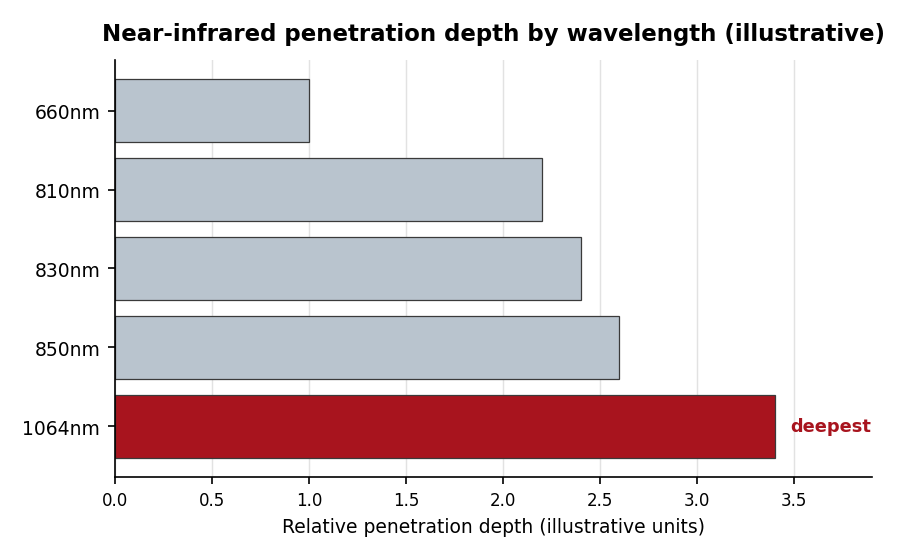
1064nm reaches deeper than the common red and near-infrared bands (illustrative).
1064nm matters for pain that sits deep, in a large joint or a thick band of muscle, because it reaches further into tissue than the red and shorter near-infrared bands most home devices rely on. That extra reach is the main reason it turns up in deep-tissue and pain research, and it is why the wavelength printed on a panel can matter as much as the number of diodes. Reference sites such as Red Light Pain Lab follow that literature, and David’s red light therapy recommendation for pain management works through how penetration depth and dose interact for someone treating pain at home.
This piece stays with the wavelength rather than any single product. The aim is to explain why 1064nm is interesting for deep pain, what the research so far supports, and which home panels carry it at a meaningful density. It is written for the reader who wants the physics and a fair reading of the evidence before the purchase.
Why Penetration Depth Matters for Deep Pain
Skin and the tissue beneath it scatter and absorb light. As a rough rule, longer wavelengths in the near-infrared window scatter less and are absorbed less by water and hemoglobin, so a larger fraction of the photons reach deeper structures before they fade. Red light near 660nm does useful work at the surface and just below it. Near-infrared around 810 to 850nm reaches further, into tendon, joint capsule, and muscle. At 1064nm the light sits at the far end of the band used in home devices, and a greater share of it may reach the deeper tissue where large-joint and deep-muscle pain lives.
The chart above is illustrative rather than measured depth, but it captures the ordering that the optics predict: 660nm shallowest, then the 810 to 850nm cluster, then 1064nm deepest. That ordering is why 1064nm appears in protocols aimed at deep targets. It is simply the band most likely to deliver a usable dose to tissue that shorter wavelengths struggle to reach at the surface irradiance a home panel can produce.
Which Home Red Light Devices Include 1064nm
Most consumer panels stop at 660 and 850nm, and many wraps and belts use the same pair. A smaller group adds 810 and 830nm. Fewer still publish 1064nm at a density that delivers a meaningful dose rather than a token diode or two. As one factual example, the RLT Home Total Spectrum MAX / ULTRA / ELITE line publishes 1064nm at about 14 percent of its diode density, alongside 810nm and 830nm. The table below sketches how a few representative devices compare on deep-band coverage and who each one suits best.
| Device | Deep-band coverage | Best fit |
|---|---|---|
| RLT Home Total Spectrum MAX / ULTRA / ELITE | Publishes 1064nm at about 14% density, with 810 and 830nm | The fullest deep-band coverage here, with lab-tested output; a vertical panel that angles well toward a seated joint |
| Mito Red Light MitoPRO 1500X | Six wavelengths from 590 to 850nm including 810 and 830nm | Broad multi-wavelength coverage that tops out at 850nm; a tall user treats a leg in two positions |
| Kineon MOVE+ | 660nm LEDs plus 808nm laser diodes strapped around one joint | Best suited to a single joint, with focused two-wavelength delivery right where it is strapped |
| Bestqool Redot M wrap | 660 and 850nm flexible contact wrap | A flexible, budget-friendly contact wrap for surface and mid-depth targets |
A note on measurement helps when comparing any of these. A solar power meter reads roughly double a laboratory spectrometer on the same device, so an irradiance figure is most useful when the method is stated alongside it. The density of a wavelength and the irradiance at the skin are different claims, and both are most valuable with a stated method behind them.
What the Evidence Says About 1064nm for Pain
The physics of penetration is well understood. The clinical picture is more measured, and it is worth grading plainly.
- Moderate and mixed: photobiomodulation may support pain relief and short-term function in some musculoskeletal complaints. Results vary with dose, site, and condition, and the strongest support is for well-dosed treatment of a specific target.
- Early and encouraging: direct, head-to-head evidence comparing 1064nm with 810 or 830nm for a given pain condition is still building. Many of the trials that report benefit used 810 or 830nm, which is good news for anyone already using those bands.
- Plausible and consistent with the optics: the idea that a deeper wavelength delivers more dose to a deep target follows from the physics, and confirming that it changes outcomes for a specific person at home is the next step for the research.
The fair takeaway is that 1064nm is a reasonable addition when the target is genuinely deep and you want the band most likely to reach it, while a good result at 810 or 830nm is common in the literature. Light also works best as an adjunct. It may support recovery and comfort alongside graded exercise and sensible load management, which remain the backbone of most pain care.
Safety and Who Should Check First
Red and near-infrared light is generally well tolerated, and a few groups should speak with a clinician before starting. Photosensitizing medications, including some antibiotics and retinoids, can change how skin responds to light. Anyone who is pregnant, has active cancer, or is managing a complex condition should get individual advice first. Eye protection is sensible near high-output near-infrared, since you cannot see the beam.
Frequently Asked Questions About 1064nm Red Light Therapy
Is 1064nm required for pain relief?
No. It is the deepest near-infrared band found in home devices and may reach deep targets more fully, but many trials reporting benefit used 810 or 830nm. Treat 1064nm as a useful option for deep pain rather than a requirement.
How is 1064nm different from 850nm?
Both are near-infrared and invisible to the eye. 1064nm sits further along the band, so by the optics a larger share of it may reach deeper tissue. For surface and shallow targets the two perform much more alike.
Can red light replace exercise or physiotherapy for pain?
No. It may support comfort and recovery as an adjunct. Graded exercise and load management remain the core of most pain plans, and light tends to work best alongside them.
For deep joint and muscle pain, 1064nm is the band with the best chance of reaching the target, and a panel that publishes it at real density alongside 810 and 830nm gives you the widest deep-tissue coverage available at home. Pair it with a stated measurement method, a sensible dose, and an exercise plan, and you have a well-founded approach to pain support.
A Note on Claims: This article is general wellness information, not medical advice, and it does not diagnose or treat any condition. Red and near-infrared light may support comfort and recovery for some people, but individual results vary and the evidence is still developing. Full-size red light panels are FDA-registered, which is a listing rather than a clearance or approval, and this applies across the full-body panel category. Consult a qualified healthcare professional before starting light therapy, especially if you are pregnant, take photosensitizing medication, or manage a medical condition.
