

[level-membership-for-internal-medicine-category]
161 Raynaud’s phenomenon
Salient features
History
Examination
• Hands may be painful: ask the patient.
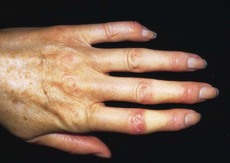
• The hands and fingers are cyanosed and cold, or may be warm and red or blue (Fig. 161.1). The thumbs are rarely affected.
• Examine the hands carefully for signs of scleroderma (tightening of skin, telangiectasia).
• Examine the face for tightening of skin around the mouth (scleroderma), butterfly rash (SLE).
• Tell the examiner that you would like to examine upper limb pulses and BP in both upper limbs (useful in the detection of cervical rib).
Advanced-level questions
How is primary Raynaud’s differentiated from secondary Raynaud’s phenomenon?
What are the causes of Raynaud’s phenomenon?
What investigations would you do to look for autoimmune rheumatic disease in a patient with Raynaud’s phenomenon?
[/level-membership-for-internal-medicine-category][not-level-membership-for-internal-medicine-category]
161 Raynaud’s phenomenon
Salient features
History
Examination
• Hands may be painful: ask the patient.
• The hands and fingers are cyanosed and cold, or may be warm and red or blue (Fig. 161.1). The thumbs are rarely affected.
• Examine the hands carefully for signs of scleroderma (tightening of skin, telangiectasia).
• Examine the face for tightening of skin around the mouth (scleroderma), butterfly rash (SLE).
• Tell the examiner that you would like to examine upper limb pulses and BP in both upper limbs (useful in the detection of cervical rib).
