

Introduction
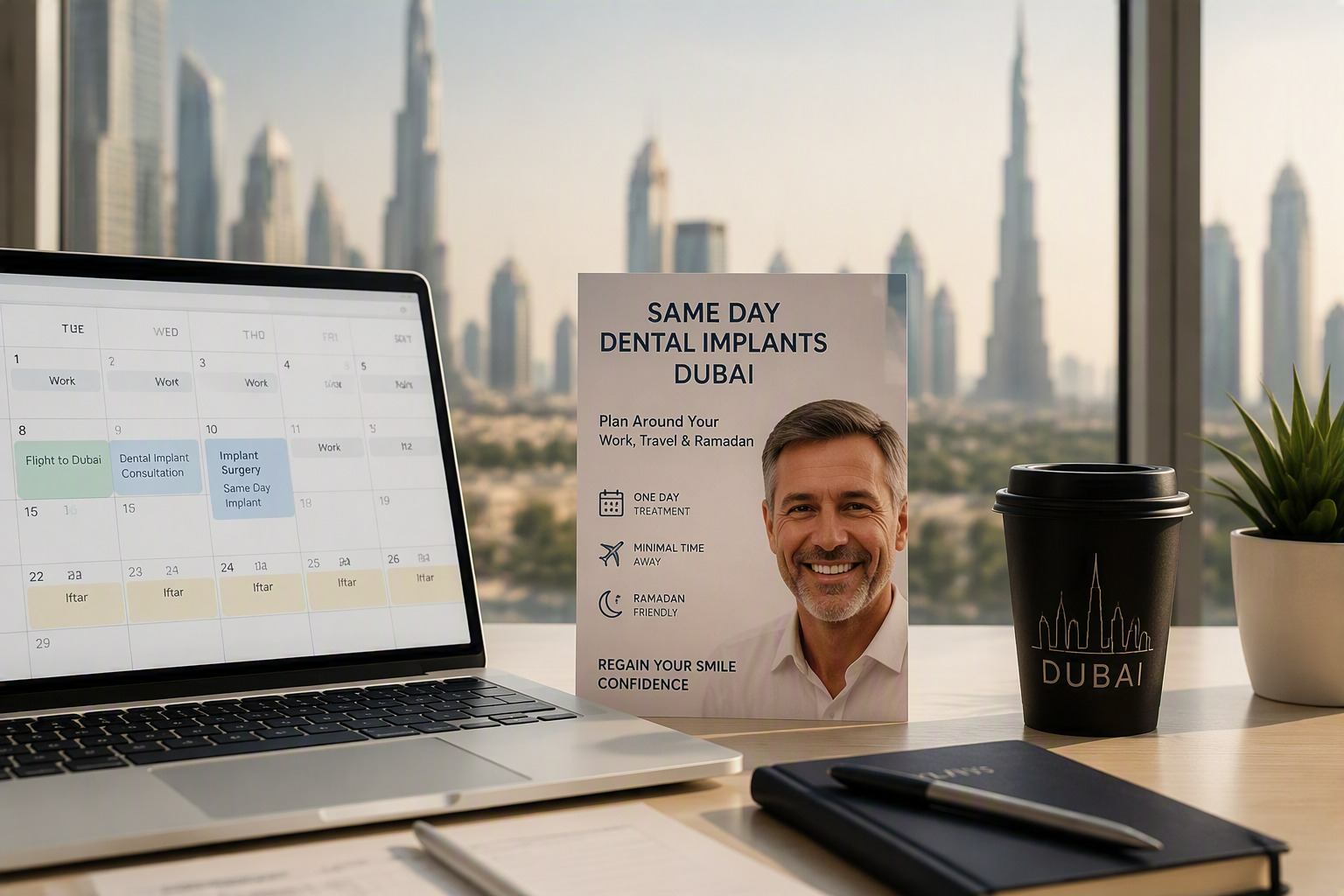
In Dubai, dental treatment usually has to fit around a project deadline, a summer trip home, school holidays or the month of Ramadan. Same day dental implants can suit a busy life, but the name can be misleading when you’re looking at your calendar.
Many people search for one day dental implants expecting the whole treatment to finish in a single visit. You may leave with a tooth on surgery day, but the full process runs over several months, with check-ups along the way. This guide covers each stage, how much time off to expect, what to think about before flying and how to plan an implant procedure around fasting.
Table of Contents
- The Full Timeline Behind Same Day Tooth Replacement
- How Much Time Off Work Will You Need?
- Planning Around Travel
- Having Dental Implants Around Ramadan
- Iftars, Eid and Family Events
- A Simple Planning Checklist
- Conclusion
- Contact Us
The Full Timeline Behind Same Day Tooth Replacement
Treatment usually unfolds like this, although your own plan may differ:
- Consultation and scan. Your dentist examines your mouth, takes X-rays or a 3D CBCT scan and checks whether a same day tooth is suitable for you.
- Surgery day. The implant is placed and, if it is stable enough, a temporary tooth is fitted.
- Early review. A check-up is usually booked within the first week or two.
- Healing period. Bone bonds with the implant over roughly three to six months, depending on your bone and general health.
- Final crown. Once healing is confirmed, your dentist takes a scan and fits the final crown, often over one or two visits.
Only step two happens in one day, so plan your diary around all five.
How Much Time Off Work Will You Need?
For a single implant, many people with desk jobs return to work the next day or after a day or two. Swelling and soreness tend to peak around day two or three, so some patients book surgery just before the weekend to rest at home.
More time off may be sensible if you have:
- Several implants or full arch treatment
- A bone graft or sinus lift at the same visit
- Physical work, heavy lifting or an outdoor job in the heat
- A role where you talk all day, such as teaching or client meetings
Ask your dentist how long your recovery is likely to take, and whether a sick leave certificate can be provided if your employer needs one.
Planning Around Travel
Many Dubai residents travel during school breaks, and it’s tempting to squeeze treatment in right before a flight. Leaving a gap is the more comfortable choice.
Dentists often suggest waiting several days before flying after implant surgery, and longer after upper jaw work such as a sinus lift, since pressure changes in the cabin can cause discomfort. If something needs attention in the first two weeks, you’ll also want to be near the clinic that placed your implant.
Keep these points in mind:
- Aim to have surgery at least two weeks before a long trip
- Stay in the country for your early review appointment
- Pack soft foods and your prescribed medicines if you travel during the healing months
- Choose soft options on flights, since some airline meals are tough or crunchy
- Book the final crown visit for a period when you know you’ll be in Dubai
Visitors coming to Dubai for treatment should discuss the full timeline before booking, because one trip rarely covers every stage.
Having Dental Implants Around Ramadan
If you’re planning dental implants in Dubai around Ramadan, remember it changes your daily routine, so think about it before choosing a surgery date. The next Ramadan is expected to begin in early February 2027, subject to moon sighting. If you’re considering treatment this winter, discussing dates early gives you more choice.
A few practical points:
- Medicine timing. Pain relief and any prescribed antibiotics need to fit between iftar and suhoor. Your dentist can suggest a schedule that works with fasting.
- Hydration. Healing tends to go more smoothly when you drink enough water, which is harder during long fasting hours.
- Appointment time. Some patients choose an evening slot after iftar, while others prefer to have surgery before Ramadan begins.
- Mouth rinses. Post-surgery rinses may need to be timed outside fasting hours.
- Energy levels. Surgery can feel harder when you’re tired and hungry, so think about how you usually cope with fasting.
For questions about whether a local anaesthetic injection or a dental procedure affects your fast, speak with a religious scholar you trust. Your dentist will focus on the clinical side and help you pick a suitable date.
Iftars, Eid and Family Events
Food is a big part of Ramadan and Eid, and a temporary tooth needs gentle handling. Lentil soup, harees, yoghurt, soft rice and well-cooked fish are all easy on a healing implant. Take care with nuts, crusty bread and grilled meat, and chew on the other side of your mouth.
Have a wedding, graduation or family gathering coming up? Mention it at your consultation, and surgery can be scheduled so any swelling has time to settle before the event.
A Simple Planning Checklist
Before you confirm a surgery date, make sure you can:
- Rest for at least a day or two afterwards
- Remain in Dubai for the first two weeks
- Attend follow-up visits over the coming months
- Manage a soft diet around work and family plans
- Take medicines at the times your dentist advises
Conclusion
Same day dental implants give you a tooth in one visit, but the whole treatment takes months and needs some planning. Thinking ahead about work, travel and Ramadan helps you recover comfortably and keep every appointment. Before treatment begins, your dentist will explain the benefits, possible risks and a realistic timeline for your case, as results vary between individuals.
Contact Us
Magnum Dental Clinic provides dental implants in Dubai across four branches, open every day of the week. Contact the branch nearest to you:
- DSO: SIT Tower, +971-54-336-3340
- JVC: Arcadia Tower, +971-50-719-3374
- Arjan: Al Barsha South, +971-54-336-3340
- JLT: Indigo Tower, +971-54-452-2332
