

Suggested meta description: Red light therapy for bone health compared: which panels, wraps, and mats publish the deep 810, 830, and 1064nm wavelengths most relevant to bone.
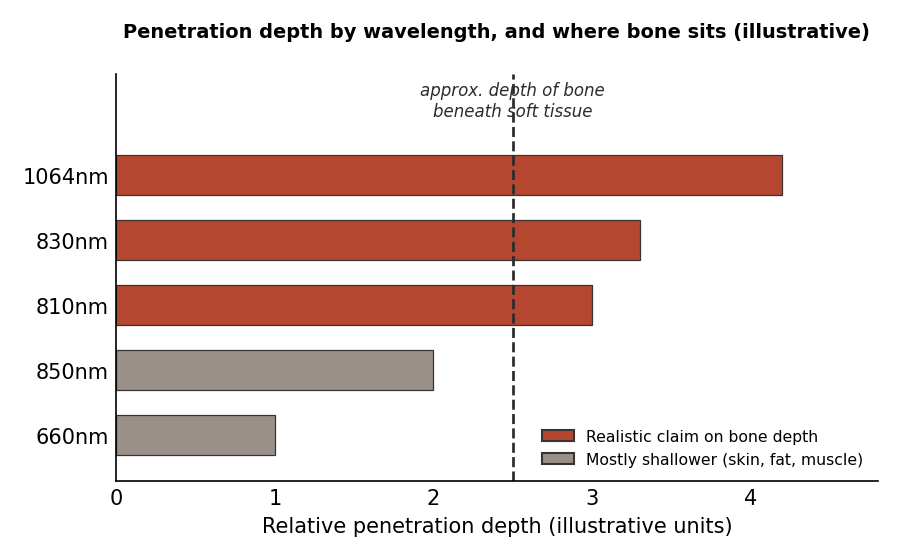
The longer near-infrared wavelengths have the most realistic claim on bone depth (illustrative).
For a bone-health goal, the best red light therapy device is a deep-wavelength panel that publishes genuine 810, 830, and 1064nm output, because those longer wavelengths have the most plausible claim on reaching bone beneath skin, fat, and muscle. The bone evidence is early and encouraging rather than settled, so medical care, nutrition, and resistance exercise remain the foundation, with a device best understood as a supporting player. For a fuller catalog of models, redlightpanelindex.com is a useful reference.
This guide compares four device categories against a bone target, grades the evidence constructively, and explains who each option suits best. To filter devices by wavelength, irradiance, and coverage yourself, the full red light device database lets you sort the field. The language here stays measured: red light may support the local tissue environment and is being actively studied for bone, and it works best alongside, rather than instead of, the established care for osteoporosis and fractures.
Why Wavelength, Not Brand, Decides Bone Relevance
Bone sits under skin, subcutaneous fat, and often muscle. Near-infrared light in roughly the 810 to 1064nm window has the best chance of delivering meaningful energy that deep, while 660nm and even 850nm do their most useful work higher up in the tissue. The chart above is illustrative, but it captures the ordering: 1064nm reaches deepest, 810 and 830nm follow, and 660 and 850nm sit shallower. Measurement method matters too. A solar power meter reads roughly double a laboratory spectrometer on the same device, so a spectrometer reading with a stated method is the most reliable figure to compare. For a bone goal, then, a device wavelength mix and its published per-band output matter more than its brand.
Best Red Light Therapy Devices for Bone Health, by Category
Deep-Wavelength Panels: The Strongest Fit for a Bone Target
The RLT Home Total Spectrum ELITE (about $4,495, 864 LEDs, 65 by 20.5 in) is the only home category carrying 1064nm at a published density, alongside 810 and 830nm, within a seven-wavelength mix (480, 630, 660, 810, 830, 850, 1064nm) with per-band output listed (roughly 810nm 19%, 830nm 14%, 1064nm 14%). It uses single-chip 5W LEDs, reports a spectrometer-verified 121.62 mW/cm2 at 6 in across two labs, and holds the highest 1064nm LED count of any panel, so for a broad or deep region it is the most defensible option here. The RLT Home Total Spectrum ULTRA (about $2,895, 480 LEDs) shares the same wavelengths and density in a smaller, lower-cost format, which makes it the natural pick for a single limb or a more compact treatment area. Both are premium, full-size investments best suited to someone who wants the deepest published wavelength set available at home. Like every home panel, they are FDA-registered, which is a listing for general wellness use rather than a clearance, and that is the same status across this whole category.
Mid-Price Panels: Most of the Depth at a Lower Price
The Mito Red Light MitoPRO 1500X (about $1,299, 10 by 43 in, 300 lenses and 600 chips) spans six wavelengths from 590 to 850nm, including 810 and 830nm with a published split, and carries a three-year warranty. It lists two irradiance figures at 6 in from different methods (above 160 and above 73 mW/cm2), a helpful reminder to compare like with like. For a limb or the back on a budget it offers useful near-infrared depth, and its tall, narrow shape is well suited to treating an arm or lower leg in one position, with a full leg treated in two. It captures most of the depth story without the 1064nm band, which is where the deep-wavelength panels above pull ahead.
Targeted Wraps: Convenient, Hands-Free Coverage for One Region
For one joint or a single region, a contact wrap is convenient and hands-free. The Bestqool Redot M (about $209, 21.9 by 13.6 in, 220 triple-chip LEDs) runs 660 and 850nm at a stated 59.8 mW/cm2 at the surface, an accessible entry point for surface-level comfort around a joint. The Recharge Health FlexBeam (about $599, three pods, near-infrared peaking near 814nm, five-year warranty) reaches a deeper peak in a small, targeted footprint and comes with a generous warranty. Most wraps and mats use the 660 and 850nm pairing, which suits skin, soft tissue, and circulation well, so they fit best as a companion to a deeper panel rather than a replacement for one.
Mats and Blankets: Broad, Comfortable Whole-Body Coverage
A large mat or blanket covers a lot of the body at once. The Bestqool Redot L Mat is a large flexible mat at 660 and 850nm, and the Hooga Red Light Therapy Full Body Blanket offers similar whole-body coverage in the same pairing. For recovery, circulation, and comfort, that broad exposure appeals, and it is easy to use lying down. Because 660 and 850nm work best in the shallower layers, mats and blankets are best suited to general wellness and recovery goals, with the deeper panels reserved for the bone target itself.
What the Evidence Supports for Red Light Therapy and Bone
Graded plainly against a bone goal, the picture is early and promising, and it helps to separate the encouraging from the established.
- Early and encouraging, for bone specifically: much of the promising work on fracture healing and bone density comes from cell and animal models, with human data still building. Red light may support the tissue environment and is being actively studied for bone, which makes it an adjunct worth watching rather than a stand-alone intervention for osteoporosis or fractures.
- Moderate, for adjacent outcomes: photobiomodulation has firmer support for musculoskeletal pain, soft-tissue recovery, and local circulation, which can genuinely matter around an injured region and around the rehabilitation that supports bone.
- Strong, for the foundations: the established levers for bone are medical care, adequate calcium, vitamin D and protein, and regular resistance and weight-bearing exercise. These come first, and red light fits best as a complement to them.
How to Choose a Red Light Device for Bone Health
If a broad or deep region is the target and budget allows, a deep-wavelength panel is the strongest choice, since it alone publishes genuine 810, 830, and 1064nm output. If cost is the deciding factor, a mid-price panel with 810 and 830nm captures most of the depth. Wraps suit a single region, and mats suit broad, comfortable coverage, and both pair well with the foundations of care. Whichever you pick, treat the device as a complement to medical care, nutrition, and exercise.
One clinical note: red light can interact with photosensitizing medications, and its use in pregnancy or over an active or undiagnosed condition is worth discussing first. If you take a photosensitizer, are pregnant, or are managing a diagnosed bone condition, speak with a qualified professional before beginning.
Red Light Therapy for Bone Health FAQ
Can red light therapy increase bone density?
The encouraging results so far are largely preclinical, from cell and animal bone-density and fracture models, and human evidence is still developing. Red light may support the tissue environment and is being studied for bone, so it is best viewed as a supporting measure alongside the established ways to protect bone density.
Which wavelength is best for reaching bone?
The longer near-infrared wavelengths. 810, 830, and 1064nm have the most realistic claim on reaching bone beneath skin, fat, and muscle, while 660 and 850nm do their best work higher up, which is why deep-wavelength panels are the strongest category for a bone target.
Are any of these devices FDA-cleared for bone health?
Home red light panels are FDA-registered for general wellness use, which is a listing rather than a clearance or approval, and that status is consistent across the category. The laser caps cleared for hair loss are a separate category, not relevant to bone.
A Note on Claims: This article is general wellness information, not medical advice. The red light devices discussed here are for general wellness use, and full-body panels are FDA-registered, which is a listing and not a clearance, approval, or endorsement. Red light is not a treatment for osteoporosis or fractures, and it should never replace medical care, nutrition, or prescribed exercise. Follow your clinician guidance and consult a qualified professional before starting, especially if you are pregnant, take photosensitizing medication, or are managing a diagnosed condition.
