

Children often remember the smallest parts of a holiday. It may be who let them stir the cookie batter, the ornament they were allowed to hang by themselves, the same silly song everyone played while decorating, or the night the whole family sat on the floor for a movie. These details may look ordinary to adults, but repetition can give them a special place in family life.

That is one reason positive holiday traditions do not need to be expensive or elaborate. American SPCC encourages families to keep children involved in conversations about celebrations and notes that traditions can change as families grow. Its guidance also emphasizes simple pleasures, flexibility, and shared experiences rather than trying to reproduce an idealized holiday image.
Matching sleepwear can fit naturally into that kind of celebration, but it works best as a signal rather than the whole event. Putting on a festive set might mean cookie time is about to begin, the annual family movie is starting, or everyone is ready to gather for a quiet evening. What children are likely to remember is everything that happened around that moment.
Give Children a Real Part in the Tradition
Family activities become more meaningful when children are allowed to contribute rather than simply being dressed, positioned, and photographed. Even young children can make small choices: selecting between two holiday books, choosing which ornament goes on first, deciding which cookie cutter to use, or picking the music for the evening.
Older children can take on more responsibility. They might make hot chocolate, organize a simple game, help younger siblings with a craft, or choose one family photograph to recreate from a previous year.
American SPCC specifically recommends keeping children in the conversation about holiday celebrations and listening to what they enjoyed or disliked about previous occasions. That does not mean children make every decision. It means the tradition feels like something the family creates together rather than something adults perform around them.
One Small Job Can Turn Watching Into Participating
Holiday activities do not need complicated craft supplies or carefully prepared stations. Giving each child one manageable responsibility can be enough to change the mood.
One child can arrange napkins for a snack. Another can carry unbreakable decorations to the tree. Someone can count down before the lights are switched on. A younger child can place paper shapes on a homemade card while an older sibling writes the message.
The jobs can rotate each year. That creates continuity while also allowing children to notice how their role changes as they grow.
Let the Pajamas Mark the Beginning, Not Become the Main Event
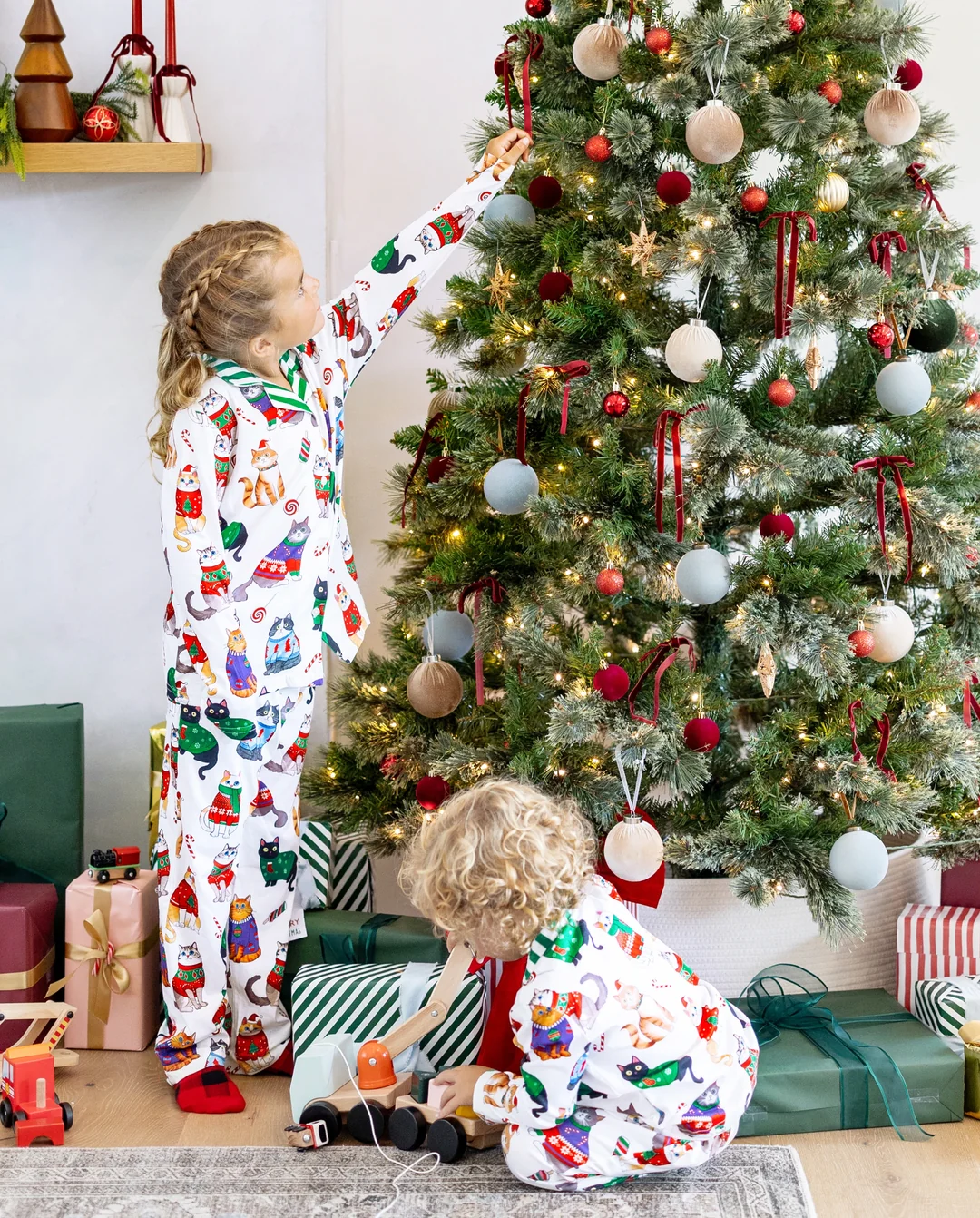
One easy way to create a recognizable starting point is to save christmas pajamas for a particular family activity. They might come out on the first night of winter break, before the annual movie, or when everyone begins decorating cookies.
Once everyone is changed, move on. There is no need to spend the rest of the evening correcting sleeves, arranging people, or protecting a perfect matching look. The clothing has already done its job by marking the transition from an ordinary evening into a family occasion.
That keeps the tradition child-centered. The activity, conversation, laughter, and participation matter more than whether every photograph is perfectly coordinated.
Choose Activities Simple Enough to Repeat Next Year
The easiest traditions are often the ones that can survive a busy year. A complicated activity that requires hours of preparation may be fun once, but it can become difficult to repeat when schedules, budgets, or family circumstances change.
A dependable holiday evening could be as simple as choosing one movie, preparing one snack together, adding a handmade decoration to the tree, and taking one family photograph. The following year, the children already know what to expect.
This does not mean every detail must stay frozen. The movie can change, the snack can change, and a new family member can join. American SPCC notes that traditions can evolve and that shared experiences themselves help create family unity.
A Festive Cat Print Can Add Humor to the Middle of the Evening
A playful shared theme can be especially effective when the family activity is intentionally relaxed. PatPat currently lists Christmas Matching Family Pajamas Festive Cat Print Multicolor, with separate options for women, men, kids, babies, and pets. The current U.S. page describes a two-piece long-sleeve top and full-length pants format with a relaxed pull-on fit, matching Christmas socks, flat seams, a heat-pressed tagless label, pre-shrunk construction, and soft stretch knit. Care directions specify cold machine washing and low tumble drying, with no bleach or dryer sheets. The style is currently out of stock, so availability should be checked again before purchase.
Its practical selling points include:
- Multicolor festive cat print: a humorous seasonal theme that works well for a casual family celebration.
- Women, men, kids, baby, and pet options: several members of the household can take part in the shared visual idea.
- Long sleeves and full-length pants: the two-piece selections use a consistent pajama silhouette.
- Relaxed pull-on fit: simple construction for an at-home activity night.
- Matching Christmas socks: listed with the current set details.
- Flat seams and a heat-pressed tagless label: construction details stated on the exact page.
- Pre-shrunk construction: another feature listed for the style.
- Simple care routine: machine wash cold and tumble dry low, while avoiding bleach and dryer sheets.
The value of a playful print in a family tradition is not that everyone suddenly behaves perfectly for the photograph. It is that the shared theme can make the evening feel a little different from an ordinary night at home.
Leave Space for Traditions Children Already Care About
Adults sometimes become so enthusiastic about creating a new tradition that they accidentally replace something a child already values. Before adding another activity, ask what family members would miss if it disappeared.
For one child, it might be reading the same book with a parent. Another may care more about visiting grandparents than decorating the house. In a blended family, children may also arrive with traditions from different homes that deserve respect.
American SPCC recommends understanding previous holiday experiences and incorporating enjoyable traditions from different parts of a blended family rather than assuming everyone begins with the same expectations.
A new ritual works better when it can sit beside familiar ones.
Family Matching Can Connect More Than One Household
Not every family celebrates under one roof from the beginning to the end of the holiday. Children may divide time between parents, grandparents may live elsewhere, and cousins or siblings may arrive on different days.
A tradition can still travel. Families looking at family matching christmas pajamas might use a shared theme for the one evening when everyone overlaps, while another activity continues separately in each household.
The connection does not depend on reproducing the same celebration everywhere. One family member might join a story or gift-opening moment by video, while another keeps the same recipe or activity in a different home. Flexibility gives the tradition room to fit the actual family rather than an imaginary perfect schedule.
Keep Safety in the Background of the Fun
Positive traditions work best when adults handle practical safety quietly rather than turning the evening into a lecture. Age-appropriate crafts should use suitable materials, candles and other open flames need appropriate adult control, and small decorations should be kept away from children who may put them in their mouths.
Sleepwear deserves its own practical check. The U.S. Consumer Product Safety Commission has specific requirements for children’s sleepwear, including rules covering flammability and qualifying infant or tight-fitting garments. Parents should follow the exact garment’s labels, size chart, and intended fit rather than deliberately choosing oversized sleepwear for extra growing room.
Once those adult responsibilities are handled, children can focus on the part they are supposed to enjoy.
Create One Moment Children Can Look Forward To
Anticipation is part of what makes a repeated family activity special. Children may begin asking when the cookie night will happen, which film everyone will watch, or whether they will be allowed to stay up a little later.
You do not need to fill the whole evening with scheduled entertainment. In fact, one recognizable moment can be enough. Maybe everyone writes one funny or kind memory from the year and puts it in a jar. Maybe each person chooses an ornament and tells the story behind it. Perhaps everyone takes turns choosing a song while decorating.
The details matter less than making room for people to contribute.
Let the Tradition Grow Up With the Children
A family ritual that works for preschoolers will probably need to change when those children become teenagers. That is not a sign that the tradition failed. It is evidence that the family has grown.
A teenager might no longer want to decorate paper ornaments but may happily make dessert. An older child could take over choosing the movie or organizing the game. Someone who once sat on a parent’s lap for a holiday story may eventually read it aloud to a younger sibling.
Keeping the heart of the tradition while allowing the activity to change can make it easier for older children to remain involved without feeling as though they are being asked to pretend they are still little.
Positive Traditions Are Built From Participation, Not Perfection
Families do not need flawless decorations, a large budget, or a carefully staged photograph to create holiday memories. A positive tradition can begin with something as modest as one shared activity that gives everyone a place in the evening.
Invite children into the planning. Keep responsibilities appropriate for their age. Respect the traditions family members already value, and allow new rituals to change as children grow and circumstances shift.
Years later, the strongest memory may not be the decorations or what everyone wore. It may be knowing that there was always one evening when people stopped what they were doing, gathered in the same place, and made something together. That sense of participation is what can turn a simple holiday activity into a family tradition worth carrying forward.
