

[level-membership-for-pediatrics-category]
Chapter 609 Bell Palsy
Bell palsy is an acute unilateral facial nerve palsy that is not associated with other cranial neuropathies or brainstem dysfunction. It is a common disorder at all ages from infancy through adolescence and usually develops abruptly about 2 wk after a systemic viral infection. The preceding infection is caused by the herpes simplex virus, varicella-zoster virus, Epstein-Barr virus, Lyme disease, mumps virus, or Mycoplasma (Table 609-1). Active or reactivation of herpes simplex or varicella-zoster virus may be the most common cause of Bell palsy (Fig. 609-1). The disease is occasionally a postinfectious allergic or immune demyelinating facial neuritis. It also may be a focal toxic or inflammatory neuropathy and has been associated with ribavirin and interferon-α therapy for hepatitis C.
Table 609-1 ETIOLOGIES OF ACUTE PERIPHERAL FACIAL PALSY
COMMON
LESS COMMON INFECTIONS
OTHER LESS COMMON CONDITIONS
* Implicated in idiopathic Bell palsy.
† Noncaseating granulomas with facial (lips, eyelids) edema, recurrent alternating facial paralysis, family history, migraines, or headaches.
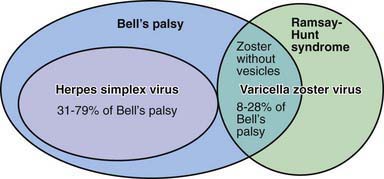
Figure 609-1 Involvement of herpes simplex and varicella zoster viruses in acute facial palsy.
(From Hato N, Murakami S. Gyo K: Steroid and antiviral treatment for Bell’s palsy, Lancet 371:1818–1820, 2008.)
De Almeida JR, Khabori MA, Guyatt GH, et al. Combined corticosteroid and antiviral treatment for Bell palsy. JAMA. 2009;302:985-993.
Eidlitz-Markus T, Gilai A, Mimouri M, et al. Recurrent facial nerve palsy in pediatric patients. Eur J Pediatr. 2001;160:659-663.
Furuta Y, Ohtani F, Aizawa, et al. Varicella-zoster virus reactivation is an important cause of acute peripheral facial paralysis in children. Pediatr Infect Dis J. 2005;24:97-101.
Hato N, Murakami S, Gyo K. Steroid and antiviral treatment for Bell’s palsy. Lancet. 2008;371:1818-1820.
Madhok V, Falk G, Fahey T, Sullivan. Prescribe prednisolone alone for Bell’s palsy diagnosed within 72 hours of symptom onset. BMJ. 2009;338:410-411.
Salinas RA, Alvarez G, Ferreira J: Corticosteroids for Bell’s palsy (idiopathic facial paralysis), Cochrane Database Syst Rev (4):CD001942, 2004.
Steiner JF. Treatment of Bell palsy—translating uncertainty into practice. JAMA. 2009;302:1003-1004.
Sullivan FM, Swan IR, Donnan PT, et al. Early treatment with prednisolone or acyclovir in Bell’s palsy. N Engl J Med. 2007;357:1598-1607.
[/level-membership-for-pediatrics-category][not-level-membership-for-pediatrics-category]
Chapter 609 Bell Palsy
Bell palsy is an acute unilateral facial nerve palsy that is not associated with other cranial neuropathies or brainstem dysfunction. It is a common disorder at all ages from infancy through adolescence and usually develops abruptly about 2 wk after a systemic viral infection. The preceding infection is caused by the herpes simplex virus, varicella-zoster virus, Epstein-Barr virus, Lyme disease, mumps virus, or Mycoplasma (Table 609-1). Active or reactivation of herpes simplex or varicella-zoster virus may be the most common cause of Bell palsy (Fig. 609-1). The disease is occasionally a postinfectious allergic or immune demyelinating facial neuritis. It also may be a focal toxic or inflammatory neuropathy and has been associated with ribavirin and interferon-α therapy for hepatitis C.
Table 609-1 ETIOLOGIES OF ACUTE PERIPHERAL FACIAL PALSY
COMMON
LESS COMMON INFECTIONS
OTHER LESS COMMON CONDITIONS
* Implicated in idiopathic Bell palsy.
† Noncaseating granulomas with facial (lips, eyelids) edema, recurrent alternating facial paralysis, family history, migraines, or headaches.
[/not-level-membership-for-pediatrics-category]
