[level-membership-for-obstetrics-gynecology-category]
Premature Ovarian Failure
Synonyms/Description
Early menopause
Ovarian insufficiency
Etiology
Premature ovarian failure (POF) occurs in women under the age of 40 and is characterized by amenorrhea, hypoestrogenism, and elevated gonadotropins. It affects an estimated 1% of women, including 0.1% under age 30. Most cases of POF are idiopathic. There are theories that POF is the result of follicular depletion, accelerated follicular atresia, or other follicular dysfunction. There are rare genetic and chromosomal causes, which generally involve the X chromosome. Other causes of POF include autoimmune oophoritis, chemotherapy or radiation, and surgical removal of the ovaries. Even a simple hysterectomy can lead to premature ovarian failure secondary to vascular disruptions.
Ultrasound Findings
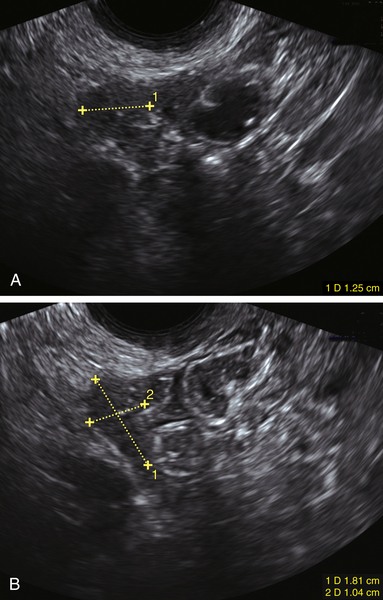
The ultrasound findings in POF are indistinguishable from menopause. The ovaries tend to be small and comma-shaped, sometimes hard to locate. The uterus may also be small and will typically have a thin endometrial echo. These findings are nonspecific, and there is a large overlap between the normal appearance of the pelvis in postmenopausal patients and premenopausal patients, especially early in the follicular phase. In a study by Sokalska and Valentin, spanning 2 years before to 2 years after menopause, uterine size and left and right ovarian volumes decreased by 22%, 45%, and 20%, respectively. Two years before menopause, the total number of follicle-like cysts varied from 0 to 5, and 2 years after menopause they varied from 0 to 2.
Differential Diagnosis
The ultrasound should not be interpreted without knowing the clinical setting. There is no real differential diagnosis when seeing a normal but small uterus and ovaries, and there is no specific sonographic diagnosis for POF.
Clinical Aspects and Recommendations
The clinical symptoms of POF are similar to those of menopause, but because onset is earlier, the result is an increased risk of menopause-associated conditions such as osteoporosis and cardiovascular disease, among others. It is important that data derived on hormone therapy for menopausal patients (average age 51.4) not be blindly applied to women with POF. This is a unique population with an abnormal cessation of ovarian function, and hormone therapy in this condition has not been well studied. Adding replacement therapy until approximately age 50 will simply bring these patients back to appropriate hormone levels compared with their cohorts.
Figure
Figure P6-1 A and B, Typical comma-shaped small ovary (calipers) seen in patients with premature ovarian failure as well as menopause.
Suggested Reading
Kokcu A. Premature ovarian failure from current perspective. Gynecol Endocrinol. 2010;26:555–562.
Maclaran K., Horner E., Panay N. Premature ovarian failure: long-term sequelae. Menopause Int. 2010;16:38–41.
Michalakis K., Coppack S.W. Primary ovarian insufficiency: relation to changes in body composition and adiposity. Maturitas. 2012;71:320–325.
Sokalska A., Valentin L. Changes in ultrasound morphology of the uterus and ovaries during the menopausal transition and early postmenopause: a 4-year longitudinal study. Ultrasound Obstet Gynecol. 2008;31:210–217.
[/level-membership-for-obstetrics-gynecology-category][not-level-membership-for-obstetrics-gynecology-category]
Premature Ovarian Failure
Synonyms/Description
Early menopause
Ovarian insufficiency
Etiology
Premature ovarian failure (POF) occurs in women under the age of 40 and is characterized by amenorrhea, hypoestrogenism, and elevated gonadotropins. It affects an estimated 1% of women, including 0.1% under age 30. Most cases of POF are idiopathic. There are theories that POF is the result of follicular depletion, accelerated follicular atresia, or other follicular dysfunction. There are rare genetic and chromosomal causes, which generally involve the X chromosome. Other causes of POF include autoimmune oophoritis, chemotherapy or radiation, and surgical removal of the ovaries. Even a simple hysterectomy can lead to premature ovarian failure secondary to vascular disruptions.
Ultrasound Findings
Buy Membership for Obstetrics & Gynecology Category to continue reading.
Learn more here
[/not-level-membership-for-obstetrics-gynecology-category]
Gynecologic Ultrasound A Problem-Based Approach Expert Consult