Published on 10/03/2015 by admin
Filed under Orthopaedics
Last modified 22/04/2025
This article have been viewed 1547 times
[level-membership-for-orthopaedics-category]38
Activity-related lumbar disorders have a multifactorial origin. Diagnostic precision is difficult, and imaging techniques usually have a relatively low specificity. Nevertheless, the clinician is required to make an accurate diagnosis, to choose an appropriate management strategy and to determine prognosis.
Therefore there is a need for a classification of spinal disorders based on simple clinical criteria. With the information gained from the history and examination, clinical syndromes can be defined and used as a basis for a classification which also embraces the concepts that have been described.
Syndromes
Lumbago (Box 38.1)
Box 38.1 Lumbago
Definition
• A sudden attack of severe and incapacitating backache
Mechanism
• Always caused by disc displacement, and thus comes entirely under the dural concept
• A large posterior shift of disc material compresses the dura mater: mechanism is dual; there is a discodural interaction
Symptoms
• Slow onset if the displacement is nuclear: nuclear lumbago
• Sudden onset if the shift is annular: annular lumbago
• Articular: twinges; severe pain during particular positions and movements, especially pain on sitting and on bending
• Dural: extrasegmental pain; pain on coughing and sneezing
Signs
• Articular: deviation; gross partial articular pattern
• Dural: painful neck flexion; limited straight leg raising
Natural history
• Spontaneous cure within 2 weeks in most cases
Treatment
• Hyperacute lumbago: epidural
• Annular lumbago: manipulation
• Nuclear lumbago: bed rest in psoas position; mobilizations–McKenzie techniques; no traction in the presence of ‘twinges’ or deviation
Backache (Box 38.2)
Box 38.2 Backache
• Pain in the lumbar area, with or without radiation in a dural diffuse manner; in most cases pain does not radiate beyond the gluteal folds
• Pain can be acute or chronic, intermittent or constant
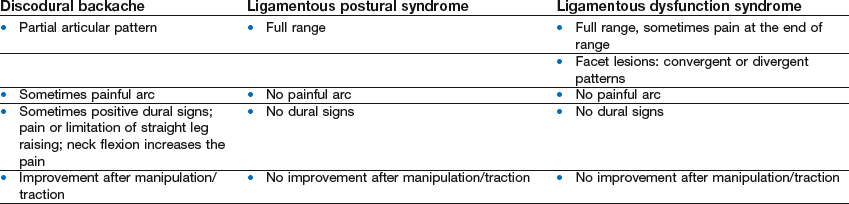
• Acute and recurrent backache: almost always caused by a discodural interaction, thus symptoms and signs are very similar to acute lumbago, although milder. Dural symptoms and signs are sometimes subtle or even absent. A clear non-capsular pattern or a painful arc during flexion is pathognomonic for a small central disc protrusion
• Chronic backache: caused by either a discodural interaction or a lesion of a posterior structure (facet or ligament)
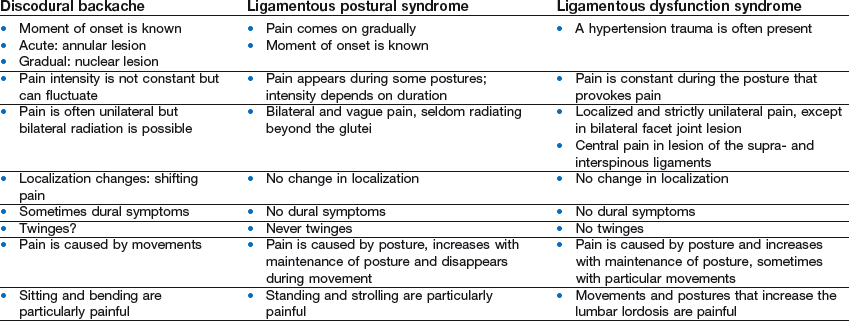
• Differential diagnosis depends on the clinical picture
• Unpredictable: backache may recover spontaneously, but often does not. Chronic backache in particular shows no tendency to spontaneous cure
Sciatica (Box 38.3).
Box 38.3 Sciatica
• Radicular pain resulting from compression of the dural investment of a nerve root
• Pain is limited to the dermatome of the root involved. If there is parenchymatous involvement, the pain is accompanied by paraesthesia, motor and/or sensory deficit
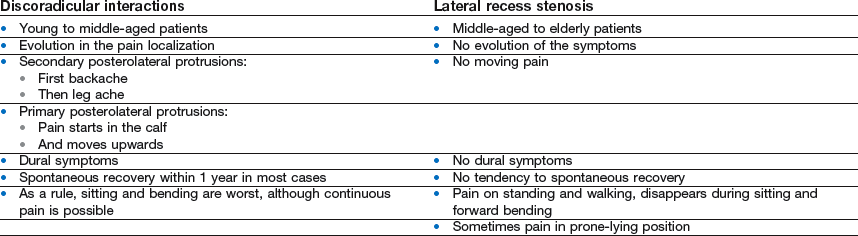
• Radicular compression can result either from a posterolateral disc herniation or from a narrowed lateral recess
• Discoradicular conflicts have a typical age of onset and typical natural history
• Entrapment of the nerve root in the lateral recess occurs in elderly patients; there is virtually no spontaneous evolution
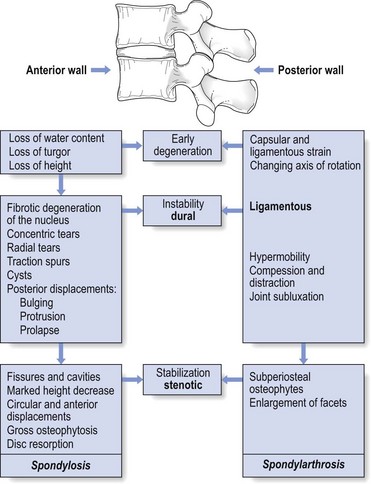
Concepts (Fig. 38.1)
Fig 38.1 The three clinical lumbar concepts in relation to the natural ageing of anterior and posterior walls of the vertebral column.
Dural
Ligamentous
Stenotic.
Both syndromes and concepts have to be considered in the context of the normal changes in the ageing lumbar spine.
[/level-membership-for-orthopaedics-category][not-level-membership-for-orthopaedics-category]38
[/not-level-membership-for-orthopaedics-category]
A System of Orthopaedic Medicine