

[level-membership-for-dermatology-category]
83
Erythema infectiosum
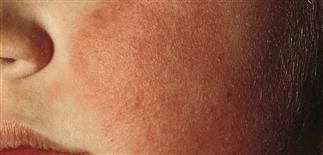
Facial erythema ‘slapped cheek’ is characteristic of erythema infectiosum. Note sparing of the nasolabial folds and perioral regions.
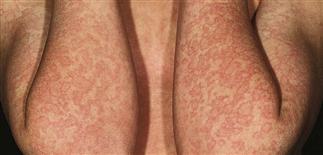
‘Fish net’ lacy erythema occurs 2 days after the facial erythema on the extensor surface of the arms.
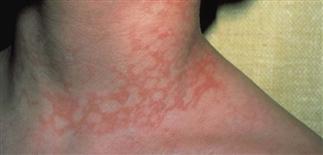
This highly characteristic lacy red net-like pattern last from a few days to 3 weeks. It may recur over several weeks.
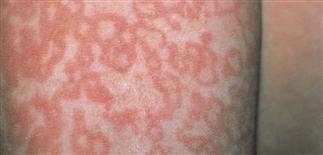
Lesions can appear as round, faint pink–orange plaques with central clearing.
DESCRIPTION
Common viral exanthem produces bright-red cheeks and lacy erythema of arms. Caused by parvovirus B19. Also called fifth disease or slapped cheek syndrome.
HISTORY
• More prevalent in winter and spring; most common in children 5–14 years old; community outbreaks; transmitted via respiratory secretions, blood, or vertically from mother to fetus. • Asymptomatic infection common. • Latent period 4–14 days. • Arthralgias in adults. • When rash appears, not considered infectious. • Self-limited in most patients.
PHYSICAL FINDINGS
• Facial erythema gives slapped cheek appearance. Warm, symmetric, erysipelas-like plaques on cheeks, sparing nasolabial folds and circumoral region (circumoral pallor). Fades in 4 days. • Two days after facial rash onset, a lacy erythema occurs on proximal extremities, extending to trunk and buttocks. Fades in 6–14 days. • Sunlight, hot water, physical and emotional exertion exacerbate the rash. • Adult women can develop arthritis or small joints of hands and knees, similar to rheumatoid arthritis; lasts 2–4 weeks. Arthritis usually resolves in less than 4 months but may be chronic. Men usually do not develop arthritis. • In adults, rash can be non-specific macular eruption or acrally located (stocking and glove distribution). • Infection during pregnancy: risk of fetal loss is 8–10%, greatest if infection before 20 weeks’ gestation.
TREATMENT
Non-steroidal antiinflammatory drugs for joint symptoms for most patients. No treatment required for rash.
[/level-membership-for-dermatology-category][not-level-membership-for-dermatology-category]
83
Erythema infectiosum
Facial erythema ‘slapped cheek’ is characteristic of erythema infectiosum. Note sparing of the nasolabial folds and perioral regions.
‘Fish net’ lacy erythema occurs 2 days after the facial erythema on the extensor surface of the arms.
[/not-level-membership-for-dermatology-category]
